|
chapter v
COMMANDS OF Śāstra
Śāstra, which sees Bharmān as He really is, has said that Bharmān Himself builds forms for Himself for the benefit of Sadhakas. But you take the Śāstra to mean that worshippers have given imaginary forms to Bharmān. The word Sadhakanam is formed by adding the sixth case-ending to the word Sadhaka. This sixth case, according to you, indicates the nominative, and you take the word Rupakalpana with Sadhakanam. Again, the word Bharmānah which is formed by adding the sixth case-ending to the word Bharmān is supposed by you to have its sixth case in the genitive sense. You thus explain the whole thing as "forms have been imagined by Sadhakas in relation to Bharmān." But this is not its right explanation. It is the word Sadhakanam, which has its sixth case in the genitive sense, and should be read with the word hitarthaya. Again, the word Bharmānah has its sixth case in the nominative sense, and should be read with rupakalpana. Thus the whole verse comes to mean "forms have been built by Bharmān for the benefit of Sadhakas." Although both sides may be equally liable to mistake, still the view which I have taken harmonizes with the context of the Sastrik saying. For the above verse appears in the Kularnava Tantra in connection with the worship of Devas possessing forms. First Devī says:
"I now desire to hear of the character of worship, so tell me the mode of worship in the purification of Kula articles, etc." In answer to this question Bhagavan Śiva, the Creator of all thinp, explains in the chapter on Worship, the necessity or otherwise of invoking Devas, and establishes the fact of the possession of form to be the very foundation of invocation. It is in this connection that the verse appears whilst making provision for the worship of embodied Deities. To say that it is impossible that they should have aspects with form is not merely irrelevant, but disproves the very thing which it is sought to prove. This instance affords no opportunity for the service of selfish ends by giving a fallacious interpretation of the Sanskrit verse.
Secondly, there are ample grounds for the support of my view, namely, (I) If Sadhakas give, according to their desire, imaginary forms to Bharmān, why should the eternal Śāstra accept such as evidence? (2) If Sadhakas may create forms according to their own sweet will, it would be hard to guess the number which have been already created by innumerable Sadhakas of different casts of mind, and the countless forms which will also in the future be created. Besides, if worship of all these forms gives siddhi, why has not Śāstra separately provided in the case of them the mode of worship, consisting of Dhyāna,1 Mantra, etc? . (3) If I am independent in the matter of the imagination of forms, why should not also the mode of worship be guided by my own free-will ? (4) If I imagine a form according to my own desire, what is there to oblige Isvara to appear in that form? (5) If I can build forms, why cannot I build Mantras as well? (6) If Mantra Śākti2 is guided by my Śākti, why, instead of expending it on Mantra, do I not worship in some other way? (7) Why should one accept a guru in respect of a worship which is to be performed by me according to my imagination? (8) What Śākti3 is there in Jiva himself whereby he may obtain supersensual, superhuman siddhi without the help of Śāstra ? (9) When have I seen, or heard, or been convinced by argument of such siddhi having been obtained by any person so that I may believe it? (10) Who will be responsible if in trying to obtain such siddhi I happen to fall? (11) Who knows in what time such siddhi may be attained? (12) If siddhi may be attained according to one's own desire, what is the necessity of worshipping G&yatri, whose substance is mantra, as said in Śāstra?
These and other grounds are as favourable to my view as they are unfavourable to yours. How will you dare to say that
1Meditation. 2 Potency of mantra. 3 Power. Sadhakas imagine forms without first answering fully these questions I have put against you ?
When dealing with Her Dhyāna, the Gāyatrī Tantra has said: "She has adopted playful bodies according to Her own desire." Again, in BhagavadgM,1 Bhagavan Himself (whose form is in question here), has said:
"Though unborn, the imperishable Self, and also the Lord of all beings, brooding over Nature, which is Mine own, yet I am born through My own Power.
"Whenever there is decay of righteousness, O Bharata! and there is exaltation of unrighteousness then I Myself come forth.
"For the protection of the good, for the destruction of evil doers, for the sake of firmly establishing righteousness I am born from age to age.
"Any devotee who seeketh to worship with faith any such aspect, I verily bestow the unswerving faith of that man."2
The Markandeya Purana in Devīmahatmya3 says: "Eternal is She whose appearance4 is the universe which She pervades, yet hear from me of Her birth in various forms. Wherever She appears to do the work of Devas She is known in the three worlds to be bom (although She is in reality free from birth and death)."
The same book in the hymn in praise of the Devī says: "Mother, Thou hast by dividing Thyself into many forms, achieved the destruction of great Asuras,5
The following discourse between Himalaya and Parvati appears in Bhagavati Gita in Mahabhagavata:
The Devī said: "O father, Lord of Mountains, of my own free-will have I divided My own form for the purpose of creation into the dual aspects of male and female. Of these, Śiva is the supreme Purusa, and Sive the supreme Śākti.6
1 Chap, iv, verses 6, 7, 8; and chap. vii. verse 21. 2 For convenience, reference is made to a published translation. This and the other extracts from the Bhagavadgita are from Mrs. Besant's translation, with the Sanskrit text. 3 Chap. i. 4 Murti. 5 Demons. * That is, the supreme "male" and "female" principles. Yogis who discern the truth1 speak of Me as Bharmātattva, with its two aspects of Śiva and Śākti.2 As Bharmā I create this universe of moving and non-moving things,3 and as Maharudra I, of My own will, destroy it at the time of dissolution.4 High-souled Himalaya, it is I, too, who, for the putting down of evildoers, maintain as Visnu, the supreme Purusa, this entire created universe. High-souled Himalaya, it is I, too, who, by repeated incarnations on earth as Rāma and others, destroy Danavas and save this world. Father! of all these eternal and occassional forms of Mine, the greatest is that consisting of Śākti, for it is certain that without Śākti, the spirit in the form of Purusa has no power of action. Great King, know all such forms of Mine as have been above mentioned, as well as my forms of daughter and the like visible to you, to be My gross forms. I have already told you what My subtle form is. Great Mountain, none can apprehend My subtle form, the sight of which gives nirvana kaivalya to Jiva, without first meditating on My gross form. For this reason a Sadhaka who desires liberation must first seek refuge with My gross forms, and after having fully and duly by Kriyayoga5 worshipped these forms slowly and little by little meditate on my unwasting, subtle, and supreme form."
Himalaya then said: "Mother Mahesvari, many are Thy gross forms. Which of these should Jiva seek refuge with in order easily to attain to liberation ? As thou wouldst favour me, MahaDevī, tell me this."
The Devī replied: "This universe consists of my gross forms. Of all these, the Devī form deserves the highest worship, and soon grants liberation. High-souled Himalaya, that Devī form is also manifold. Of these, the Mahavidyas grant liberation speedily. Great King, hear their names from me: MahaKālī, Tārā, Sodasi, Bhuvanesvari, Bhairavi, Bagala, Chinnamasta, Mahatripurasundari,6 Dhumavati, Matangi.7 All these insure liberation. If Jiva will give his devotion to these forms liberation
1 Tattva. 2 See ante. 3 That is, the organic and inorganic world. 4 Pralaya. 5 Yoga of action. 6 Kamala. 7 The ten forms which the Devī assumed prior to Daksayajfia (see Introduction to Tantra Sdstra). is of a certainty soon within his reach. Father, by means of Kriyayoga seek the protection of any of these forms. Directing your mind towards Me alone you will of a surety possess Me. O Mountain, high-souled people who have found Me are never reborn. For them there is no birth in this life transient and full of sorrows. King! to the devoted yogi who ever remembers me with undistracted devotion I grant liberation. If one but once remembers Me with devotion at the time of death he is nevermore overcome with the mass of worldly sorrows. High-souled man! to him who worships Me with devotion and singleness of heart I grant eternal liberation. Seek My protection in My aspect as Śākti. It is that which surely procures liberation, and liberation will be attained by you. Great King! even those who worship other Devatas with respect and devotion really worship Me alone, for I am in all and the giver of reward in every sacrifice. (That is, since I am in everything there is, leaving aside Devatas, nothing in this world which, in a spiritual sense, is separate from me. And as to Devatas, whoever, of them may be worshipped, they are merely manifestations of My own greatness; so that, whatever sacrifice may be performed, it is I who, in the form of the Devata worshipped therein, grant in return for such worship its reward. But, great King! liberation can never be obtained by those who are devoted to these Devatas alone (that is to say, who in their devotion to the Devatas whom they worship are indifferent, disrespectful, or wanting in devotion to other Devatas, considering the latter to be different from the former). Therefore with thy mind under control, seek shelter with Me for the loosening of the bonds of physical existence, and without a doubt you shall find Me."
In the NirutTārā Tantra it has been said: "Devī, Śiva and Śākti are each divided according as they are with or without attribute. The supreme attributeless Bris full of lustre, as is also the supreme attributeless Purusa,2 who shines like a great blue jewel. But that attributeless shining Daksina-kilika3 is far removed from all prapancas4 (that is to say, Herahmasanatanl1
1 Śākti. 2 Śiva. 3 See ante. 4 Objects, consisting of the combination of the five tattvas ; 'earth,' "water," "fire," "air," and "ether". attributeless aspect, being imperceivable by physical beings formed by māyā, lies at a great distance, for it is beyond the reach of māyā, and therefore, so far as Jiva formed of māyā is concerned is situate beyond the sea of māyā).
"In Her attributeless aspect that unbounded Sarasvati is of unmeasurable power, and the Mulaprakxti of the fifteen phases of Śākti, such as Kālī, Kapalini, Kulva, and others. Again, in Her state with attributes, when She gives birth to the three Devas—Bharmā, Visnu, and MahesVara—in the great ocean of the original cause,1 Her womb; it is She who gives birth to Mahākāla, the first-born. It is She who, assuming a female form, gives birth to the entire universe, consisting of moving and unmoving things. It is She who, as Visnumāyā. and MahaLakşmī, has spread Her charm over this entire universe. That AdyaŚākti DaksinaKālī is Siddhavidya, and, as such, She is Mulaprakrti and Purusa. Prakrti and Purusa are inseparably connected. One does not exist independent of the other. United with Śākti, Purusa attains Śivahood; and united with Śiva, Prakrti attains Śāktihood. It is the inseparable connection consisting of this union which is ParaBharmātattva. It is in this union that they should be contemplated. It is of this union that Śiva Mantra consists. In Dhyānayoga2 alone should japa be made of this union. The Mantra consisting of this union of theirs is the Mahamantra, and gives both enjoyment3 and liberation.4 He who desires enjoyment attains the four abodes, Salokya and others,5 and he who desires liberation is absorbed in nirvanakaivalya. Kālī, unbounded Sarasvati, is the great desire-gratifying tree6 of those who long for the fourfold fruit of dharma, artha, kama, moksa,7 for She is the sole source of enjoyment and liberation even for Bharmā, Visnu, MahesVara. (That is to say, imperfect Jivas alone, completely under the influence of māyā, seek from such a tree that fruit which is according to their individual desire. But the peculiarity of this tree is that even those who are the guardians and controllers of māyā, and who are perfect Isvaras, have
1 Kārana. 2 Yoga by meditation. 3 Bhoga. 4 Moksa. 5 See Introduction to Timbra Śāstra. 6 Kalpataru. 7 See Introduction to Tantra Śāstra. to depend upon it for their individual enjoyment and liberation.) A Sadhaka should be initiated by his Guru, and by virtue of his grace worship Kālī, that great tree gratifying the desires of Mahākāla, who embodies all Mantras and Tantras."
The following are SadaŚiva's words to Devī in the Maha-nirvana Tantra:1 "Mahākāla, the destroyer of the universe, is but another aspect of Thyself. At the time of the great dissolution kāla will swallow the entire universe. Because of this gathering unto death and destruction of all created things, He is called Mahākāla and you Kali. The three worlds sing of Thee as the Primal One,2 because at the time of giving birth Thou didst give birth to even Mahākāla, the first Purusa; and as Kali, because at the time of destruction Thou dost gather into Thyself even Mahākāla, the Destroyer of all. Then Thou alone, in Thy formless aspect, unknowable and beyond speech and mind dost exist. Thou art formless, though possessing form (that is to say, Thou art not bound to any particular form, as a Jiva is who possesses form), for by means of māyā Thou dost assume innumerable forms according to Thy desire. Thou Thyself art without beginning, and yet art the begginning of all (that is to say, there is none prior to Thee). It is Thou who createth, preserveth, and destroyeth the world."
Sadhaka, what do you understand from these statements of Śāstra ? Are the forms of Bharmān imagined by Sadhakas or built by Himself ? What clearer evidence than this do you expect from Śāstra ? This is why I said that there can be no objection to what Śāstra has said. It is the fault of our intelligence which does all the mischief. Śāstra has repeatedly said that He took forms according to His own desire. But you and I are ashamed of believing this, because on first entering school it dawned on us that "Isvara is formless and consciousness itself." Every dawn has its setting, but in the "Dawn of Sense"3 there is
1 Chap. iv. 2 Adya. 3 Bodhodya, the title of a work for children by the late Pandit Isvara Chandra Vidyasagara. The following passages are a satirical play on the word Isvara as denoting the Pandit and also the name of God. neither dawning nor setting. From beginning to end, in both purpose and effect, it is only full of accounts of Iivara's own self. Many people are therefore troubled with the thought that Śāstra is Isvara's1 word, and "the Dawn of Sense" is also Iivara's2 word, so they know not which to disregard at the risk of going to Hell. The IsVara of the nineteenth century is truly an extraordinary and wonderful thing: for though, according to Śāstra, Bharmān3 and Isvara are in one sense one and the same, yet in another sense they are not so. Bharmān is without, whilst Isvara is with, attributes. Bharmān is inactive, while Isvara creates, preserves, and destroys. But in the various little religious4 of the nineteenth century Bharmān and Isvara have come to mean one and the same thing. Such a golden cup of stone was never seen before.5 This also, indeed, is part of IsVara's sport! However that may be, He whom the Śāstra names Isvara can never be formless, for His function is aisVarya, or lordship over the universe. He who has this self-consciousness of lordship cannot be without attribute, and it is impossible to be formless without being attributeless. Again, self-consciousness is a particular state of mind. He who has mind has surely body, and it is mere tautology to say that He whose body is eternally established possesses form. To call IsVara the Lord of the universe, devoid of form, whether done under the authority of Śāstra or reason, is as though one said that the ocean was devoid of water. An Isvara with form is necessary for the creation of a universe with form. Had He been devoid of form, His creation also would have been devoid of it.
Such were our dawning ideas as the result of our training under a schoolmaster in boyhood. What we have subsequently understood of ourselves, and which science is supposed to confirm, is that an IsVara possessing body can never be omniscient; for we suppose that, having a body, He must necessarily be bound
1 God. 2 The Pandit. 3 Bharmān as the unknowable Supreme without attributes is contrasted with that aspect of It which manifests Itself in the work of creation, etc., and is adored as the "personal" God (IsVara). 4 Upadharma: as if one were to say not creeds but "creedlets". 5 A Bengali saying for an impossibility. by māyā, and possessed of limited knowledge. Such being our inference, it would be wrong to hold that Yogis and Rsis, who were free of the bonds of life, were unerring either; for they, too, had bodies. Not to mention Isvara, the powers of Yogis, Rsis, Sadhus, and Sadhakas, derived from Siddhi are still daily visible. Even infidels cannot ignore this directly perceptible1 truth. Believers as we are, how can you and I ignore it ? Is He, then, by whose worship even Jivas with limited knowledge and under the influence of māyā become free from the bonds of māyā, and acquire omniscience—is He not omniscient also ? Is not this a point worthy of thought ? As when the door of a room is opened the air within it is united with the great spaces without, so by the opening of the doors of their minds composed of the three gunas the individual2 and the supreme3 principles unite, and are merged in the Self of the ParaBharmān. Is He by whose grace they achieve this unable to keep Himself free of the influence of māyā because of His having of His own free-will assumed form ?
Śāstra4 says: "How can He be subjected to bondage because of His having taken to Himself a body of his own free-will—He who gratifies by the enjoyment of the pollen of His lotus feet Munis who, by the force of Yoga, have thrown off the ties of all Karma, and are no longer bound whatsoever they may do ?
Bhagavan, then, in spite of His contact with māyā due to the assumption of mayik forms, is free from the bondage of māyā. This, of course, is a thing unattainable in the Jivatattva.5 But how can we help that ? He is IsVara for the very reason that such superhuman conditions are possible with Him. His IsVara-hood consists of this superhuman power. Śāstra has therefore said: "Anima, Laghima, Prapti, Prakamya, Mahima, Isitva, Vasitva, and Kamavasayitva—these are the eight Siddhis of IsVara."6
The Śrī mad Bhagavata, in the discourse between Bhagavan and Uddhava, says: "Anima is minuteness so fine as to be imperceptible
1 Pratyaksa. 2 Jivatattva. 3 ParaBharmātattva. 4 Chapter on Rāsa in the Śrī mad Bhagavata. 5 World of embodied spirits. 6 See post and following passage. by the senses,1 Mahima is greatness. Laghima is lightness. Prapti is knowledge of all which the Jiva perceives by His senses, due to the fact that Isvara is the presiding Devata of the senses of all living creatures. Prakamya is the enjoyment of all things heard, seen, etc., Isitva is the application of Śākti or the spreading of the Śākti of His own māyā over every Jiva in the universe. Vasitva is freedom from the three gunas of sattva, rajas, and tamas. Kamavasayitva is the attainment of whatsoever I desire. Good man! these are My eight natural siddhis."
He is Isvara or Īśvarī, Bhagavan or Bhagavati, in whom these eight siddhis eternally exist. Now tell me, O Jiva, are these human powers? Without such powers He becomes a mere Jiva like you or me. If He becomes subject to māyā like you or me, what difference is there between Jiva and Isvara ?
Though eternally connected with māyā, māyā is yet subject to Him. Though full of māyā,2 He is above it. It has therefore been said in the Vedanta doctrine:
"Prakrti, in which the Bharmān, who is all consciousness3 and bliss4 is reflected and which consists of the three gunas, sattva, rajas, and tamas, is twofold. Prakrti consisting of pure sattva guna is māyā, and prakrti consisting of impure5 sattva guna is avidya. The image of consciousness reflected in māyā is called Isvara. When reflected in avidya it is called Jiva. As māyā has but one aspect, so Isvara, the reflection in it, has but one aspect.6 Avidya which consists of many gunas, has many aspects, with the result that Jiva, the reflection in it, has also many aspects. The difference between Jiva and Isvara is that while Isvara rules māyā, Jiva is subject to it."
Both are connected with māyā, but whereas māyā is subject to Isvara, Jiva is subject to māyā. This is the difference between Jiva and Isvara. It is only because man cannot conceive the superhuman force of Isvara's Śākti that he wonders how Isvara
1 That is, the power to make oneself as little, as big, as light, as heavy etc., as one will. 2 māyāmāyā. 3 Cit. 4 Ananda. 5 That is, sattva and the other gunas. 6 Svarupa — that is, that which it really is. can be almighty and omniscient if he possesses form. Foreseeing such an error, Bhagavan said to Arjuna:1
"The foolish disregard Me, when clad in human semblance, ignorant of My supreme nature, the great Lord of being."
In the Bhagavati Gita2 the Mother of the universe3 gave the same instruction to Himalaya:
"Similarly all other sattvik, rajasik, and tamasik dispositions which exist derive from Me and exist in Me under My control. But, Great Mountain! I am not under their control. Great King! Jivas, charmed by My māyā, fail to recognize this all-pervading supreme, unwasting, non-dualistic form of Mine. But, Father! only those who with a single mind worship Me with devotion can cross this vast ocean of māyā and enter into that supreme form of Mine."
As we cannot directly see the beauty of the lunar orb unless the moon rays come in contact with the eye, so unless the mind and heart become intoxicated with the worship of Him, His true essence4 cannot be perceived. For this reason, although Śāstra gives a thousand and one instructions, to persons who have not yet acquired a fitness to receive them, they are but as music to the ears of a deaf man.
The root objection nowadays is that as something without bounds cannot be contained in a receptacle with bounds, as unbounded space cannot be held in a limited room as a lake which measures a yojana5 cannot contain such a mass of water as can deluge the universe, so the limited body of Isvara cannot possibly hold the Śākti6 of Isvara. But here let us say that while illustrations and comparisons may be of value and adornment in history and literature, yet illustrations taken from the things of this world have not always equal application to matters touching superworldly realities. It is the height of folly to proceed to discuss the matter with the notion that only that is true which fits with our illustrations, and that which will not so fit is false. For instance, in worldly
1 Bhagavad Gita, chap, ix, verse ii. 2 Part of the Devī Bhagavata Purana. 3 Jagadamba. 4 Tattva. 3 Eight miles. 8 Power. it with some object. There is no inclination to action which has not a selfish interest in it. If, however, you apply this rule to the matter1 of the creation, will you tell me what selfish interest Isvara served, or will serve, by creating this universe ? Ask all Śāstras and Sub-Śāstras on earth, Veda, Tantra, Purana, Koran, the Bible, etc., and see if you get an answer to this question. Who can say that for a selfish end Isvara has created this world ? Ask of the greatest and bravest of warriors, "Why has this world been created ? " and he will at once be vanquished and fly from the field. All discussions, disputes, inferencess, and theories of Philosophy2 are concerned with such questions as to how the world was created, is preserved, and will be destroyed. But directly the question arises as to why the world was created the six systems of dariana (philosophy) become adariana (sightless).3 The authors of Yoga, Visesa, Mimamsa, Nyaya, and Samkhya, the Veda and Vedanta, are all blind to the path whereby an answer may be got to the question, Why does this samsāra exist ?" The Sadhaka poet RāmapRāsada has therefore sorrowfully said: "Six blind men wrote books, and they were called Dariana (philosophies)." When Śāstra does not answer this question I must either be a sceptic or say IsVara must have some selfish purpose. But to say that He has self-interest is to divide Him. There can be no self without others, nor self-interest without self. As there can be no happiness without sorrow, nor sorrow without happiness, no light without darkness or darkness without light, so there can be no "others' interest" without "self-interest", and no "self-interest" without "others' interest". If Isvara, then, created for His own selfish interest, there must certainly have been other interests existing before the creation. For there can be no self without another. And if there are others, then Isvara is not one without a second, and there must be some-one else to dispute His sovereignty (the idea of the Mussalman's Satan comes in imperceptibly here). Secondly, if before Him there was another different from Him, who created that other ? If someone else created that other, then Isvara is not the creator of all. And
1 Tattva. 2 DarsanaŚāstra, 3 Darsana means sight. Philosophy is said to be the cause of sight. if it be said that Isvara Himself created him, then in the first place was He such a fool as to Himself create His own enemy? In the second place, had Isvara any interest in creating him? If He had such interest, who was that other in respect of whom such interest arose,1 and against whom did Isvara create him? Proceeding continually in this manner to think of others and others, the world is filled with others only. And if then Isvara begins His creation He becomes a creator no better than Visva-mitra.2 Secondly, if Isvara created him without self-interest, what was the reason of being self-interested when creating us ?
But be His interest served or not, what right has He to throw me on the rack of this samsāra and crush me ? You say He is almighty. That He may or may not be; but I am weak, and He is sufficiently mighty to crush me at every step. Is not, according to you, Isvara just ? Now, what sort of justice is it that He should crush me day and night at every step because He is mighty ? You will say that I suffer the fruits of my own karma, and that for this He cannot be blamed. Then I reply: "Who created me and gave me this propensity for doing karma ?"3 It was the work of your Isvara, and I am unable to understand what sort of mercy this is of your merciful Isvara to put a thorn into one's eyes, and then to chastise one for crying on that account. Advocates of illustrations tell me now: shall I become a sceptic, or say that Isvara is extremely partial or selfish ? It is to such a conclusion that your illustration leads. Ask this illustration for once whether the selfish propensity of ourselves has any correspondence in Isvara, and you will see that it will follow the same path as Veda and Vedanta have followed. Press it hard, and the illustration will say: "In the name of Dharma my name is drstanta (illustration). I am the end (anta) of what is visible (drsta). I am not even the beginning, not to speak of being the end, of that which I have neither seen nor heard. Illustration is the conclusion of only such things as we perceive by natural
1 A play upon the word "Svartha" (own interest) and "parartha" (another's interest), in the sense that the first suggests the second. 2 That is, he would begin creation when the world was already created. 3 Pravrtti. processes. But we must understand whose is this natural process ? The nature of Jiva is to exist only, whilst that of the Mother of the universe is to create, exist, and destroy. How can we, with our nature made to exist only, judge of the nature of her of whom we know neither the beginning nor the end ? Illustration has not the power to move a step in a matter unheard and unseen beyond the scope of intellect."
Puzzled by this problem of the solution of questions by illustrations. Gitanjali1 sings, with a sorrowful mind, as follows: Whose sport is this? this Samsāra bound by māyā from which there is no escape. Who arranges this dance and clown show? Whom should I blame ? Who is the author of Yoga, ViSesa, Nyaya, Sankhya, Veda, and Vedanta ?2 Why this Samsāra ? All are blind to the answer of this question. The blind put forth their shoulders to lift the blind thereon that they may trample on opponents and wave the banner triumph. These six systems of philosophy are a fearful sight. They are mere disputations, like the rumblings of clouds, Hence difference of opinion is likely to bring death by thunderstroke. True it is Thy sport is eternal, and Thou playest the instrument of māyā. So decked like a clown we all dance. The whole is like a juggler's display. Bands of ghosts play with dust, blind to the time Thou keepest. From five ghosts innumerable ghosts are created. The Samsāra is but the playground of ghosts. But, O Mother! I ask again, It is Thou who makest the Samsāra dance, And it dances; but what fruit dost thou reap from its dance, That Thou should make it dance incessantly ?
1 A volume of verse by the author. 2 Veda and systems of philosophy. If Thou sayest Thou desirest no fruit, then the dance closes. Who is it that Thou makest to dance ? It is Thyself who dances under the enchantment of Thy own Mantra, Discrimination says all are one; or may be I am different from Thee. Thyself am I; or I am Thine, according as it is unity or separation. All are transient. Such is the supreme truth. Why, then, is Jiva in bonds ? The fire of the Samsāra burns the heart. Why does Jiva suffer so miserably ? When a madman dances, what interest has he to dance ? Similarly it is Thy nature to dance. There is neither beginning nor end of the dance Thou dancest. Unceasing is Thy dance on the lotus of Mahākāla's heart. That dance makes dance the Samsāra, and all its Jivas in the womb of kāla (time). Whoever Thou mayest be, O Bharmāmayi ! thou art the place of birth of the Bharmāņda. "I," "You," and "All" exist in Thee without whom all are blind. The joyous dance of the Dancing Lady is in the hearts of all. When it ceases, then Jiva ceases also. All this, O Mother ! is surely fruit of Karma. All are subject to Thy will. Thou art full of desires to create, preserve, and destroy. It was Thyself who existed before and exists now. There is nothing of "I" in me. In Thee all is born and destroyed. That only which remains is the relation of Mother. If in Thy aspect of Jiva Thou constantly makest Jiva dance, Or laugh, or weep, wherein is the harm ? What matters it ? Thine is the rule. Thyself art the ultimate cause. This knowledge, too, I possess, but the mind is blind. So, O Śyāmā ! O Mother ! I say mayest thou destroy Śiva Candra's sorrows. For this it was that I said that all things do not equally come within the province of illustrations. If in spite of his having (as you say) no attributes, you impute attributes to the attributeless Isvara, and call Him Creator, why, because of the absence of attributes are you so unwilling to admit that IsVara with form has omnipotence ?
Secondly, you are unwilling to admit that a small receptacle can contain a vast number of powers. But how is it that you will admit the existence of these powers where there is no receptacle at all ? Śāstra says: "He takes swiftly even without hands, moves swiftly even without feet, sees even without eyes, and hears even without ears. He knows the universe, but none know Him. It is Him whom Śāstra has called PRādhāna and Adipurusa.1 The Bharmān without body and without hands, feet, eyes, and ears, can yet take, move, see, and hear. Why, then, are you astonished when told that "the embodied Bharmān, who has hands, feet, eyes, and ears, can take, move, see, and hear. The possibility, then, of applying the illustration that a small receptacle cannot hold a vast number of Śāktis is removed to the distance of a hundred yojanas.2 You will next say that if He can see and hear without eyes or ears, why should He take eyes and ears to Himself? Do you really take the sloka to mean that He has no eyes and ears, and still sees and hears ? If this be so you understand it wrongly. Just consider that seeing and hearing are functions of eyes and ears. Where did He who had never eyes and ears learn to see and hear ? Who will believe that there is action without acting ? As a matter of fact, He has neither action nor acting. He who is the sole cause of all causes of "acting" has not to wait for "acting" Himself.
He has no eyes, ears, nor sees, nor hears. He is the embodiment of eternal knowledge, and is all consciousness. Ignorance cannot avail against Him so as to make Him lack the knowledge of anything in the universe. Even without the organs of sense, He is full of that knowledge which you and I acquire only through direct perception by means of the organs of sight, hearing, and so
1 That is, material and efficient cause. 2 About 8 or 9 miles. forth. He does not lack knowledge because of the absence of sense-organs. He knows all without seeing or hearing. Śāstra has therefore said: "He knows the universe, but none know Him." In fact, it is not the purpose of Śāstra to say that He sees even without eyes. Śāstra means that He has knowledge of all things even without seeing. For what we understand by sight is not possible without eyes. For this reason Śāstra only says at the end, "None know Him," instead of saying at each of the different parts of the sloka: "None hold Him," "None go to Him,' "None see Him," "None hear Him." The sutra consists only of that part of the sloka which says "None know Him." All other portions are merely explanatory and are required that we may understand it. Śāstra first of all taking a comprehensive view of the various forms of knowledge acquired by direct perception mentions the sense organs through which such perception is had, and then says that the knowledge which we acquire by direct perception through the organs of sense exists eternally in Him despite the absence of such organs. Therefore at the end only it is said: "None know Him."1 The conclusion is that although He knows everybody, none know Him; or, in other words, He is the vessel of all knowledge, but none are the vessel of His knowledge. All knowledge rests in Him, and has Him as its end. This is what Śāstra means, and not that He sees even without eyes.
Thirdly, you say that eternal Śākti cannot exist in limited forms, by which you wish to say that His Śākti of seeing all things is infinite, but that the eyes of a limited body arc small. It does not, however, follow from this that you have no faith in His possessing a body or eyes. On the contrary, your dissatisfaction appears to rest on the ground that the eyes I speak of are very small. You wish to see a body much bigger than that to which I refer; so big that we cannot see the whole of it from head to foot all at once. You are then a more profound believer in Isvara's body than I am. In fact, whenever Bhagavan (or Bhagavati) has shown His (or Her) true appearance to a devotee in order to gratify the desire of the believer in His or Her body,
1 Aphorism, verse. whenever a devotee, weeping, has eagerly prayed to see Its true appearance, then Bhagavan, who is ever merciful to devotees, has shown His universal appearance; and knowing that that appearance, boundless and of shining brilliance, is invisible to ordinary eyes, He has first granted Divine vision to the devotee, and then manifested that appearance to Him. The following occurs in the Bhagavad Gita:
"O Supreme Lord, even as Thou describest Thyself, O best of beings, I desire to see Thy form omnipotent. "If Thou thinkest that by me It can be seen, O Lord, Lord of Yoga, then show me Thine imperishable Self." The Blessed Lord said: "Behold, O Partha! a Form of Me, a hundredfold, a thousandfold, various in kind, divine, various in colours and shapes. "Behold the Adityas, the Vasus, the Rudras, the two Aivins, and also the Maruts;1 behold many marvels never seen ere this, O Bharata." "Here, to-day behold the whole universe, movable and immovable, existing in My body, O Gudakesa. What else desirest thou to see ? "But verily thou art not able to behold Me with these thine eyes. The Divine eye I give unto thee. Behold My Sovereign Yoga." Sanjaya said: "Having thus spoken, O King, the great Lord of Yoga, Hari, showed to Partha His supreme form as Lord. "With many mouths and eyes, with many visions of marvel, with many Divine ornaments, with many upraised Divine weapons. "Wearing Divine necklaces and vestures, anointed with Divine unguents, the God all-marvellous, boundless, with face turned everywhere. "If the splendour of a thousand suns were to blaze out together in the sky, that might resemble the glory of that Mahat-man.2 "There Pandava beheld the whole universe, divided into manifold parts, standing in one in the body of the Deity of Deities.
1 Vaidik Devata. 2 Great Spirit. "Then he, Dhananjaya, overwhelmed with astonishment, his hair upstanding, bowed down his head to the Shining One, and with joined palms spake."
Arjuna said:
"Within Thy Form, O God, the Gods, I see All grades of beings with distinctive marks; Bharmā, the Lord, upon His lotus-throne, The Rsis all, and Serpents, the Divine With mouths, eyes, arms, breasts multitudinous, I see Thee everywhere, unbounded Form. Beginning, middle, end, nor source of Thee, Infinite Lord, infinite Form, I find."1
The following passage occurs in the discourse betewen Devī and Himalaya in the BhagavatI Gita in Maha Bhagavata. Himalaya said:
"Mother, although Thou art eternal (devoid of birth and death), Thou hast graciously taken birth in my house. The cause of this grace must surely be a store of religious merits accumulated in many births in consequence of which I am favoured to see Thee in this appearance of a Bharmāmayi daughter. (But for the fruit of austerities and devotions earned in scores of births this could not have been even with a thousand years of prayer. By the sight of this appearance of Thine all the fruit of religious merit has been exhausted. I am thus, O Mother ! destitute and without claim. Formerly you were bound to show mercy to me; but now, O Mother ! I am a mendicant for your mercy). Of Thy grace show unto me now Thy appearance as Mahesvari. (Visvesvari, Thou art the Īśvarī of the universe—Visva. Poor as I am, what can I do for Thee? What is there, O Mother! in my power to do ? All that I am capable of is to offer my lasting obeisance to those beauteous lotus-feet of Thine.) I bow to Thee."
Visvesvari Devī said: "Father, I grant you divine vision. (With that vision) look at my appearance as Isvara of all. Destroy all the doubts of your heart, and know Me as holding all Devas in Myself."
1 Bhagavad Gita, chap. xi. verses 3-16. I have slightly altered Mrs. Besant's translation in the first three lines of this passage. Śrī Mahadeva said to Narada: "Thus granting the most excellent (knowledge of Bharmān) to the King of mountains who made obeisance, Devī then showed him Her divine Mahesvara aspect effulgent with the brilliance of ten million moons; bearing on His head, with its clusters of matted hair, the beautiful crescent moon; holding in His left hand a trident, and with the right bestowing blessings, yet awesome and terrible to see." Himalaya was struck with wonder, and (with a heart fearful and unsatisfied said again:
"Mother, show me another aspect of Thine." Thereupon, O great Muni! the Devī, eternal and of universal form, withdrew that appearance of Hers and showed another.
This next was beautiful as the moon in autumn. The head bore a beautiful crown, and the four hands were adorned with a conch-shell, discus, mace, and lotus.1 The form was brilliant, with three lustrous eyes, clad with celestial garments, hung with celestial garlands, anointed with celestial perfumes, and its fair lotus feet were adored by great yogis. The King of mountains saw that from all sides of this vast2 body innumerable arms were extended, and innumerable feet were displayed, and that faces with opened eyes were all over its body. The sight of this supreme excellent appearance, replete with the qualities of Isvara, filled the Great Mountain with wonder. Prostrating himself at the lotus feet of his daughter Bharmāmayi, Himalaya said:
"Mother, the sight of this supreme and excellent appearance of Thine, replete with the qualities of Isvara, has filled me with wonder. Again I pray Thee show me another aspect of Thine. O Highest Isvara, for him who possesses Thee none in this world can grieve. He is truly blessed. (There is no one in this world who has not a want of some sort, but O Mother! what want can he have who possesses Thee; whose self is merged in Thy vast Self; whose littleness has by its force compelled Thee to abandon Thy greatness, and to attach Thyself to the heart of Thy devotee; whose force has compelled the Isvara of all to supplicate the
1 Sankha, cakra, gada and padma of Visnu. 2 Virat. supplicant, the Kālīka maintainer of the universe entreating the devotee that he may be satisfied; and has even compelled, O Mother! the mother of the three worlds, to incarnate as daughter. A want must exist in relation to something, but, O Mother ! where Thou existeth such a want can never exist. Thou art the Śākti in all things good or bad, lifeless or living, in the world. So I say, O Mother; he who possesses Thee of universal form can, because of Thee, have no want, not merely in this universe alone, but even in untold milllions of universes. People grieve for him alone who is destitute. But who will grieve for him who holds thee ? who holdest all things in Thyself ? Sinking in Thy existence Jiva is beyond all want and its satisfaction. Though he be the meanest and poorest of men in the samsāra, he is by Thy grace a King of Kings. None therefore grieve for him. All rather envy him, and being unable to emulate him speak of him as a man thrice blessed. O Mother ! by Thy grace favour me; even after receiving such grace I again seek grace, for how else shall I dare to look at the true appearance of Her whose appearances are numberless ? ) Knowing that I shall receive this grace, I say, O merciful Mother ! obeisance to Thy feet for evermore."
After seeing many other forms of his daughter, Himalaya, at the end of the hymn says: "Mother, who is there, Deva or human being, in the three worlds capable of fully describing this universe, which is Thy appearance, or Thy qualities, even by the effort of many ages? (Devī, Thy true aspect is unapproachable by even Bharmā and the other Devas.)- What can one of small intelligence like myself say of it ? What I have to say, O Mother! is this: If Thou hast mercy for me, by Thy grace, charm me not by Thy great māyā. I have nothing else to say to Thee. O Mother! Īśvarī of the universe, I bow to Thee."
Oh, thou advocate of formlessness, after witnessing all this vast play full of forms and attributes as described in the Śāstra, do you still grieve at the smallness of His appearance ? Wheresoever you will look you will see innumerable eyes, innumerable feet, innumerable hands, innumerable heads, which even infinite space is unable to contain. What more eternal sports of eternity do you wish to see ? Even Arjuna, conqueror of the three worlds, was tormented with fear at the sight of the terrible kāla aspect of Bhagavan, and, weeping, said:
"Radiant, Thou touchest heaven, rainbow-hued, With opened mouths and shining vast-orbed eyes, My inmost self is quaking; having seen, My strength is withered, Visnu, and my peace. Like Time's destroying flames: I see Thy teeth, Upstanding, spread within expanded jaws; Nought know I anywhere, no shelter find. Mercy, O God ! refuge of all the worlds."1
(Formerly I thought that you were a Deva, now I know that you are Devesa, Lord of Devas. Formerly I thought that Thy abode was in the universe. Now I know that the universe is in Thee: So I say, O Lord! the conclusions at which I, a Jiva, have arrived are false. Be now pleased with Thy natural graciousness to grant me power to see Thy true aspect.)
Sadhaka, do you still believe that you and I have the courage to look upon that appearance ? Does this enormous power which shatters the Bharmāņda and destroys all the regions bespeak, in your opinion, but a small Śākti ? The quantity of water which the sea holds is not small, but the jars which you and I possess are small. The Śāktis and Vibhutis2 of Bhagavan are unlimited and eternal, but neither your nor my brain can contain them. The smallness of the quantity of water in our jar makes us, when sitting in our houses, think that the endless sea is small when in truth it is not. In case you should say that a perfect display of Isvara's Śākti was not proved by the fact that it overpowered the weak human heart of Arjuna, frightened at the prospect of kith and kin, I will cite another example. It is true that Arjuna, in his play as a human being,3 was already afraid of committing an unrighteous act. That fear was the fear of a Jiva, but He who is above both righteousness and unrighteousness, and is ever feared by Indra, Yama, Candra, and Surya, is afraid of nothing. The heart of the almighty
1 Bhagavad Gita, chap, xi, verses 24 and 25. 2 Manifestations. 3 Arjuna was an incarnation of the Rsi Nara. Supreme Purusa, higher than the highest, who alone among the Devas is the vanquisher of death, whose name, Paramesvara, is the true epithet of His real self, who after he has destroyed the Bharmāņda1 at the time of the great dissolution,2 Himself exists for ever as Purna Bharmān;' Mahākāla, unwasting, untouched by time, immortal, is neither weak nor afraid of anything. Yet, notice how He, too, once trembled with fear and was beyond Himself when He could not find a path of escape.
When Mahadeva refused Jagadamba permission to attend Daksa's sacrifice,4 even though She repeatedly besought it, the daughter of Daksa,5 who is eternal perfect Bharmān, seeing that Bhagavan was influenced by a husband's vanity,6 assumed a terrible aspect, with the object of shattering that vanity. Śāstra gives the following account of this in Maha Bhagavata. Śrī Mahadeva said:
When thus spoken to by Mahesvara, Sati, the daughter of Daksa, with eyes reddened with anger, pondered for a moment. Sarikara7 has obtained me as His wife (by virtue of My own gift) after long prayer and severe austerities;" yet to-day He slights and speaks harshly to Me (though in the play of incarnation He is my husband, I shall forsake this proud Mahadeva, as also My father, the arrogant Prajapati, and in My own play live for some time in My own abode, the region of Kaivalya).Later on, being begged (and entreated in severe śadhana) by this Mahesvara, I shall reappear as Himalaya's daughter, and become Sambhu's wife. Pondering thus in Her mind for a moment, the daughter of Daksa opened Her three fearful eyes, and overpowered Sankara with illusion.9 Sambhu stood still at the sight of the Devī, with Her lips parted in anger and eyes shining like destructive fire. On being thus looked at by the frightened Mahesvara, the Devī suddenly displayed the terrible teeth in Her terrible mouth and laughed aloud. On hearing that frightful sound of laughter,
1 The egg of Bharmān, or universe. 2 Mahapralaya. 3 Perfect or complete Bharmān. 4 Yajfia. 5 That is, the Devī (Jagadamba) in Her incarnation as Sati, wife of Śiva. 6 Thinking himself superior to his wife: as appears from the text a very ancient piece of presumption. 7 Śiva. 8 Tapasya. 9 Moha. Mahadeva was paralyzed with fright. Opening His three eyes with great effort He saw (but once) the world-terrifying aspect of Jagadamba. When He looked upon Her, Her body immediately lost its golden colour, and took on that of a dark mass of crushed eye-paint.1 She appeared naked as space, with dishevelled hair, with a lolling tongue, and four arms. She was languorous with desire,2 terribly furious, bathed in sweat (caused by her anger), and of frightful countenance; garlanded with skulls, bearing on Her head a brilliant crown and a crescent moon, shining like ten million suns. Her voice thundered loudly.
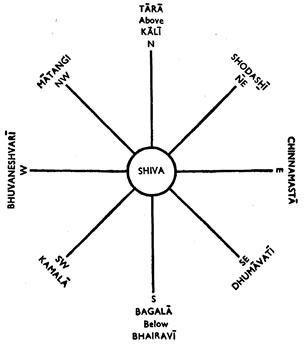
In such a fearful aspect Sati dazzling by the mass of her own brilliant energy,3 stood before Mahadeva, and uttered loud peals of laughter. Seeing the wonderful appearance of the Devī, Mahadeva lost all self-control, and, bewildered with fright, sought to flee in all directions. Seeing the Lord of Kailasa thus overcome by fear, the daughter of Daksa again uttered peal after peal of dreadful laughter, and, with the object of reassuring Him, shouted: "Fear not! fear not!" Hearing this cry and the fierce peals of laughter, Mahadeva was so bewildered with terror that He frantically rushed again in flight in every direction. Seeing her husband so overcome with fear Paramesvarl was moved to pity, and with a view to restrain Him stood for a moment before Him at each of the ten quarters of the Heaven in the form of the ten Mahavidyas. In whatever direction He ran with haste He thus saw a fearful form standing before Him. In fright He fled in another direction, only to be again confronted by another such form. After having thus run towards each of the ten quarters of the Heaven He saw that there was none without danger for Him. Then, feeling altogether helpless, He sat down on earth and shut His three eyes, and (a moment later as through an inner fear) he opened them. He saw before Him Śyāmā. Her smiling face was like a full-blown lotus. Her breasts were large. Her eyes wide and terrible, and Her hair dishevelled. She was four-armed, naked as space, shining with the light of ten million suns (although black in colour like a fresh cloud), and stood
1 Afijana. 2 Kaxnālasakalevarā. 3 Tejas. facing the south, the heavenly form of Daksina, Seeing Her thus (of a strange form full of an uncommon beauty), Sambhu, as if in great fear, asked: "Who art Thou, Śyāmā?1 Where has SatI, my beloved, gone ? "
Devī said: "Mahadeva, I am Thy Sati here standing before Thee, and yet Thou dost not recognize Me! Why is Thy mind so confused to-day ? Do I appear to Thee different from Thy Sati ? "
Śiva said: "If Thou really art my beloved Sati, daughter of Daksa, why hast Thou become black and fearful ? Who are these forms of terrible aspect standing in all directions around Me? Amongst these which art Thou ? Tell me everything, for these wonderful forms have made Me greatly afraid."
Sati said: "I am the subtle (beyond the reach of speech and mind) Mahaprakrti who creates and destroys. Owing to the promise I had aforetime given Thee (to bless Thee for Thy tapasya) I (put my true form under restraint, and) incarnated as a fair girl in Daksa's house merely to get Thee as My husband (to charm Thee by becoming Thy wife). I have to-day assumed this fearful aspect for the destruction of father Daksa's great yajna. But, O Mahesvara! Thou hast no reason to be afraid of Me (for this fearful aspect is assumed to terrify Daksa alone). The ten terrible forms which Thou seest in each of the ten directions are each of them My aspect. Oh, Sambhu! Thou possessest immense wisdom. Be not afraid (but see with Thy eye of wisdom) Thou art My most beloved husband, and I am Thy wife. Seeing Thee so greatly afraid and turning in all directions, I stood before Thee blocking them by these ten forms of Mine."
Śiva said: "Thou art the subtle (beyond the reach of speech and mind) Mulaprakrti who creates, preserves, and destroys. It is not possible that one should know Thee who art beyond the reach of speech and mind, so, not knowing Thee through great illusion, I have said unpleasant words to Thee. Pardon me, O Paramesvarl, the offence which I have thus committed. Tell me, O Consort of Śiva with fearful eyes, the names of each of
1 Black Lady. these ten most dreadful forms of Thine standing in each of the ten quarters."
Devī said: "O Mahadeva, these Mahavidyas are but different aspects of My own Self. Listen! Their names are Kālī, TarS, Sodasi, Bhuvanesvari, Bhairavi, Chhinnamasta, Sundari,1 Bhagalamukhi, Dhumavati and Matangi."
Śiva said: "O Devī! who supporteth the universe, if Thou art pleased with me, tell me which of these forms bear these respective names."
Devī said: "The dark-coloured form, with terrible eyes, which Thou dost see before Thee is Kālī. She who is above Thee of Śyāmā2 colour is Mahavidya Tārā, the very image of Mahākāla. The lean, destitute and very frightful Devī whom Thou dost see on Thy right side is, O high-souled Mahadeva, Mahavidya Chhinnamasta. O Sambhu, the Devī on Thy left
1 Kamala or MahaLakşmī. 2 Grass green, dark blue, blackish.
side is Bhuvanesvari. She who is behind you is Devī Bagala-mukhi, Destractress of foes. She who appears as a widow on the south-east is Devī Mahavidya Dhumavati, a great Īśvarī. The Devī on the south-west is Tripurasundari.1 In the northwest is Matangi, and in the north-east Mahavidya Sodasi, a great Īśvarī. She who is below Thee is Bhairavi2 O Sambhu! be not afraid (at the sight of these ten forms, which are My manifestations, and destroy the fear of existence.) Of My many forms (ninety millions of manifestations)3 these ten are the best (the most perfect vibhutis).4 To such Sadhakas as worship them with devotion they grant the four-fold fruit5 and all that is desired, O Mahesvara! all such things as Sadhakas desire, such as Marana, Ucchatana, Ksobana, Mohana, Dravana, Stambhana6 Vidveiana, are granted by them. Each of these ten Maha-vidyas is to be kept secret and never revealed. Thou shalt be the ordinancer and interpreter of yantras, mantras, puja, homa, purascarana,7 stotra,8 kavaca,9 practices, rules, and all else concerning them which may be required by Sadhakas. There is none else in the world who can reveal them. The Agama Śāstra which Thou shalt reveal from Thy mouth will be renowned in the three worlds. O Sankara! Agama and Veda are my two arms. With them I support the entire universe of moving and unmoving things. The world is maintained by Dharma, as ordained in Tantra and Veda. The fool who disregards them through delusion falls assuredly from the arms which save the three worlds. I am unable to save him who, in disregard of Agama or Veda, worships Me in a manner different from that ordained in it. This is nothing but the strictest truth. Agama and Veda are both causes of liberation. But both are difficult to understand and carry out. Knowledge of them is
1 Kamala. 2 Sec Dasa -Mahavidya-Upāsana-Rahasya, by PRāsanna Kumara Sastri, which illustrates both the figures and yantras. The text also illustrates the positions as shown on the opposite page. 3 Vibhutis. 4 See post. 5 Dharma, artha, kama, moksa. 6 "Magical" powers of destruction, driving away, perturbing, enchanting, putting to flight, stopping or paralyzing causing dissension. 7 See Introduction to Tantra gastra. 8 Hymn. 9 Amulet. hard to attain even by intelligent men. They are eternal and without end. The intelligent will know that the purpose of both the Śāstras is the same, and will practise dharma accordingly. The wise will never, through delusion, consider them to be different. Those who worship these ten Mahavidyas will act like Vaisnavas, but in rapt concentration will rest their hearts on Me. The Sadhaka will with great care keep secret, and never speak to others of mantra, yantra, kavaca, and other matters which he receives from his guru. If these things are given out siddhi will be unattained and evil will result. A good Sadhaka will therefore conceal them with every care. High-souled Mahadeva, I have now spoken to you of the subject of worship. (Let not the sight of these aspects of Mine strike terror into Thy heart, and make Thee doubt My single-minded love for Thee. I am Thy beloved wife, and Thou, too, art My very beloved husband. To-day I wish only to humble the pride of my father, Prajapati. So I pray to Thee, O Deva of Devas, that if Thou will not go to the place of sacrifice permit Me so to go. O Deva! it is my intention, with Thy permission, to go and destroy the sacrifice1 of My father, Prajapati Daksa (and not to frighten Thee)."
Mahadeva said to Narada: "Hearing these words of Devī, Sambhu stood as one struck with intense fear, and then spoke as follows to the fierce-eyed Kālī."
Śiva said: "Devī, I know that Thou art Paramesvari, the best, perfect, and supreme Prakrti. Pardon me the unbecoming words which, overpowered by delusion, I have in forgetfulness used towards Thee. Thou art the primal2 supreme Vidya3 who existeth in all created things. Thou art independent and supreme. Thou art Śākti. Who is there to order Thee to do or to desist from doing anything ? O Sive4 if Thou goest to destroy Daksa's sacrifice, what power have I to restrain that ? And why should I dare to do so ? O Mahesvari, pardon me for what (presuming on my position as Thy husband) I have, under
1 Because Daksa had, to offer him a slight, purposely neglected to invite Śiva, Her husband. 2 Adya. 3 As opposed to Avidya, though She is both. 4 The Devī as wife of Śiva. the influence of intense delusion, said to Thee. Do Thou as it pleases Thee."1
Interpreter of Śāstras, do you consider that that display of power is of no account, at the sight of which even Mahaxudra, who causes the great dissolution, was astounded, trembled with fear, and sought to flee ?
When Nisumbha was killed in the battle with the Devī,2 Sumbha, seeing Bharmāni, Vaisnavi, Mahesvari, Indrani, Kau-mari, Varahi, Narasinghi, Camundi, Kausiki, and Śivaduti,3 fighting with fury, sarcastically addressed Her who rejoices in war, saying:
"O Durga., proud of the strength of Thy arms, be no longer proud. She who fights with the help of the powers of other Devas has no reason to pride Herself so much as the single-handed conqueror of the three worlds."4
She who dwells in all hearts and who ever leans to mercy showed it then without stint. In that field of battle she made Sumbha a reply unheard of even by great yogis who had attained siddhi and become pure and free of the bonds of life. Jagadamba knew that the King of the Daityas was moved in his actions by an ill-directed intelligence and a naturally wicked nature. Thus, just as a mother cannot forsake her son even if he commits
1 Sati then went to the sacrifice (yajna). There, Daksa poured invectives on the head of Śiva. Sati's great devotion to Her husband (the Hindu girl prays that she may become like Sati and get a husband like Śiva) could not bear to hear Daksa's abuse of Him, and She gave up Her life. Nandi hastened to Kailasa and told Śiva, who rose in terrible wrath. Fire flashed from His eye and took the fearful form of Bhairava, who went with a host of ghosts and goblins to destroy the yajna. Śiva followed. The yajna was destroyed. Nandi, Śiva's follower cut off Daksa's head and threw it into the fire. Śiva then took up the dead body of Sati and went away bearing it on His shoulder. The story continues with the history of the Mahapithas. Sati reappeared in Her incarnation as daughter of the Mountain-king. The story of the Daksa-yajfla is one of the most ancient as, it is one of the best known, of all Śiva and Śākti legends. 2 The brothers Nisumbha and Sumbha were Lords of the Demoniac Danavas, who had defeated the Devas. The Devī, however, In whose body was the united Śākti of all the Devas, slew first Dhumralocana, Canda, and Munda, who had been sent against Her, and then the great Danava Raktabija, and finally both Sumbha and Nisumbha (see Candi of Markandeya Purana). 3 The Śāktis of Bharmā, Visnu, Śiva, and other Śāktis. 4 That is, Sumbha himself. hundreds and thousands of offences against her, but rather with smile and joy takes him on her lap, and then with feigned anger calls him wicked, so the Mother of the universe, looking upon Sumbha with merciful eyes but with such a feigned anger, said: "Wicked one, I alone exist. Who other is there in the world ? Look ! All these manifestations1 will enter into Me. I will then dispel the doubt which has arisen in your mind at the sight of a number of Devalaktis." (The mother, as if caressingly, said: "Wicked one, you see these DevaŚāktis, and now by a trick wish to know the truth concerning them.") Then in an instant, at the will of Her who is all will Herself, Bharmāni and all other Devīs entered into Bharmāmayi's body, and (Sumbha saw that in the battle-field) there was none but Ambika alone.
Then Devī again said: "I withdraw the many forms in which I (displaying My wealth of manifestation)1 appeared. I now alone stand in the battle-field. So Sumbha, now desist."
It was as if a boy on seeing many mothers was disconsolate on being unable to recognize his own. The Mother therefore showed him Her real self, and consoled him, saying: "Look, I am thy Mother, so be quiet." But Sumbha was not one to be satisfied with knowing what She was without letting Her know what he was, so putting on the arms and accoutrements of the hero, the hero son of the heroine Mother advanced to heroic struggle. O Mother! he who runs to your arms with his own strength is not a mendicant for your mercy. So the music of war rang out, fiercely shaking heaven, earth, and the nether world, and the evertriumphant Lord of Daityas stood in hand-to-hand conflict, to the sound of victory-giving shouts from this and other worlds.
Śāstra says that when, wounded in the heart by the Devī's spear he fell dead and dropped from the sky to earth, the latter, with its seven principal mountain ranges,2 seven seas, and seven islands, shook with the unbearable weight of his body. At his death all the regions rejoiced. The whole world regained health. The sky, hitherto overcast with a deep mist, cleared. Inauspicious clouds which had been shooting meteors all around,
1 Vibhuti, sec post. 2 Kulacala. disappeared. Rivers, the flow of which had long been stayed by the din of the twang of his bow and his thundering shouts, became on his destruction again free, and moved along their channels. The hearts of Devas were filled with immeasurable joy. Gandharvas1 commenced to sing in sweet tones. Kinnaras, Siddhas, and Sadhyas2 began to play on musical instruments. Apsaras3 commenced to dance. Pure air again flowed; the sun at length assumed his natural radiance. Fires could at last burn quietly, and without making the heavens resound with the sound of their burning.
Sadhaka! whose power can compare with the power of him for whose sake the ordained course of Nature was arrested ? Is it not a sign of the shortness of our life, intelligence, good fortune, and śadhana that we presume to deem small the power of manifestation4 of Her whose great māyā. charmed even the great charmer Sumbha, ruler over the three worlds? Can you say that the Śākti is small of Her who can make the impossible possible, whose māyā made even Bhagavan Rāmacandra forgetful of himself upon the occasion of the destruction of the hundred-headed Ravana ?5 Does not Her play in Her incarnations as a fish, tortoise, and boar, whereby She saved the Vedas, supported the universe, and held the earth on the end of the boar's tusk, bear evidence of a full display of divine Śākti?6 The sudden appearance, bursting through a crystal pillar, of the strange half-man, half-lion, in order to save Prahlada, chief among devotees;7 the display of the Bharmāņda within Her mouth to mother Yasoda;8
1 Celestial beings (Devayonis) who, according to the Visnu Purana, were sons of Bharmā, "born imbibing melody"; celestial musicians and choristers who play and sing at the banquets of the Devas; belonging together with the Apsaras—their wives—to Indra's heaven. 2 Other classes of Devayonis. 3 Beautiful and voluptuous Devayonis of Indra's Heaven; wives of the Gandharvas; produced at the churning of the ocean. 4 Vibhuti. 5 When Rāma was returning from Lanka, he met the hundred-headed Ravana. On seeing him, forgeful that he was Bhagavan, Rāma did not dare to fight. 6 Various incarnations of Visnu. 7 The Nrsimha AvaTārā of Visnu. 8 Yasoda was wife of Nanda, in whose home Kŗşņa was brought up. The infant Kŗşņa showed to Yasoda the universe in His mouth. the destruction of Putaña by sucking milk from her breasts;1 the upholding of Mount Goverdhana by a boy of seven;2 the charming, unknown to the three worlds of Brahmā through one whole year, by the raising of calves, cows, and cowherds bymāyā;3 the humbling of the pride of Kandarpa4by the assumption, in playful favour to devotees, of thousands of forms in early youth for the gratification of herdswomen who were maddened with love, and had attained siddhi by the practice of tapas for many ages;s the showing of the virāt6 aspect to Akrüra7 in the waters of the Yamuna8—all these are doubtless not perfect manifestations so far as the perfect Bharmān is concerned, yet, O man, I ask you, can you imagine even in dream anything greater than these ? The world of Jīvas could (were it to desire it) obtain even greater things of Him. But there are none who have the capacity to entertain such a desire.
"Manifest Thy divine Śākti to such an extent." It is beyond the power of Jiva to measure His greatness by saying "to such an extent". For this reason the extent to which He has manifested His Śākti for the removal of the burden of the earth in consequence of the tapasyā performed by the devotees is sufficient for Jivas. So I say, Do not trouble yourself with the thought that the receptacle is small. It is not really so; it assumes a small form to serve the extremely small purposes of the small world. You and I, the small Jīvas of this small world, do not count even as much as the smallest atom in His view. What right have we to see His universal aspect, which is rarely seen by Brahmā and other Devas ? Secondly, the Lord of the universe has no
1 Putaña was a female demon (Ràksasī) with poisoned breast, sent by Kamsa to destroy the infant Kŗşņa, who, however, destroyed her by sucking her breasts. 2 By Kŗşņa,. 3 Bharmā stole the calves and cowherds of Gokula in order to test Kŗşņa,'s power. The latter assumed the forms of the stolen eows and cowherds, so their absence was not noticed. This lasted for one year, when the calves and cowherds were restored by Brahmā, and Kŗşņa withdrew hismāyā. 4 Deva of love. The reference here is to the Ràsalīlā. 5 That is, the Gopis. 6 Universal. 7 Uncle of Kŗşņa, who induced Rāma and Kŗşņa to go to Mathura and kill Kamsa. 8 River Yamunā. need to show that sort of lordliness which you and I show to others with greatness, largeness and the like. What avails our ignoring of His lordliness when even Sumbha, Nisumbha, Ravana, and Kumbhakarna,1 could avail nothing by their ignoring it? So I say that when the greatly powerful King, Bali, could not save himself by looking on Vamanadeva2 as really a dwarf, why do we, who are really dwarfs, stretch out our arms to catch the moon shining in the firmament of the devotee's heart ? As you use the illustration of water to show that a small receptacle cannot contain a vast Śākti so I will take that of fire to show that an immeasurable Śākti can be eternally hidden even in a small receptacle. Put a spark of fire on a mountain heap of grass, and you will see that spark will extend throughout it and will illumine every side with enormous tongues of flame, kissing the cheeks of the firmament. The spark is no longer a spark, but has become a destructive fire flaming terrifically and fit to consume the whole heap. Similarly, however small Bhagavan's appearance in His incarnation may seem to you to be, bring to it a substance fit for the display of divine manifestation3 and you will see that the Bharmāņda is filled with the eternal Bharmā-play of Śākti and has become the field for the display of Śākti such as the Nrsimha of Prahlada,4 Śrī Kŗşņa of Arjuna, Gopala5 of YaSoda, Śyāmāsundara6 of the herdswomen,7 Nandanandana of Akrura,8 Śyāmā of Sumbha9, Uma of Himalaya,10 Sītā of Rāma," and Sati of Śiva.12 You will then realize that His greatness is not small, but that the Jiva's capacity is small; His
1 Daityas and Raksasas. The last was brother of Ravana. 2 Incarnation of Visnu, in the form of a dwarf. 3 Vibhuti. 4 The man-lion incarnation of Visnu for the protection of the son of Hiranyakasipu. 5 One of Kŗşņa,'s 108 names. That by which he was called by Yasoda. 6 The name by which Kŗşņa was called by the Gopis. 7 Gopis of Vraja who loved Kŗşņa,. 8 Name of Kŗşņa,; as to Akrura, see post. 9 The Devī Victrix of the demon Sumbha (see post). 10 The Devī as daughter of Himalaya and wife of Śiva. As to the derivation of the name see the first canto of Kālīdasa's Kumara-sambhavam. Uma unmarried, is the Śākti of will, as the Sutra says, "Icchaiakti uma kumari" 11 Wife of Rāma. 12 Devī, wife of Śiva and daughter of Daksa. appearance is not small, but the eyes of Jlva are so. He is not small, but you and I are so. So I say, O Sadhaka, do not suppose that a small receptacle cannot hold the eternal Śākti, or proceed to measure the greatness of Mahamāyā, whose power can make that possible which seems impossible.
But while there is yet time, seek the protection of Her feet, and opening the door of your heart say: "Mother, all my intelligence, learning, and reasoning are at an end. Now be gracious to me. In my struggle with doubt stand before me as Thou didst stand before Arjuna and before Sumbha. Fill the world for once with Thy true appearance so that my birth may be blessed, my life may be blessed, my eyes may be blessed and I, O Mother, may sink in Thee, becoming wholly Thine." |