
CHAPTER II
The Vedic Chandra Cult And The Stūpa
The symbolic art which found expression in the construction and decoration of the Stūpa will be better understood if the Stūpa itself is first considered as an Aryan royal tomb, rather than as a Buddhist monument. The Stūpa in its earliest known form was a dome roughly hemispherical in shape, the procession path at the base being usually enclosed by the massive Tailing, known as a vedika, such as surrounded an Aryan palace, fortified camp or settlement, or kept off the "impure" at Vedic sacrifices. The vedika had an entrance gateway, or torana, at each of the cardinal points, similar to that which is represented in Buddhist sculptures as the approach to a royal palace or town. On the summit of the Stūpa Was the receptacle for the cinerary urn of the king or hero, crowned by the royal umbrella, and often surrounded, like the Stūpa itself, by the vedikl which marked off holy ground. Some-tmes for"greater safety, the urn was buried deeply in the structure of the Stūpa. The exterior of the dome was plastered, so that the deeds of the hero Or saint might be depicted on it for the edification of the relatives or pilgrims as they went round in solemn procession. The Stūpa, as it now exists,is inearly always a solid structure of brick or stone, but proba1y it was originally a domicaf hut built of bambu or wooden ribs.Thus the earliest Stūpa may have been the Aryan
chieftain's hut or tent, imitated or reproduced in Vedic funeral rites as a temporary abode for the spirit of the deceased, until the due performance of the shraddhas by his relatives helped him to pass from the earthly sphere.
Vedic rites may be divided into two main classes, in which the germ of the two main divisions of modern Hinduism, the Vaishnava and Saiva sects, may be discovered. The first were addressed to the spirits of the day—Surya, the Sun; Ushas, the Dawn; Indra, the wielder of the Thunderbolt, brother of the Fire-god, Agni, and others. They were joyful rites accom-panied by songs, and were performed in the daytime by the Kshatriya householder or the chieftain of the tribe to secure the prosperity of the living. The I chieftains who presided at the tribal sacrifices were the Surya-vamsa, the ministrants of the Sun-god, and from these patriarchal rites sprang the idea of the bhakti-marga, the path of devotion, and karma-marga, the path of service, which became the leading motives of Vaishnava religious teaching. The second class included all the rites performed for the benefit of the dead, which were addressed to Chandra, the Moon, Varuna, the God of the night sky, and to Yama or Siva, the Lord of Death.
These were associated with the pessimistic school of thought, mainly Brahmanical, of which both Saivism and Buddhism were branches, looking for moksha, or liberation by following the jnana-marga, the way of knowledge, whether it was that indicated by the Vedic seers, or the Eightfold Path pointed out by Sakhya-Muni.
The rites of both classes were often intermingled, but those of the Chandra cult were naturally centred round the Stūpa and the cremation ground, while the
sacrificial hut, or the car of royalty with the sikhara roof, naturally became the principal shrine of the Surya It was thus that the Stūpa became the sacred symbol of Buddhism, for the early school of Buddhism the Hinayana, was essentially pessimistic, teaching vanity of earthly desires. And in taking over the symbols of the Chandra cult, Buddhism adopted the Whole symbolic framework of Vedic sacrificial rites, though the burnt offerings and oblations were no longer to be considered as the means of salvation; moksha, or liberation, was to be obtained by the suppression of the fires of evil thought and action, of lust, hatred and envy, anger and wrong thinking.1
A11 the symbols and metaphors commonly described Buddhist—the wheel, the trisula, the railing, the eightfold path, etc., as well as the form and planning of the Stūpa and its accessories, were Aryan, and connected with the Vedic rites of the Surya and Chandra cults before they became Buddhist,If one considers the essential character of the Vedic sacrificial rites, it will bcecome clear why Buddhist teaching brought about a radical change in Aryan art practice, so that the art of the Aryan royal craftsmen was no longer an art of Wood and clay, bambu and thatch, but an art of fine masonry and brickwork, of which we see the first development at Bharhut, Sanchi, Karle, and elsewhere. In the first place, Asoka's adoption of Buddhism as the Aryan state religion made the Stūpa with all its accessories a permanent memorial and shrine of the Blessed One, instead of the temporary resting-place of the remains of a Kshatriya chieftain. The Buddhist |Church needed more durable structures than the improvised tabernacles provided for Vedic sacrifices. Wood retained all its practical advantages as building
1 Buddhism, Mrs. Rhys Davids, p. 181,
material, but it lost the sacramental character it has acquired as the means of sacrifice and the vehicle of the Fire-god, Agni. At the same time, the forms of Aryan craftsmanship, such as the tribal ensigns, the carvey sacrificial posts and railing, the tabernacles in which the Yogi meditated, and the Stūpa, preserved the sacra mental character they had acquired in the Vedic era and were therefore for a long time closely imitated by the Buddhist masons and sculptors. This was not as is generally assumed, because the technical skill for adapting wooden construction to that of stone was lacking;
Buddhism, also, though it was by no means a creed of universal brotherhood in the same sense as Christ anity—for the Buddha would not admit slaves, debtors nor persons in the royal service into his Sangha—cer tainly must have made the Aryan building craft less exclusive; for in rejecting the Vedic sacrificial system Buddhism abolished the distinction between the "pure" who could, and the "impure" who could no; take part in the performance of sacrifices. Thus a Indian Buddhist king had a much wider choice of craftsmen for the royal service than would have bee the case if he had followed the pre-Buddhist Aryan traditions.
It was not, however, until Asoka's time, where Buddhism became the state religion of Aryavarti that the Sangha began to enlist the painter and sculptor into its service. The earliest Buddhist ritual was of a strictly Puritan character, for the Buddha's teaching was a protest against the extravagance a Brahmanical sacrifices. Music, painting and seulpture were to be regarded as worldly snares which diverted the mind of the novitiate from, the contemplation of the Four Aryan Truths: firstly, that suffering is in
separable from life ; secondly, that desire— the thirst for pleasures; being, and power—is the cause of suffering; that suffering can be suppressed ; fourthly, Eightfold Path is the way which leads to the in of suffering. While, therefore, the Stūpa which contained the holy relics, or symbols, had to be built steongly and Well, it was not until later times st and craftsman, as such, were admitted into the Order of monkhood.
Even during Asoka's reign the craftsmanship of the cnapter-house which contained the Stūpa, and the itself, was studiously primitive, reflecting the strict asceticism of the Buddha's original doctrine. In the rock-cut monasteries at Ajanta, where there is progressive series illustrating the development of Buddhist art from about the second century B.C. to the seventh: century or later, the early ones are oriented the north, instead of towards the rising or setting sun, the columns are plain, without caps or bases and the law of the Buddha, which limited the decoration of monasteries to designs of " wreaths and creepers, and bone-hooks and cupboards,'' and forbade" imginative drawings, painted in figures of men and women," 1 was strictly observed.
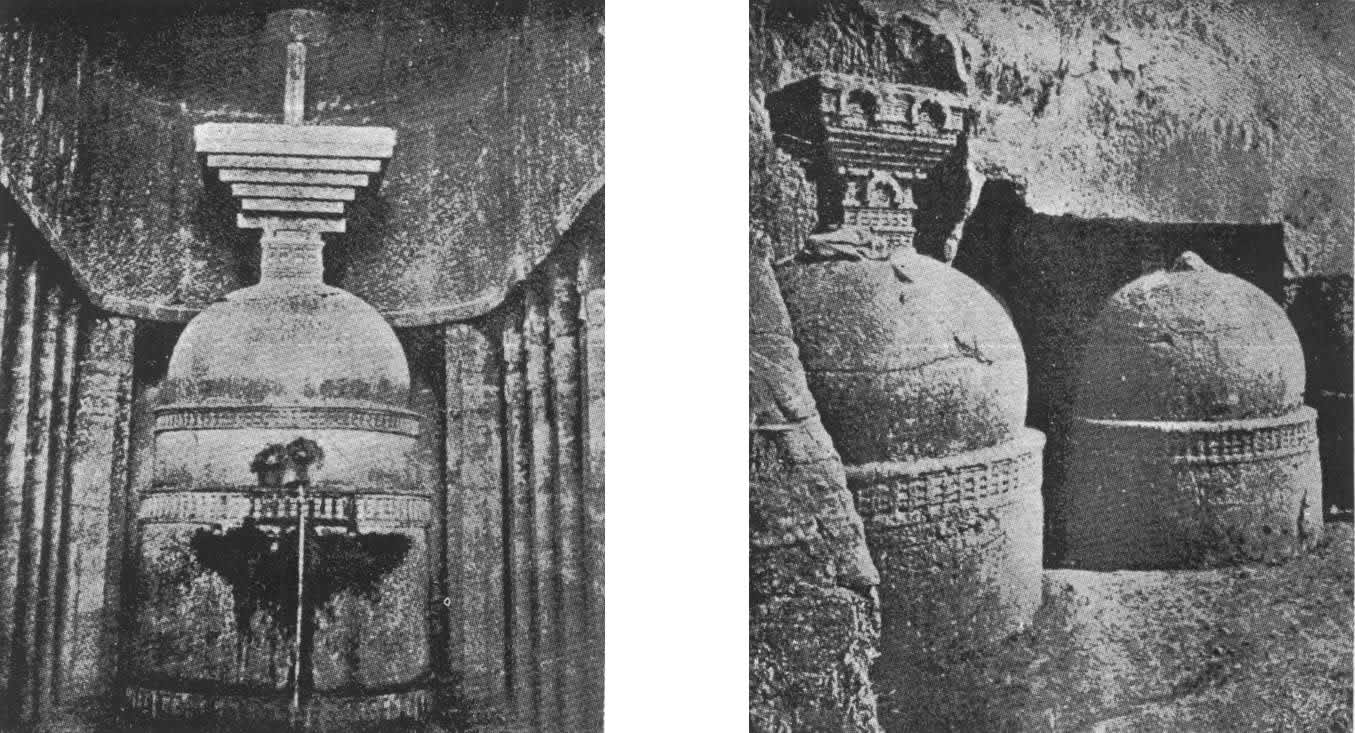
At Bhaja, a place in the Western Ghats of the Bombay presidency, not far from the great Karle chaitya house, there is a series of monolithic Stūpas carved out of a scarp of rock which also contains an Buddhist rock-cut monastery. The Stūpas are ascribed with the names of the Theras, or Brethren, to whorn they were dedicated, probably the abbots of the monastery
They closely resemble the representations of Stūpas apon the gateways of Sanchi. Though later
1 Chullavagga vi. 3, 2.
than Asoka's time, they will serve to illustrate the form which the Aryan royal tomb assumed at the beginning of the Buddhist era.
The dome—the anda, or egg—which was regarded as a symbol of the universal dome or cosmos—is raisec on a high plinth. In a structural Stūpa there would have been two procession paths, one at the base of the dome in close proximity to the holy relics, and another at the ground level This is the case at Sanchi, but here the rail enclosing the procession path is only carvec as an ornamental band. The dome has become slightly bulbous in shape, a later development of the hemii spherical Stūpa The railing round the actual pro. cession path at the ground level, if there was one, was probably of wood, for this was a transition period when lithic forms were, often combined with their wooden prototypes. The all the Stūpa the symbol of royalty, the umbrella, which crowned them, is missing; and in most cases the relic casket, or harmika which served as a pedestal for it, has been destroyed but in the nearest Stūpa in PI. I, fig. B, the harmika is intact. This is a very elaborate one; the simple and earlier type shown in fig. A is from a Stūpa in the chaitya hall at Bedsa in the same neighbourhood the vedika railing which surrounded the relic caske is represented as an ornament: above this is a series of slabs placed one over the other, and gradually increasing in size, so as to form a kind of altar. The top is shown to be enclosed by another railing in the middle of which the shaft of the umbrella was fixed
The same peculiar form is carved at Karle, and many other early Buddhist chaitya halls, as a throne of platform for the Devas, who are seated on the capital; of the pillars enclosing the Chapter-house of the Order Its connection with Vedic ritual can be traced in the
Vajapuja sacrifice, performed by Aryan householders for obtaining worldly advancement. At the conclusion of the sacrifice the householder, after a dialogue with his wife referring to their attainment to the higher spiritual spheres, mounted the sacrificial post and seated himself on the top, upon which seventeen robes were spread. When he came down he was enthroned and consecrated as a Samraj, or universal monarch.1 Evidently the structure above the relic casket on the Stūpa is such a symbolic altar throne.
The arched ornament resembling a horse-shoe on the Bhaja relic casket represents the gable of the curved roof of a shrine through which the light fell upon the altar. It occurs in nearly all the buildings represented in the Bharhut or Sanchi sculptures. No doubt similar roofs and similar shrines were common in pre-Buddhist times, and the gradual adaptation of the form as an emblem of the rising or setting sun I must have been a survival of Vedic symbolism. At first the imitation of the roof-end is very close, though no one familiar with Indian ways of thinking would believe that the whole intention of the sculptor lay in I copying the form of a roof. He, no doubt, was thinking of the sun- or moon-light streaming in through the ; lattice-work which filled the upper part of the arch, ' and of the face of the sun or moon, which on certain holy days looked in at the window. Successive generations of craftsmen, put the thought into symbolic form.
In the later monasteries at Ajanta an image of the Buddha as the Light of the world sometimes fills the
1 See Barnett's Antiquities of India, pp. 166-7. In the same rite a I wheel was set up upon a post and turned by a Brahman while a symbolic chariot race was being run.
window space, and the arch then serves as the glory or aura of the image. And when the chaitya hall turned towards the west, the crocodile-dragon of Varuna, the ruler of the cosmic ocean into which the sun sinks every evening, was carved at the springing of t arch,1 and a lion's or dragon's mask, with gaping mouth as if swallowing the whole arch, was carve at the crown.
But in the earliest rock-cut Assembly halls of tin Buddhist monasteries, where this arch is the mail motif of the severely restrained decorative scheme one can hardly realise the symbolism behind it, for i is simply a copy of the window over the entrance. An certainly the rules of the Sangha did not tolerate any traffic with the despised Vedic fire-worshippers. The] only prescribed the patterns which were lawful for the bhikkus to use as decorations, and gave them a meta phorical interpretation in accordance with the Buddha's teaching.
the carved entrance to one of the rock-cut hermit-ages in Bihar, near Gaya, known as the Lomas Rishi cave, is an exact reproduction of the roof-end from which the sun-window is derived. The hermitage was one of those which were dedicated by Asoka for the use of a certain sect known as the Ajivikas, and date! from about 257 b.c. The interior consists of a hall 33 feet long and 19 feet wide, with a semi-cylindrical roof. The walls, floor, and ceiling are quite plain, but have a very fine polish. At one end of the hall a narrow "door opens into a domed chamber, or shrine, nearly circular in shape, like a hollow Stūpa. In a similar adjacent hermitage, known as the Sudama or Nvagrodha cave, the rock is cut over the entrance so as to
1 Horns, the Egyptian sun-god, was also represented in conflict with the crocodile-dragon.
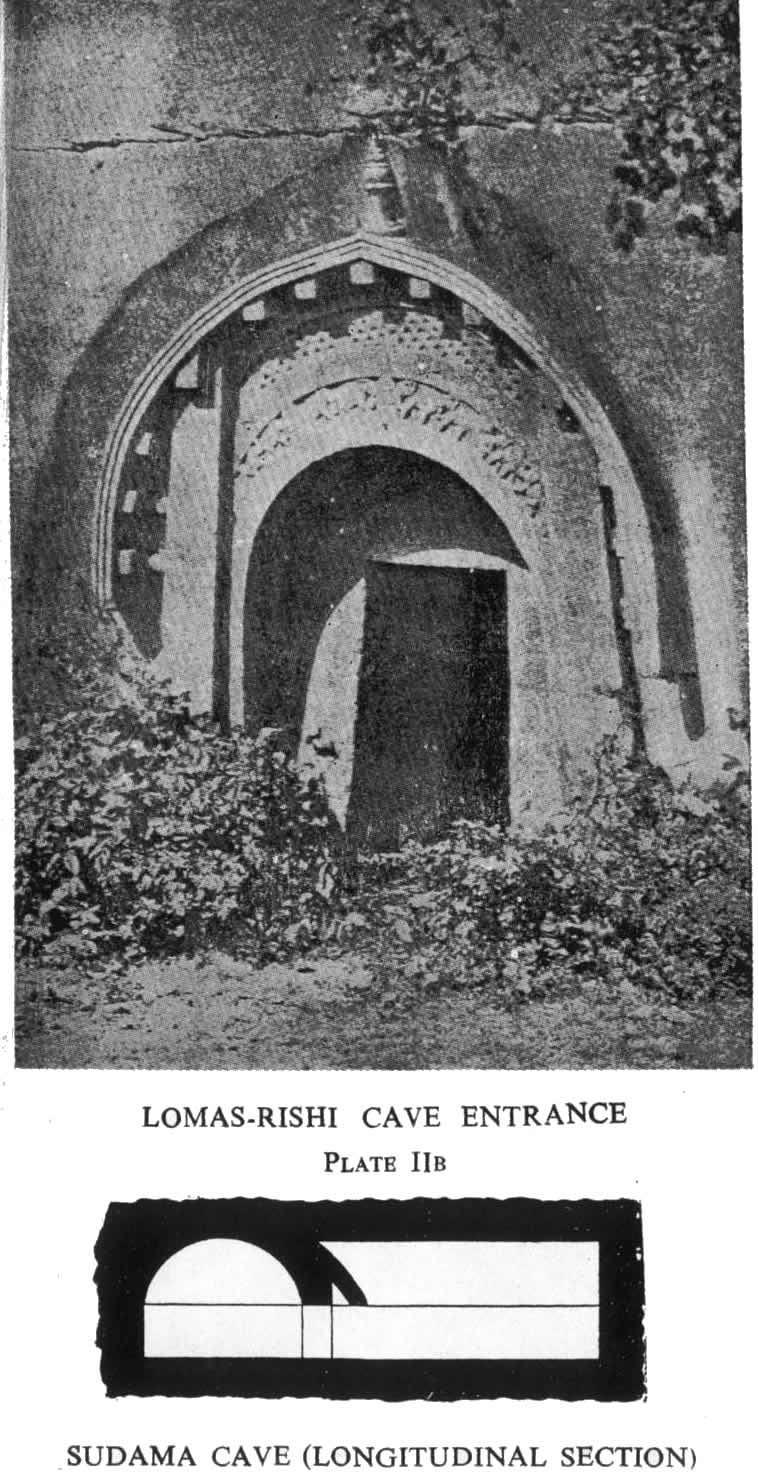
simulate the thatched roof of the shrine or Stūpa (Pl II, B). Possibly we have here a representation of an ancient Aryan Stūpa with the assembly-hall or chapel where shraddha rites of the deceased hero were performed,