|
IX
Education
NEVER-ENDING are the discussions as to what India ought to learn, and how that knowledge should be imparted to her. But it is much more vital to ascertain what India will consent to unlearn. Upon the answer to that question her future depends.
Someone—is it Sir Alfred Lyall ?—tells of an Indian who was thoroughly versed in the mathematics of astronomy, and could calculate eclipses many years ahead, but who confessed that he still believed, and should teach his son, that eclipses were caused by a dog eating the moon. Nothing could be more characteristic* Indians have an amazing capacity for learning, and for ignoring the consequences of what they learn. They will admit that, for the outer world, two and two make four, but they pin their actual faith to the sages of old whose subtler genius assured them that two and two made five. Not till India has unlearnt this habit of mind will the day of her true greatness dawn.
Many people hold that the worst error of our rule has been the effort to substitute European for Oriental education. This I cannot believe. Our error—our inevitable error, since we knew no better—lay in introducing bad education instead of good. We gave what we had, and it was better than nothing ; but it was not what the
* "A schoolmaster once tried to convince his pupils that the earth goes rolund the sun. ' Now, do you believe it ? ' he asked. * Yes, as long as we are in the class-room.' " James Kennedy I.C.S., in Asiatic Quarterly Review, October, 1910. situation really wanted. James Darmesteter put the case accurately, a quarter of a century ago, in his Lettres sur I'Inde, when he said that the instruction given by England to India was " superficial and empty, not of set political purpose, but because European instruction in general, and English in particular, was itself superficial and empty."
It is the fashion to denounce Macaulay as the evil genius of Indian education, because he turned the scale in favour of European matter and methods. Let us see what was the actual character of his intervention.
Macauxay's Minute.
A clause in the Charter Act of 1813 empowered the Governor-General in Council to apply one lakh of rupees a year " to the revival and improvement of literature and the encouragement of the learned natives of India, and for the introduction and promotion of a knowledge of the sciences among the inhabitants of the British territories in India." On the face of it, this is a grant for the promotion of Eastern literature and Western science; and at first the money was used in the payment of stipends to students of Oriental subjects. It does not appear that the teaching of science was seriously attempted— perhaps because it pre-supposed on the student's part a knowledge of English, or some other European tongue. But by 1835, when Macaulay was Chairman of the Committee of Public Instruction, it became evident that a great development of education was impending, and a lively controversy arose as to whether it should be predominantly Eastern in its substance and methods, or predominantly Western. The Orientalizers had on their side the plain meaning of the words of the Charter; but Macaulay was not the man to let the literal interpretation of a document stand in the way of what he considered common sense and sound policy. As his famous Minute is not very easily accessible, I may quote some of its most .characteristic passages :
I never found one among [the Orientalists] who could deny that a single shelf of a good European library was worth the whole native literature of India and Arabia. . . .
The question now before us is simply whether, when it is in our power to teach [English] we shall teach languages in which, by universal confession, there are no books on any subject which deserve to be compared with our own ; whether, when we can teach European science, we shall teach systems which, by universal confession, whenever they differ from those of Europe, differ for the worse ; and whether, when we can patronize sound Philosophy and true History, we shall countenance, at the public expense, medical doctrines which would disgrace an English farrier—Astronomy Which would move laughter in. the, girls at an English boarding-school—History abounding with kings thirty feet high and reigns thirty thousand years long—and Geography made up of seas of treacle and seas of butter. , . .
We are forced to pay our Arabic and Sanskrit students, while those who learn English are willing to pay us. . . .
It is confessed that a language is barren of useful knowledge. We are told to teach it because it is fruitful of monstrous superstitions. We are to teach false history, false astronomy, false medicine, because we find them in company with false religion.
There are faults of excess and faults of emphasis in this pronouncement; but it is absurd to talk of the mischief wrought by Macaulay's " blighting rhetoric." Such language can be held only by those who think that England ought to have perpetuated her empire in India by keeping the people entirely ignorant of Western political ideas. Even supposing that this would have been desirable (which I do not believe) it would certainly have been impossible. Not in India alone, but all the world over, the day of the ring-fence is for ever past. We might have hindered the percolation of ideas ; we could not have prevented it. For the material development of the country, by means of the railroad and the telegraph, a lingua-franca was indispensable ; and if some other language than English (say Hindustani) had been chosen for the purpose, Western books Would have been translated into that language, and
discontent would have spread just as surely, though we should probably have known less about it. The people who denounce Macaulay are logically bound to go a step further, and maintain that the railway, the telegraph and the manufactory ought to have been excluded from India, which should have remained a patch of the Middle Ages in the midst of the modern world—a region where time stood still. I am not aware that any of them has explicitly advanced so impossible a theory ; but it seems to be implicit in such a passage as the following from Meredith Townsend's Asia in Europe. Mr. Townsend tells us that he was one of those who, in the 'fifties, " bestirred themselves to resist Macaulay's ideas."
They maintained that true instruction would never be gained by an Oriental people through a Western language, that education in English would be productive of nothing but a caste, who, like the " scholars " of the Middle Ages, would be content with their own superiority, and would be more separated from the people than if they had been left uneducated : that, in short, English education, however far it might be pushed, would remain sterile. They pressed for the encouragement and development of indigenous culture, and would have had High Schools and Universities, in which men studied, first of all, to perfect the languages and literature and knowledge of their own land. They fought hard,but they failed utterly, and we have the Babu, instead of the thoroughly instructed Pundit.*
* The sort of instruction which would have held the field had these views prevailed may be estimated from Deussen's account of his visit to the Sanskrit College at Benares, in 1892 : " The various sciences, grammar, law, philosophy, even astronomy and medicine, are here taught in accordance with the ancient native handbooks. The absolute dependence upon Indian antiquity, the solution of every dispute by a reference to the ancient authorities, as well as the discussions of their axioms, remind one strongly of medieval teaching in Europe. Equally medieval is the strict adherence to all sorts of superstitions which both limit and dominate the ideas of learned and intellectual men in a most extraordinary manner." My Indian Reminiscences, p. 157. At Madhura Deussen met a pundit who " was a medical man, he had studied the Ayurveda and had an extensive practice in the neighbourhood. ' "What is fever ? * I asked him. ' Fever,' he replied, ' is a false mixture of three of the juices of the body, wind, mucus, and bile.' ' And how do you cure it ? ' Here he glibly rattled off a terrific list of drugs, which, after having been pounded and mixed, were to be administered to the patient." " Ayurvedic remedies " are- popular and widely advertised in India.
It is true that we have the Babu, to carry out a thousand duties of civilization for which the Pundit would have been unfit, even if he would have condescended to them. We also have (a more doubtful blessing) the vakil or pleader ; and we have the " failed B.A.," and the successful B.A. who feels himself cruelly wronged because Government does not provide for him the comfortable post to which he thinks he is entitled. English education has had many drawbacks, some of them inevitable, some of them arising from defects in our very idea of education. But who can doubt that in the main Macaulay was right ? He may even be said to have " builded better than he knew ; " for he laid the foundation of a united India, capable—unless it deliberately misuses its opportunities—of taking its place among the great nations of the world. It is never the intelligent Indian who doubts the benefits of English education. He may resent Macaulay's language, but the justice of his conclusion he knows to be beyond dispute. The only rational objector to English education is he who holds (as Lord Ellenborough held a century ago) that it endangers the eternity of English rule. That it certainly does ; but if England desired to hold for ever an empire founded on ignorance and mental stagnation, one Could only say " the less England she."
Statistics.
It was not until 1854 that Macaulay's Minute took full effect, and the existing educational machinery was set in motion. After sixty years have passed, we find that (roughly speaking) -" rather more than one male in ten and one female in a hundred can read and write ; less than one male in a hundred and one female in a thousand can read and write English."
It is estimated that, in all, about one million Indians have some knowledge of our language. Many of them, no doubt, speak and write it very badly ; but the amazing thing; as I have already noted, is that thousands of them have mastered it to absolute perfection. Macaulay, indeed, when he wrote his Minute, was probably influenced by his observation of the extraordinary linguistic faculty so common in India. " It is unusual," he writes, " to find, even in the literary circles of the Continent, any foreigner who can express himself in English with so much facility and correctness as many Hindus." I had made the same remark a hundred times before I came across it in the Minute of 1835.
In the decade of 1902-12 the total number of educational institutions in India increased from about 148,500 to about 176,600, and the number of pupils from 4,530,000 to 6,796,000. The total number of boys under instruction rose from 4,084,000 to 5,841,000, or by 43 per cent., and the total number of girls from 446,000 to 955,000, or by 114 per cent. These are at first sight large figures ; but they mean that, after a decade of steady increase, only 29 per cent, of boys of school-going age, and 5 per cent, of girls, were receiving any sort of instruction. The total expenditure on education had risen during the decade from £2,681,670 to £5,256,223. About half of this expenditure is met by Government, or by municipalities or local boards. About a quarter is covered by fees,* and the remainder by endowments and subscriptions." *
The Next Move : Vernacular Education.
" In one point," said Macaulay in 1835, " I fully agree with the gentlemen to whose general views I am opposed. I feel with them that it is impossible for us, with our limited means, to attempt to educate the body of the people. We must at present do our best to educate a class who may be interpreters between us and the millions whom we govern."
* It is stated that the unwillingness of even the well-to-do classes to pay reasonable fees for their children's schooling seriously retards the progress of education.
* The above figures are taken from the Statement exhibiting the Moral and Material Progress and Condition of India, 1911-12. In that we have succeeded ; and we now cry out, not without reason, that the intermediary class do not interpret us wisely or fairly. Yet we are preparing, with sublime inconsistency, to multiply tenfold the possible readers of the vernacular press ; for the day of universal education is rapidly approaching. What was impossible in 1835 will in all probability be an accomplished fact in 1935. Mr. Gokhale has drafted a bill by which free and compulsory education would, with all reasonable celerity, be established throughout British India ; and though the Government, for financial and other reasons, cannot accept that measure, it stands committed to the principle that lies behind it. In a Resolution issued at Delhi on February 21, 1913, we read : " The propositions that illiteracy must be broken down, arid that primary education has, in the present circumstances of India, a predominant claim upon the public funds, represent accepted policy no longer open to discussion." And again : " It is the desire and hope of the Government of India to see in the not distant future some 91,000 private schools added to the 100,000 which already exist for boys, and to double the 41/2 millions of pupils who now receive instruction in them." And yet again : " The Government of India hope that the time is not far distant when educational buildings will be distinguished as the most modern and commodious buildings in the locality, and scholars in India will have the advantage in this respect of scholars in the West." Critics of the Government, European as well as Indian, hold that this insistence on buildings merely delays progress. " What ought to happen," says Sir F S. P. Lely,* " is that the Department should assign a master and staff to every village where the people undertake to provide a house. . . . The villagers, if left to themselves, could provide a house at a fraction of what the Government department has to pay . . the Deputy Inspector having no word in the matter, unless only he found the conditions insanitary." It is not necessary
* Suggestions for the Better Governing of India, 1906. 246 for me to take a side in the discussion, though I think there is something to be said for the Government view, that " the influence for good of clean and well-arranged buildings,* with the concomitant domestic discipline, can scarcely be exaggerated." The essential fact is that a great movement in the direction of vernacular education is formally promised, and that the rooting out of illiteracy is only a matter of time—perhaps of no very long time.
Surely not without reason have I called it a sublime inconsistency, which, in one breath, complains of the results of the education already given, and proposes to extend it to the scores of millions as yet untouched by it. On the theory of never-ending empire—the official theory—it is nothing short of madness. If a little knowledge of English has begotten the agitator and the anarchist, is it not clear that a widespread ability to read the vernacular languages will enormously increase the influence of the makers of political mischief ? It may be said, no doubt, that it is in the sheer ignorance of the people that the mischief-makers find their strength. That is true; but ignorance, in this sense, will not be corrected by the mere ability to read and write. If vernacular education means no more than that—if we are not prepared to impart something more than the power of reading seditious newspapers —then vernacular education cannot but enormously increase the difficulty of maintaining our hold upon India. The fact that we blithely proclaim the extinction of illiteracy as a policy "no longer open to discussion" seems to me "to prove at once an immensity of honest good-will and an incapacity for clear and consistent thinking. Anything less Machiavellian than our conduct in this whole
* In every Japanese village the school-house is the largest and most prominent structure—a fact which certainly enhances the prestige of education in the eyes of the people. I could not but remember this when, looking into a village school near Poona, during the mid-day interval, I found it an absolutely bare hovel, the earthen floor of which an old woman was busily daubing with cow-dung. matter of (education it would be hard to conceive. We do our immediate duty according to our lights, and we let the consequences take care of themselves.
Anglo-literary Training.
The problem is enormously difficult, for two main reasons : first (as James Darmesteter points out), because we have not ourselves developed a rational system of education; second, because a rational system of education would be resented and resisted by the people whom we propose to teach. How are we to get round this complication of difficulties ? Our only chance, it seems to me, is clearly to realize the conditions of the problem, and to call in the best Indian intelligence to help us in solving it. This is as much as to say that we must frankly and sincerely admit our object to be, not to make Indians Englishmen, or even citizens of the British Empire, but to make them competent, clear-sighted citizens of their own country. Hitherto, for the vast majority of Indians, India has not existed in the real world, but in a world of myth, nightmare, and vain imagination. Only by the aid of her own finer spirits can she be brought down from this cloud-cuckoo-land and anchored on the solid earth. And only by a frank recognition of her right to self-government as soon as she is ready for it can the co-operation of her finer spirits be secured.
It is commonly said that the education we have hitherto given India errs in being too literary. That is true enough ; but it would be equally true, and would come nearer the heart of the matter, to say that it is too English. Our aim has been to make of Indians pseudo-Englishmen ; and it must be owned that in this endeavour we have attained remarkable success. To their great linguistic gifts Indians add a tenacious verbal memory which enables them to master what may be called the catchwords of culture. There are hundreds of Indians who write quite as good English as the average British journalist, and betray their foreignness only in their excessive fondness for quotations and ready-made phrases. " Babu English " is the ridiculous aspect of this characteristic—the English of a man who has stuffed his head with idioms and stereotypes which he pours forth without any sense of fitness, as in the case of the man who announced his mother's death in these terms : " The hand that rocked the cradle has kicked the bucket." But " Babu English " is really a rare phenomenon.* The educated Indian generally uses his quotations and tags with perfect appropriateness, if only he would be a little more sparing of them.
It may have seemed for a brief moment, some thirty or forty years ago, as though this gradual Anglicization of India were destined to solve the problem of her spiritual future. Religious and social reforms appeared to be gradually following in the track of literary education, and such an institution as the Brahmo Samaj, with its eclectic unitarianism, may have seemed full of promise. But it was very soon evident that this apparently marvellous receptivity and adaptability was a surface phenomenon of small significance. The Indians who became effectually Anglicized lost touch with their own countrymen, and carried with them no real following. The genuine outcome of our literary education—our training in Milton and Byron
* Perhaps commoner in practice than " Babu English " is the expression of sentiments which seem all the more quaint for being couched in irreproachable language. I have before me a type-written letter from an Indian official to his European superior, complaining that some charitable work he has undertaken has been misinterpreted, and has got him into trouble with his compatriots. " After all," he writes, " I took up the Work as it was of public charity, and therefore. His [God's] work, and also the work which interested Government, whose servant I am. It was my ambition to please Him as well as yourself. His verdict we may not know. As for your appreciation, I might as well get it by a small private testimonial." Here is a not very luminous passage from notes on a law-suit under revision. " The issues first and second though they contain automatic points in their latter and former portions respectively, yet the objects which they hide in themselves apply mutatis mutandis, differentially to the statements of the parties." and Shelley, in Burke, Mill, Macaulay and Spencer—was the dissemination of democratic ideals, invectives against tyranny, and violently partisan views of the historical relations between England and India. All this is perfectly natural, and might have been foreseen. You cannot teach the subjects of an alien autocracy to declaim about:
" Some village Hampden that with dauntless breast The little tyrant of his fields withstood,"
and expect them to refrain from making any personal application of the lines. What was less easy to foresee was the recrudescence of aggressive Hinduism, or in other words, of anti-rationalism, which has followed upon the spread of Anglo-literary education. This is, in my view, the really disquieting and baffling feature of the situation. One thing, at all events, that has not resulted from our well-meant educational efforts is any wide dissemination of political or spiritual wisdom. How was it to be expected that India should greatly profit by a course of irrelevant, or, at any rate, premature, politics, unsifted history, and poetry which, to Eastern learners, could at best be little more than half-•understood rhetoric ?
Let me give one or two instances of what I mean by Anglo-literary education. I once visited a High School for Girls, very well conducted by an English head-mistress. The physical drill and teaching of household occupations seemed to me excellent ; it was in the class-room devoted to geography and history that my doubts were aroused by two maps displayed on the walls, and pointed out, with no little pride, as the work of the girls themselves. One was a map of England, in which the principal products of the chief towns were shown by means of objects attached at the appropriate spots. Thus a toy motor-car indicated Coventry, a ship, Liverpool, a knife, Sheffield, a scrap of woollen cloth, Bradford, and so forth. In this there was no harm; if one had felt sure that the local products of India had been illustrated with similar care ; but one or two maps of India, exhibited at the same time, showed no suchelabora-tion of detail.*
The second map to which my attention was called belonged to the historical department. The reader would scarcely guess its subject, if he were to think for a year of the unlike-liest theme to propose to a class of Indian girls. It was a plan of the battlefield of Agincourt, showing the positions of the contending forces ! The details of the battle of Agincourt may be of great interest from a strategic point of view, or from the point of view of a somewhat narrow British patriotism; but what have Indian girls to do with either strategy or the quarrels of the Plantagenets ?
It was again at a girls' school (this time under Indian control) that I came across an amusing example of the value of literary education specifically so called. A show pupil of fourteen or thereabouts (a married woman, by the way), was told to recite Thomas Moore's verses, very popular, I believe, in India, entitled " Those Evening Bells." In order that I might follow with understanding, the text had been written out, and was handed to me by the headmistress. The reciter, however, spoke quite comprehensibly, and I was surprised to hear her say :
" And so 'twill be when I am gone. That tuneful peal will still ring on, When other birds shall walk these dells. And sing your praise, sweet evening bells."
I turned to the written copy and found that she had followed it exactly. The true text, of course, is :
"When other bards shall walk these dells ;
but " birds " made quite good enough sense both for the pupil and for the teacher. In India, by the way, the art
* A schoolboy, it is stated, if asked to enumerate the watering-places on the south coast of England, will rattle off " Folkestone, Hastings." etc., with great volubility, but will be nonplussed if you ask him the meaning of " watering-place." of recitation is generally understood to mean suiting the action to the word in such detail that every line shall be illustrated by at least one appropriate gesture. If you talk of your heart you must clutch your left breast: if you allude to your eyes, you must point to these organs. I remember hearing a boy recite, " Break, break, break," and accompany it with a whole gymnastic of gesticulation. At the lines :
" And the stately ship goes past To its haven under the hill:"
he shaded his eyes and assumed the attitude of an old coast-guardsman scanning a sail on the horizon. At
" But, oh, for the touch of a vanished hand,''
he brandished a very visible paw : and at
" The sound of a voice that is still "-
he pointed downwards with a significant flourish, implying, to the European mind, the gloomiest conjecture as to the present location of the owner of the voice. On the other hand, I have seen Indian schoolboys go through the Trial Scene in The Merchant of Venice with excellent discretion.
The Arya Samaj.
Whatever the successes or failures of Anglo-literary education, it has at least done one indispensable service in making the basis of instruction (theoretically, at any rate) an appeal to reason, in place of the Oriental appeal to sheer authority, of which something has already been said in Chapter IV. " The traditional idea of education in India," says Mr. S. M. Mitra, " is based on reverence for the teacher {guru) whose word was law, and who was almost worshipped by his pupils (chelas)." Such an ideal was natural enough so long as all knowledge was held to be stored up in the past, and thought was conceived as a mere pouring of the mind into ready-made moulds, or at best as the ability to perform certain prescribed feats on a mental flying-trapeze. When European Hinduizers speak with awe of the culture imparted at the " universities " of ancient India, I cannot but think of the University of Cairo as it exists to-day, and of the great mosques in which hundreds of young men are squatted on the floor, rocking themselves to and fro hour after hour, day after day, year after year, while, with closed eyes and muttering lips, they memorize the Koran. No doubt the Indian gurus sometimes inculcated the doctrine of subtler thinkers than Muhammad ; but the whole conception of education as the reverential acceptance of a set of sacred texts and glosses is fitted only for a static world which never existed in fact, and has ceased to exist even in theory. There is too much reliance on authority, too much mechanical memorizing, in Western systems of education; but their aim, their ideal, is to make the pupil think for himself, and accept a formula only when he has tested it and found it work. The West has at any rate proceeded some way towards the realization that the true teacher ought not to strangle, but rather to stimulate, the critical, the questioning instinct in his pupil. It is clear that this must also be the ideal of Indian education if India is to develop her character and make the best of her intelligence. The relation of guru and chela, in so far as it survives, is a. thing to be discouraged and finally eradicated. In the modern world, intellectual idolatry is as much out of place as religious idolatry.
It is for this reason that I look with hesitation upon the work of the Arya Samaj, a reforming body of great and growing influence in Northern India. It numbers nearly a quarter of a million adherents, conducts numerous schools, and has two great educational centres, the Dayanand Anglo-Vedic College at Lahore, and the Gurukula near Hardwar, the sacred spot where the Ganges flows out from the foothills of the Himalayas. The Lahore College takes its name from the founder of the sect, Swami Dayanand Saraswati (1824-1883), called by his followers " the Luther of India." He was a Brahmin from Kathiawar, who broke away from his caste and preached a doctrine of which the watchword was " Back to the Vedas." Idol-worship, pilgrimages, child-marriage, enforced widowhood, even caste itself, Dayanand rejected. He rejected the name " Hindu," which he held to be originally a Muslim term of contempt. " Arya " he declared to be the only name that ought to be acknowledged by adherents of the Vedic religion. He made a principle of proselytism, which is to" the orthodox Hindu an impossibility, inasmuch as Hinduism is not a result of conviction but a privilege of birth. He even " gave practical proof of his moral courage by publicly reclaiming Hindu converts to Islam."
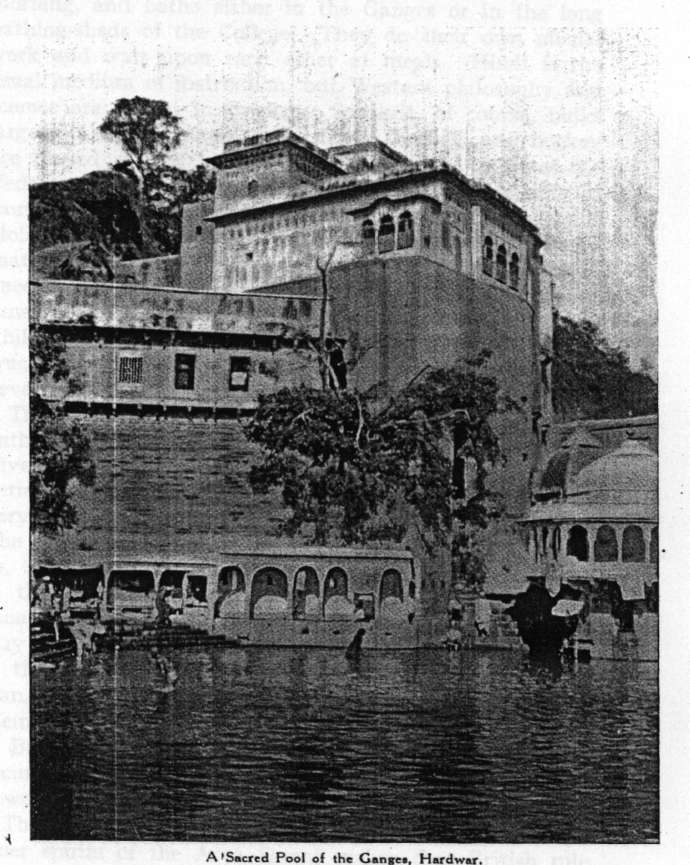
I have visited both the Lahore and the Hardwar Colleges, and have been greatly struck by the earnest spirit in which their work is conducted. Lala Hans Raj, the late Principal of the Anglo-Vedic College, and Mahatma Munshi Ram, the present Principal of the Gurukula, will always rank in my recollection among the most impressive figures I met in India—which is saying a great deal. Their splendid physique, and the grave dignity and urbanity of their manners, made them seem, in everything but years—for neither is more than middle-aged —ideal types of the Eastern sage. The Gurukula, which represents a different shade of heterodoxy from that of the Anglo-Vedic College, is animated by a spirit of cloistral austerity. It is situated on the eastern bank of the Ganges, four branches* of which divide it from the pilgrim-haunted Hardwar. This seclusion is chosen on purpose that the three hundred pupils may be as remote as possible from evil influences—" especially those of the home." Pupils are received at the age of seven and do not pass out of the college until they are twenty-four. They never go " home for the holidays," and intercourse with their parents is severely restricted. They rise at four in the
* I crossed one of these streams on a raft of kerosene-tins, another by ferry-boat, the third on a bridge of boats, and the fourth on horseback.
morning, and bathe either in the Ganges or in the long bathing-sheds of the College. They do their own menial work and wait upon each other at meals. Hindi is the usual medium of instruction, but Western philosophy and science are taught in English. Sanskrit, of course, bulks large in the curriculum, and cricket, football, and hockey are played in that language. Fire—the god Agni of the Vedas—is prominent in both public and private acts of worship ; but I was assured that it was regarded, not idolatrously, but as a symbol of purification. It chanced that when I arrived at the College, the Principal was kneeling on the verandah of his bungalow, facing a red sunset over the green Ganges, and absorbed in prayer, while a tongue of spirit-flame wavered aloft from a brazen crucible placed on the ground before him. Assuredly, I never saw a more impressive act of devotion.
The Arya Samaj is regarded with suspicion by the authorities, on account of its supposed seditious tendencies. Several of its adherents, in conversation with me, energetically repudiated this suspicion. " We depend for our very existence," they said, " on the British Government. The orthodox Hindus hate us, the Muhammadans hate us, the Christians hate us. We are encircled by enemies : in the British Government lies our sole security: why should we dream of oversetting it? " And again, "One may be loyal to the King-Emperor and the great officers of the Government without being loyal to every policeman." And yet again: " By their fruits ye shall know them. There are no Aryas in Bengal, and outrages occur in Bengal- There are no Aryas in Bombay, and outrages . occur in Bombay. In the Punjab the Arya Samaj is powerful, and there are no outrages in the Punjab."
This reasoning is specious and no doubt sincere. The wiser spirits of the Arya Samaj realize that British rule gives India her best chance of moral and intellectual regeneration. It was Mahatma Munshi Ram himself who wrote (in the Civil and Military Gazette): If any insane persons have for one moment thought that the Hindus of the present day—the great majority of whom are degraded, hypocritical and base—are fit for governing the country, and have preached sedition in their madness, surely the teachings of the great apostle of Vaidic Dharma cannot be held responsible.
A teacher holding these views is not likely to work for a premature overthrow of the British power. But it must not be supposed that the missionaries who go forth from the Gurukula—and its pupils are being expressly educated for missionary work—will preach the doctrine of eternal subservience to alien mastery. If it be sedition to work towards the ultimate fitness of India to control her own destinies, then is the Arya Samaj, beyond all doubt, a potent instrument of sedition.
It may appear, then, as if this body were carrying out a scheme of education exactly consonant with the ideas I am trying to set forth. Perhaps it comes, in fact, as near to enlightenment as can reasonably be expected. But its idolatry of the Vedas is a huge set-off to its many merits. How can an education based on so outrageous an excess of authority-worship fit men for rational action in the real world ?
Swami Dayanand, it is true, rejected as apocryphal the Brahmanas and Puranas, which orthodox Hinduism accepts, in a general way, as revealed ; and in so doing he purified the doctrine of his sect. But at the same time, he, as it were, concentrated and intensified the claim of the Vedas to a superhuman origin. It is impossible to think of God as actually the author of a large mass of heterogeneous literature having its sources in all sorts of historic circumstances. As soon as the heterogeneous nature of the Bible is clearly realized, its claim to divine authorship is fatally weakened. If inspiration is still asserted, it is only in a very attenuated sense. So, too, with the diverse and multifarious " sacred books" of the Hindus : the inspiration claimed for them was not —could not be—very literally understood. But when the heterogeneous mass was thrown overboard, and only the more or less homogeneous Vedas remained—genuinely ancient, and springing from no clearly ascertainable historic soil—it became possible to imagine them as the actual and literal " outbreathings " of the Creator, and to claim for them the full authority attaching to oracles of God. This was the effect of Swami Dayanand's " Back to the Vedas " watchword. On this extreme of bibliolatry the teachings of the Arya Samaj are based.
The Samajists do not fail to make the most of the seeming detachment of the Vedas from history. It is true that the rishis who composed the hymns are in many cases named : but this fact is lightly passed over. Here is a specimen of Samajist argument.*
Divine revelation must be meant for all men and consequently given at the beginning of the creation. The Koran, the Bible, and the Puranas are compositions of recent times, and if they Eire
The Koran, the Bible and the Puranas are full of historical details. It is unintelligible how such books can be called Divine revelations". In historical details, there is no veil that can be drawn only by a supernatural agency. The doings of individuals and tribes can be noticed and recorded by any man ; but such records do not deserve to be called a Revelation. The Vedas are free from historical details *
This is true, in so far that the historical events which
* From The Arya Samaj : Its beliefs, aims, and methods of work, by
* The writer proceeds : "The Koran, the Bible and the Puranas are full of contradictions, whereas not one contradiction can be pointed out in the Vedas. As Science advances the teachings of these other books are discovered to be conflicting with the laws of Nature. The advance of Science, on the other hand, furnishes confirmatory evidence in favour of the Vedic teachings." Subtle indeed must be manifestly underlie the Vedic literature have remained unrecorded ; but while we cannot bring the Vedas into definite relation with history, it is only too easy to place them in their anthropological context, and to see in them not the oracles of a God, but the artless utterances of primitive men (in some cases highly gifted) personifying and seeking to propitiate the powers of Nature. Anything, on the face of it, less like a divine revelation it would be difficult to conceive. The first condition of a revelation, (as the Samajist pundit justly observes) is that it shall reveal something otherwise unknown ; but this condition the Vedas do not fulfil. They " reveal " the hunger of primitive man for all sorts of worldly advantages—for cattle, for rain, for sons, for the destruction of enemies, for long life, etc.—and they show his eagerness, in the pursuit of these blessings, to make friends with every unseen power he can possibly conceive or conjecture. They " reveal " worship and sacrifice as a form of direct bribery, after the fashion of this artless invocation to Indra : " Desirous of milking thee like a milch cow at pasture, Vasishtha has let loose his prayers to thee." They " reveal " the tendency of primitive man to ingratiate himself with one god by outbursts of unmeasured flattery at the expense of all the rest—the tendency which Max Muller has denominated " henotheism." They " reveal " too—but this is infrequent—the perplexities of a reflective mind in view of the mystery of existence. But what is there in all this that needed to be " revealed ? " The hymns of the last class* are doubtless the noblest, and are extremely interesting ; but it is surely the business
* The 129th Hymn of Book X. of the Rig Veda is, as rendered by Max Muller. a remarkable utterance of a sort of agnosticism. It ends thus :
Who knows the secret ? Who proclaimed it here. Whence, whence, this manifold creation sprang ? He from whom all this great creation came. Whether his will created or was mute. The most high seer that is in highest heaven. He knows it, or, perchance, e'en he knows not. of "revelation" not to utter perplexities, but to solve them.
No doubt the Samajists explain away the manifestly human and non-divine contents of the Vedas, by processes not unknown to other theologians. For one thing, they profess to extract monotheistic teaching from documents which breathe polytheism in every line. But though I believe the Vedas to be, of all the " sacred " books of the world, perhaps the most unpromising materials for deification, it is not on their individual demerits that I wish to dwell. What I cannot but deplore is the fact that the Arya Samaj, so enlightened in many of its tenets, should give its soul into bondage to any " holy texts " whatsoever, and should simply substitute an intellectual idolatry for the worship of stocks and stones. The childish incompetence of thought revealed in the expository tracts of the Samaj is only accentuated by a parade of modern scientific method. We are offered, for example, " internal " and " external " evidences that " the Vedas are the Word Divine." The internal evidences are simply assertions contained in the Vedas themselves : for example :
He from whom the Rig Veda sprang. He from whom the Yajur-Veda sprang, like unto whose hairs are the Samas, and like unto whose mouth is the Atharva-Angiras—what is that Being like ? Him do thou declare, O Sage. .
Answer : Know, O mortals, that this Being is Skambha (Hilar of the universe or Fulcrum of all existence).—Atharva X., 7—20.
The external evidences are similar assertions occurring in other writings ; such as this from Manu :
To the wise elders, to the sages and saints and mankind in general, the scripture is an eye giving constant light; nor could the Veda-Shastra have been made by human faculties, nor can it be measured by human reason (unassisted by revealed glosses and comments) : this is a sure proposition.
It would seem that the followers of Dayanand, if not he himself, admit " revelation " in glosses and comments subsequent to the Vedas; but it would be mere waste of time to examine the evidential value of such statements, whether " internal" or " external." Argument in a circle is everywhere a pleasant intellectual exercise, but nowhere is it more popular than in India. You prove an author inspired by showing that he was inspired to assert his own inspiration, and that other (uninspired) authors have repeated his assertion.
Dayanand, indeed, must not be held responsible for the logic of his followers. Here, however, are a couple of extracts from the writings of the Maharishi himself, which sufficiently disclose the intellectual level upon which he moved.*
" The Rig Veda, the Sama Veda, the Yajur Veda, and the Atharva Veda are the outbreathings of that great being."—Shathapatha, Kan. I., Chapter 5.
To make this clearer :
" Maitriya (says Yajnavalka) by Him who encompasses even Space, the Rig Veda as well as the other Vedas—all four of them —are breathed forth without effort." This is a fact. And as the vital air issuing from the body is breathed in again, even so are the Vedas breathed forth and finally breathed in again by God. This is certain.
On this subject many people say : " How could the Veda which is in word form have proceeded from God who is incorporeal and without parts ? " To this we reply : " Such an objection cannot hold good when urged against an almighty God. Why ? Because even in the absence of mouth, the pranas (breathing power) and other appliances in the Supreme, the power to do His work, is ever present (or manifest) in Him. And even as in the mind of man, when absorbed in silent thought, words in question-and-answer form are being constantly pronounced, even such (we must believe) is the case with the Supreme also. He whose omnipotence is undoubted, taketh not the help of anyone in doing His work. Mortals cannot do their work without the help of others, but such is not the case with God. When He, though incorporeal and without parts, made the entire universe, then how can the fact of His having made (revealed) the Vedas be doubted ? "
Just as a father ever does kind offices unto his children, even so does God, in His infinite Mercy, preach His knowledge unto all
* From An Introduction to a Commentary on the Vedas. Young-men's Arya Samaj Tract Society Lahore. men. If He did not do this, then, as the result of ignorance and barbarism transmitted from age to age, men would find it impossible to realize Dharma (duty), Artha (wealth), Kama (felicity), and Moksha (salvation), and hence would be shut out from the enjoyment of supreme bliss. When the merciful God has created roots, fruits, and so forth for the enjoyment and happiness of His creatures, how could He then have left out vouclisafing to them the Vedas, the source of all bliss, the record of all Law and Knowledge ? The happiness which accrues to man from the possession of the most enjoyable things in the universe, does not come up even to a thousandth part of that which the possession of knowledge gives. It follows from all this that God. is the author of the Vedas, and even this must be believed.
And Swami Dayanand is one of the great thinkers of modern India ! That India which we are asked to regard as possessing a unique spiritual genius ! That India which proposes to send forth its Swamis to spiritualize the Western world, the world of Berkeley and Kant, of Bergson and William James.*
" But is not this Veda-worship better, after all, than the worship of Siva and Kali, of Ganesh and Hanuman ? Since the Arya Samaj renounces caste, * child-marriage, enforced widowhood, sraddha (ancestor-worship), pilgrimages and other abuses of Hinduism, and since it is admitted on all hands that, in India, at any rate, education must proceed upon some religious basis, may not ' Back to the Vedas ' be the very idea predestined to solve the great and pressing problem of discovering a principle of instruction at once
* " Once more," said Swami Vivekananda, " the world must be conquered by India. This is the dream of my life. . . . We must conquer the world through our spirituality and philosophy, we must do it, or die. The only condition of Indian national life ... is the conquest of the world by Indian thought." An " eminent Hindu teacher" entitling himself " His Holiness Swami Sri Shankeranand Sannyasi " has recently been evangelizing in South Africa. His doctrine is that " When man through the help of a real spiritual teacher has realized that he is only a stranger here, and that his original and proper residence is the eternal happiness, he cannot be entrapped into the net of illusion, and thus he reaches the supreme stage of the Highest—the Ultimatum."
* It is reproached with many backslidings in the matter of caste, (see p. 91). There is no doubt, however, that the Samaj does excellent work among outcasts and untouchables. fairly enlightened and fairly acceptable to the Indian people ? Ought not the Government, perhaps, in its promised campaign against illiteracy, to take a leaf out of the book of the Arya Samaj ? Might it not even entrust to the Samaj, at all events in Northern India, the working-out of its proposals ? " Such thoughts as these have again and again beset me, in reflecting upon the difficulties of the situation. " Assuming," I have said to myself, " that some compromise with unreason is inevitable, might not this compromise prove the least injurious ? "
To these questions there are many answers ; but the most conclusive is that the compromise would not be even " fairly acceptable to the Indian people." The Arya Samaj is, after all, only a heretic sect, and the Government is forbidden, by its essential principle of religious impartiality, to endow any sect whatever. It might almost as well endow Christianity while it was about it, and try to force Christian education upon the masses. The attempt would be scarcely more shocking to the general sentiment.
The Chances of Christianity.
Here a word may be said in passing as to the prospect of a solution of India's problems through the spread of Christianity. It is a vision that has haunted many fine spirits, from Herbert Edwardes in the past to the Rev. C. F. Andrews in the present. The Renaissance in India: Its Missionary Aspect, by the last-mentioned writer, is certainly one of the most helpful books of recent years. Its ardent humanity, its faultless sweet-reasonableness, almost persuade one to share the writer's hopes that in Christ lies " the key to India's future." But what are the chances ? After many centuries of occasional missionary effort, and a century of constant labour by many European and American organizations, the tale of Indian Christians does not amount to quite four millions ! In other words there are three hundred and eleven millions still awaiting conversion. It is true that the influence of Christianity is not to be measured by the number of actual converts. It is traceable in all the intellectual movements of modern India—in every reform, indeed, which does not proceed directly from the Government, and in many which do. But this merely means that Western enlightenment has come to the East in such close association with Christianity that it is impossible to distinguish between the one influence and the other. Christian missions—and not least among them the Salvation Army—have assuredly done splendid work. I brought with me (I confess) a vague prejudice against the missionary and his calling, but it did not take me long to throw it off. After a few weeks in India, one fully enters into the spirit of Sir Alfred Lyall's Theology in Extremis, and feels that here one would die for a religion which elsewhere one would disown. Certainly it would be to the immeasurable advantage of India if the great landslide in the direction of Christianity, which Mr. C. F. Andrews seems to anticipate, were one day to occur. So strongly do I feel this that I should be sorry to say a word that might have a featherweight of influence in impeding such a movement. Christianity would be for India a half-way house to civilization—of that there is no doubt. But if you ask for the evidence portending a mass-movement towards that halfway-house, I confess that I cannot find it either by observation or in the writings of the missionaries. Some people hold that the current is rather setting towards Islam, and that view seems to be quite as plausible.
The coming education for the masses, at all events, cannot be Christian. So far as it is directed by Government —and no other agency is adequate to the gigantic task— it must be wholly dissociated from sect or creed. But a host of authorities rise up to assure us, theoretically, that " education without a religious basis is like building a house without foundations," and practically, that under the system of secular education hitherto pursued by the Government " no appreciable rise in morality can be observed." It would seem, then, that we are in a cleft stick : that we cannot give religious education, and that non-religious education is powerless for good.
A little examination, however, may perhaps lead us to a more cheerful view of the case. To take the question of experience first, the weight of evidence is against the assertion that secular education is powerless for good. Grave as have been the defects of the methods hitherto adopted, the saner view seems to be that they have done much to raise the average character of those who have come under their influence. It would take pages to marshal the evidence on both sides. Here it need only be said that, from the nature of the case, the failures are more apt to be noted and remembered than the successes, and that large allowance must be made for the point of view. The British official may sometimes record as moral delinquency what is, in fact, the awakening of a (perhaps misguided) sense of moral responsibility.
Passing now to the theoretical question, is it, in fact, impossible to devise a form of education which, without affirming or denying anything as to powers unseen or other lives than this, may have a definite and potent effect in the upbuilding of character ? It does not seem to me impossible at all, if India will faithfully apply her best intelligence to the task, and if the British Government, on its part, will place no hindrance in the way of a scheme of instruction which shall answer to the legitimate aspirations of intelligent India.
It is true, no -doubt, that little is to be expected from the administration of the three R's with a " cauld clash o' morality."* The mistake lies in imagining that it is
* Something, however, can be done on these lines. The Government Resolution of February, 1913, lays it down that " Excellent materials for ethical teaching are available in the Mahabharata, the Ramayana, portions of Hafiz, Sadi, Maulana Rumi, and other classics of Sanskrit, Arabic, Persian, and Pali." I imagine that this remark was partly, at any rate, inspired by the success which is said to have attended the introduction supernatural religion alone that can " touch morality with emotion." If a fervent sense of supernatural religion were necessary to the formation of character, then England herself would be in a parlous case ; for who can allege that any deep personal religion is generally characteristic of the British schoolboy of any class ? In nine cases out of ten, it is not devotion but loyalty that keeps a young man straight—loyalty to his family or school traditions ; loyalty to his class, or (if you will) to his caste ; loyalty to his country, or to some larger, yet still mundane, ideal—to science, to art, or to social service. It may be religious fervour, in the narrower sense, that makes the saint, though even that is not always true ; but if it needed religious fervour, or even conviction, to make an upright man and a good citizen, then, I repeat, England's case would be desperate indeed. The crying fault of English education, to my thinking, is that we do not make strong enough and definite enough appeal to the largest loyalty of all—the loyalty to that, great host of Humankind, which has won such splendid victories (though here and there chequered with defeats) on its march out of the dim and tragic past, and is clearly destined to far greater triumphs in the immeasurable future, if only each man does faithfully the duty that falls to his lot. This is not an appeal to any Religion of Humanity in a technical, Comtean sense, but simply to the plain facts of anthropology and history, which, rightly presented, are just as capable as any creed of touching morality with emotion, and have the great advantage of being unassailable by criticism. Not until
into some schools of Youth's Noble Path, by Mr. F. J. Gould —a book of moral lessons extracted from the classics aforesaid. Mr. Gould himself visited India at the invitation of the Bombay Government, and gave some lessons, with encouraging results. It is reported that in the schools of the State of Mysore " direct moral teaching is given by capable men who make their discourses interesting and instructive by illustrating moral precepts with examples taken from the Ramayana and the Mahabharata, history, fables, folk-lore, etc." If material for the upbuilding of character can be extracted from the Epics, so much the better; but certainly the process must be one of drastic expurgation. we place our moral teaching on a historic basis, and admit that its sanctions are antecedent to, and independent of, theology, will the problem of English education be ultimately solved.
This, however, is a digression, intended merely to illustrate the fact that it is not through religion alone that morality can be raised to the temperature at which it passes into our blood and nerve—into the very fibre of our being. All that is needed is to kindle a sentiment, or (one might almost say) to awaken an instinct, of loyalty to something higher than our own personal or family interests—" something, not ourselves, that makes for," or rather demands, " righteousness."
Patriotism as an Inspiring Principle.
Where are we to find in India this " something not ourselves ? " To appeal to the Indian masses on the ground of world-citizenship—of their participation in the onward march of humanity —would be so premature that the suggestion sounds ironic. But may not the necessary stimulus be found in that very idea of India, of the Motherland, which a timorous or merely selfish policy would have us proscribe as seditious ? Just as the loyalty of an English, French, or German schoolboy ought to be extended so as to embrace, not only his country, but the world, so the loyalty of the Indian schoolboy of the near future should be encouraged to attach itself, not merely to his caste or sect, but to his country. Whether we like it or not, this is what will happen —nay, is happening in certain parts of India. It seems to me that the only true wisdom for the Government is to recognize that the inevitable is also the desirable, and to seek in patriotism that reinforcement of character which is falsely declared to be the peculiar property of religion. " Bande Mataram " should no longer be the watchword of sedition, but should be accepted as the inspiring principle of a great effort of national regeneration. It should be the motto, not only of the schoolroom, but of the secretariat. "Is national patriotism," some people may ask, "the only, or the best, inspiring principle ? What about Imperialism ? Why should not the loyalty in which you would have us seek the starch of character be loyalty to the British Empire ? " I do not discuss the question, because to anyone who has a living vision of India it is merely absurd. What can the British Empire mean to the Indian schoolboy ?* What has it meant to the Indians who have actually put the idea to the test in South Africa and Canada ? The question of the ultimate relation of India to the British Empire will be solved, when the time comes, by considerations of statesmanship which we cannot yet foresee, in a world very different from that of to-day. In the meantime, of course, loyalty to India need not exclude loyalty to the King-Emperor, the head of the actual Government. The best way to endanger the latter loyalty is to declare it inconsistent with the former.
Let it not be thought, however, that I consider the problem solved by the mere mention of the word " patriotism " as the inspiring principle of the new education. The real difficulty lies in disengaging patriotism from the ignorant or misinformed vanity to which India is already far too prone. The battle will lie, not between patriotism and no patriotism, but between enlightened and misguided patriotism ; and if, by a narrow and jealous policy, we strengthen the worser cause, nothing but disaster can follow. By misguided patriotism I mean that which declares India to be a land specially favoured by heaven ; the home of the loftiest religions, the profoundest philosophies, the noblest civilizations, the world has ever seen ; a land whose divine genius has passed under the eclipse of brutal foreign domination, which it has but to cast off in order to shine forth in redoubled radiance, the wonder and envy of mankind. Of this vision of India, what can one say but that." history laughs and weeps it down ? " It should be the task of the true scholar-patriot to teach his country that no region
* See note, p. 167 (1917). of earth is specially favoured by heaven ; that to India's lot has fallen many glories, but also many calamities ; that if we regard the past alone, we are bound to admit that the balance deflects on the wrong side; but that it lies with this and the coming generations to redress the balancer and make the real India of the future far greater and more splendid than any of the fabled Indias of the past. Especially should the teacher show that, whatever may be the truth about these vanished glories, it will be time to boast of them when they are restored, and not till then.
It may be thought that the whole tenor of this book is to depreciate and belittle the past of India ; but I attack only the legendary and fictitious past which threatens to enslave and blight the future. No one feels more keenly than I do that a reasonable and well-founded patriotic pride is possible to every Indian. His country is one of the most beautiful and wonderful in the world. The very legends that have gathered round it, the very superstitions that have weighed it down, are among the most fascinating phenomena in the history of the human spirit. In philosophy, in art, it has been, though not supreme, as its idolaters would have us think, yet nobly distinguished. It has set the world's standard of spectacular magnificence. If it has been the prey of many conquerors, that is only because it has been the dream of all. Had India never existed, history would have lacked many of its most marvellous pages, and the imagination of the world would have been immeasurably the poorer. The children of the Motherland have ample grounds for legitimate, though chastened, pride ; and un-chastened pride is, in any people, only another name for ignorant vanity. If India can but find the wise teachers she needs, she may one day exchange that chastened sentiment for the exultant pride which says : " These and these evils were, and are no more."
What is wanted, then, is a sound course of Indian ele mentary education, and especially a series of text-books written by Indians for Indians, which shall place India before the youthful mind as a real country in a real world. There is no lack of men qualified to produce such books— men familiar with the results of modern scholarship and science, and capable of expressing them clearly and acceptably. European help should doubtless be called in— the help, I mean, not only of books, but of men—but information must be conveyed through Indian channels and under Indian sanction. The theological difficulty is surely no greater in India than in England. Hinduism, though it has talked much of " righteousness," has never claimed moral teaching as one of its functions, so cannot hold its privileges invaded. Moreover with all its sruti and smriti, it has no definite canon of sacred books—none, at any rate, that is accessible to the masses—so that the inconsistency between the theological and the scientific conceptions of the world need not become so definite and clear-cut as it is with us. Even the Koran stands in no more flagrant conflict with astronomy, geology and anthropology than does the Bible. Moreover, the accommodating nature of the Indian intellect in regard to the acceptance of contradictions ought to smooth away certain initial difficulties. No desperate conflict between science and theology need arise in minds which are capable of believing, at one and the same time, that the world is round, and that the world is flat. This capability must, in time, be eliminated ; but in the first stages of mental awakening it may prove convenient. Not, indeed, that India is the only country where enlightenment and superstition can co-exist comfortably in the same mind. They do so in every clime—one might almost say in every brain, excepting those in which superstition reigns supreme. It is all a question of proportion, of degree ; and the growth of world-realization must of course be gradual in India, as it has been everywhere else.
The true difficulty, I conceive, will not be theological, but social. What attitude is the new education to adopt towards those social institutions, with caste in their forefront, which have no inherent and necessary connection with religion, but are inseparably bound up with it in the popular mind ? This is a problem which the intelligence of India must solve for itself; and it is just here that the patriotic ideal, judiciously brought into play, ought to be the determining factor. It may be said that the patriotic ideal can never take hold upon the popular mind until caste, its negation, is vanquished. But this is to assume that India is exempt from the providential muddle-headed-ness with which, as we have just noted, she is, in fact, rather superabundantly endowed. The idea of caste and the idea of a great united India, though essentially incompatible, may quite well be housed in the same head ; but under the right system of education, the larger, saner, wholesomer idea ought gradually to eliminate its rival. So too, with immature marriage and enforced widowhood : it is one thing to cling to them in opposition to European prejudice and Christian disapproval, quite another to close the ears to the remonstrances of Indians who have obviously nothing but the welfare and greatness of India at heart. While social reform means, or appears to mean, the victory of Europe over the national ideal, it is natural enough that many otherwise enlightened Indians should view it with coldness, and even hostility ; but if once it is seen and admitted to be an indispensable preliminary, not to the defeat, but to the triumph of the national ideal, patriotism cannot but rally to its support.
Even now, it seems to me, enlightened " Servants of India "—to use the title of Mr. Gokhale's nobly-inspired confraternity—might set about the composition and compilation of vernacular text-books, and thus show the Government the way it ought to go. What books already exist I do not know ; but they can scarcely be informed by the ideal here propounded, Perhaps a Central Committee might be formed which should distribute the different tasks among men of known competence. It would, I assume, matter little in what language the books were originally written, since they could be translated into all the others. But each division of the country should have its special historical-geographical handbook in its own idiom.
And here we come upon a point to which I cannot find that sufficient attention has been given. " It is an amazing fact," writes the Rev. J. Knowles,* " that the Indian Empire has a greater number of alphabets than there are for all the other languages in the world." This statement may, perhaps, be open to criticism ; but the fact that it can be made without patent absurdity is sufficiently significant. Mr. Knowles continues :
" There are about 50 recognized indigenous alphabets, and there are probably twice as many varieties of scripts used in writing them. Most of the sounds are common to all languages . . . but it is remarkable that hardly any of the letters for the same sound have the same form in any two different vernaculars. No less than 10,000 symbols are in use to represent the 64 sounds which are all the vernaculars contain.
To print the most ordinary book in the Devanagari character, a fount of some eight hundred types is required ; Malayalam and Sinhalese require over seven hundred each.* The great number of syllabic characters renders it very difficult to learn to read and write in these languages ; and even if the number of types required were smaller, the necessity for employing so many different founts must-enormously enhance the cost of providing books for a general scheme of vernacular education. A quarter of a century ago, Sir M. Monier-Williams wrote : " Britain is bound to give her unlettered millions of subjects the option of acquiring a simple alphabet, which would, if adopted, reduce the labour of education, now much increased by the complexity of indigenous graphic systems." I cannot learn that any definite steps in this direction have
* Our Duty to India and Indian Illiterates ; London, Christian Literature Society, 1910. See also the same writer's : Common Alphabet for Indian Languages, Eastbourne, W. H. Christian, 1913.
* There are great discrepancies in the numbers stated by different writers, and even by the same writer at different times. It is sufficient for the argument that the number of types required by any syllabic system of notation is necessarily very large. yet been taken ; but surely an All-Indian Alphabet is the most indispensable of pre-requisites for a campaign against illiteracy. Mr. Knowles, the unwearied champion of this idea, reckons that fifty-three alphabetic characters would be sufficient to represent all the sounds in the Indian vernaculars, and has actually designed such an alphabet, based on our ordinary Roman types. I am told that his phonetic analysis is defective, and that his scheme would require serious modification. On this point I can have no opinion ; but, whatever the merits or defects of his system, the principle remains unaffected. If it be true (and there is no reason to doubt it) that all, or even the chief, vernacular languages of India could be printed and written by means of a single alphabet of from fifty to sixty letters, it would seem to be the plainest duty of the Government to appoint a commission of experts to devise such an alphabet.*
Though there should certainly be no unnecessary delay in setting about the great effort of enlightenment now formally promised, I would suggest to the Indians who are impatient for sweeping measures that a well-considered and thoroughly-prepared movement is better than a hasty rush at so difficult a problem. For one thing, the training of teachers is an indispensable preliminary, and for this the best European aid should be called in. For another thing, it is of vast importance that female education should not be left to lag hopelessly behind, but that measures should be taken to bring it more or less into line. Better, for a beginning, comparatively few schools taught by competent and tolerably-paid masters,* than a great number taught by starved incompetents. Better schools
* There would be some opposition to the introduction of a reinforced Roman alphabet on the score of its being un-Indian. But this opposition could surely be overcome ; unless, indeed, one of the indigenous syllabaries could be so adapted as to give it the advantages of an alphabet.
* How low is the standard of remuneration may be gathered from the fact that, the Resolution of February, 1913, lays it down that " trained teachers should receive not less than Rs. 12 per month,"—that is, sixteen shillings. attended by a thousand boys and five hundred girls than schools attended by two thousand boys and no girls, or only a handful. Into questions of ways and means, I have no space to enter, even if I had the knowledge. Let me only say that in such a country as India, there must always be differences of opinion as to the relative importance of the various purposes to which public funds are applied, and that, for some time to come, the Government will scarcely escape the charge of lavishing money on other objects which its critics consider less essential, and treating education with parsimony. But if the Government gives proof of the sincerity of its intentions, it seems to me that fair-minded critics should not complain too bitterly if the rate of progress does not quite answer to their wishes. India has been content with illiteracy for thousands of years ; it does not so very greatly matter whether it takes twenty, or forty, or even sixty years, to root it out.
A Literate India.
But when once illiteracy becomes the exception instead of the rule, how marvellous will be the change 1 On the material side, the whole working of the machinery of civilization will be greatly facilitated. The peasant will be much better able to hold his own against the village accountant, the landlord and the money-lender. He will be able to make free use of agricultural banks, and perhaps he will put his savings into the savings-bank instead of hanging them on his wife's nose, wrists and ankles. On the intellectual side he will gradually pass into a world of new interests—a world bearing some resemblance, at any rate, to the globe on which he is actually placed. The ferment in his mind will doubtless take strange and possibly dangerous forms. He will exchange apathy for mobility, excitability, and will be very accessible to suggestion, good or bad. The vernacular press will then have ten times its present power; the rhetorician and the sophist will be loud in the land. If the Government be determined to remain obstinately hostile to national aspirations, it is, as I have already said, pursuing the maddest of policies in educating the masses. Even if it adopted (as it will surely be driven to adopt) the view that its great function is precisely to train India for Swaraj, it may have to face a difficult period of turbulent impatience, to which, in the interests of the country itself, it must not yield. I cannot but think that one way to avoid or minimize this danger would be for the Government to become itself a purveyor of vernacular literature, both in the shape of books and periodicals. If you create a reading public, it is but reason to provide it with something good to read. Well-edited, interesting, well-illustrated papers, to circulate through each of the great regions of the country, would be only a logical corollary to the whole theory of popular education. There is no harm in a subsidized press, so long as its position is frankly avowed. A secret bribe paid to a paper which professes independence is a totally different matter.*
In this chapter, even more than in its predecessors, I am only too well aware that I must have been guilty of many superficialities, and doubtless of not a few errors. The one theory which I advance with perfect confidence, is that the educational problem falls into line with all the rest, inasmuch as the key to it lies in the recognition that our rule in India is a means, not an end, and that the end is none other than the addition of a great self-sufficing, self-respecting civilized community to the free and equal nations of the earth."
* Scarcely had I written these lines when I came across a letter from Sir Henry Lawrence to Lord Canning, written shortly before the Mutiny, in which he speaks of incendiary newspapers. " I would not trouble any of them," he says, " but, with your Lordship's permission, I think we might squash half the number by helping one or two of the cleverest with information, and even with editorials and illustrations. . . . An illustrated vernacular, cleverly edited, would tell well, and do good both politically and morally." |