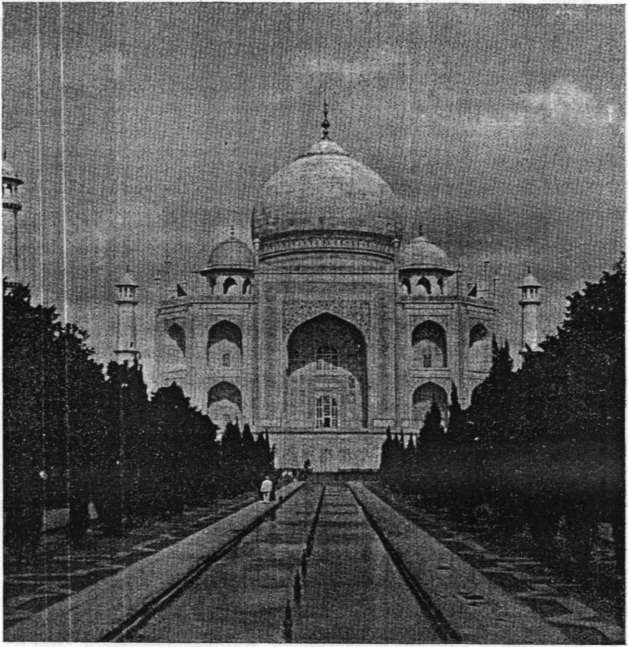
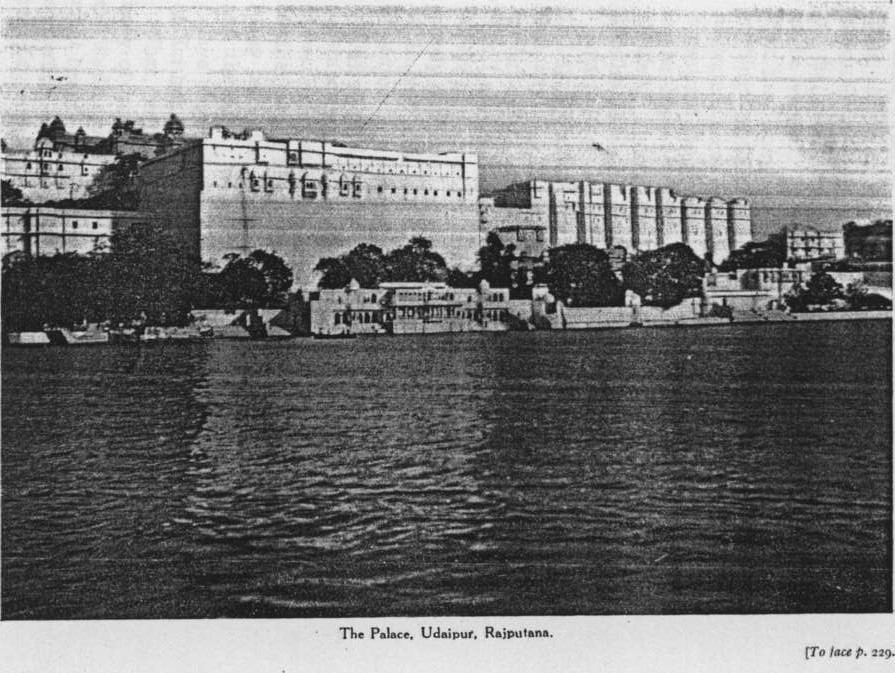
|
VIII
ART AND CULTURE
INDIAN art may be regarded in two aspects: as a reflection of the soul of the people in the past, and as one of the influences which must shape the soul of the future. In other words, it is at once a key to the national psychology and a factor in the problem of education.
The term " art " is here understood as covering all sesthetic activities: not only architecture, sculpture, painting and music, but all literature that is not primarily religious or philosophical. The Vedic hymns are ruled out, for two reasons. In the first place, though scholars assure us that they contain some great lyric poetry, they are primarily religious rather than aesthetic utterances. In the second place, the emotions they express cannot fairly be called those of Indians, but rather of an invading race not yet subdued to the climatic and ethnic influences which have made the Indian people as they emerge into the light of history. Even if we suppose all the hymns to have originated on Indian soil (and this is denied by good authorities) they remain the work of an external and as yet unamalgamated race.
I propose to speak first of Hindu (as distinct from Muham-madan) art; then of Hindu literature down to the coming of the Muhammadans ; then of the influence of Islam on the arts of India. Finally, I shall attempt an estimate of the evidence offered by Indian art as to the capacities and Umitations of Indian character. Hindu and Buddhist Sculpture.
European writers, in dealing with Indian art, have gone to wild extremes of depreciation and idealization. We have on the one hand Sir George Birdwood's dictum that " sculpture and painting are unknown as fine arts in India." In estimating the value of this pronouncement we must remember that Sir George Birdwood's definition of fine art, " the unfettered and impassioned realization of the ideals kindled within us by the things without us," would exclude a great deal of the most highly-esteemed religious art of Europe. But with whatever qualifications we read it, the statement remains excessive. India has certainly not been lacking in artistic talent, and abounds in very noteworthy works of art, which it is impossible to attribute entirely either to foreign influences or to the mechanical reproduction of fixed types. On the other hand, we have Mr. E. B. Havell as the chief spokesman of a group of critics who glorify Indian art as a supremely great expression of the spirit of man, equal, if not superior, to the art of any European people, ancient or modern, and owing little or nothing to influences from without. This opinion is in my view just as excessive as Sir George Birdwood's. It may be said, indeed, to follow with a certain plausibility from the initial definitions and assumptions of the Havell school of criticism. But these definitions and assumptions are rather hard to accept.
The apotheosis of Indian art is clearly allied to the general revolt against Renaissance ideals and conventions, which has given birth to Post-Impressionism, Futurism, and other kindred movements. But there is more in it than this. Its mainspring is not really aesthetic but theosophical. I do not mean that it proceeds specially from the body calling themselves Theosophists, but that it is based on religio-philosophic dogmas to which the term theosophy, in its widest sense, may fitly be applied. Whether its leading champions would acknowledge themselves Theosophists in the narrower sense of the word, I do not know.
Mr. E. B. Havell is a writer of wide knowledge and no small literary power. If whole-hearted, uncompromising conviction be a merit in advocacy, then Indian art is indeed fortunate in its champion. Let us turn to his Ideals of Indian Art* for a few characteristic utterances :
When we consider (he writes) the esoteric and exclusive character of early Aryan culture, we shall begin to realize that what seems to be an abnormally slow development in the technic arts in Indian civilization was deliberately willed as a part of the extraordinary precautions taken by the early Aryan immigrants in India, and their allies, to prevent what they believed to be their divinely-inspired wisdom being perverted by popular superstition. . . .
If the intellectual aristocracy of the Aryan tribes refrained from committing their thoughts of the Divinity to writing, and strictly observed the Mosaic law, " thou shalt not make to thyself any graven image, or likeness of anything which is in heaven or earth," it was certainly on account of the peculiar conditions in which they found themselves placed, and because they stood on a much higher spiritual plane than the races by which they were surrounded, not from any lack of artistic geniust * (p. 7).
Already in this Vedic period, centuries before Hellenic culture began to exert its influence upon Asia, India had conceived the whole philosophy of her art. . . . The Vedic period, though it produced no immediate development in what we are accustomed to call the fine arts, must nevertheless be regarded as an age of wonderful artistic richness (p. 9).
These passages afford a good example of the intensity
* London, John Murray, 191-1.
* A little further on, Mr. Havell tells us that " The devas themselves came down from heaven to- take part in the sacrificial feast," and that " the correct recitation of appropriate hymns" transported the soul of the sacrificer to the abode of the gods. Then he proceeds, " When they saw the devas themselves sitting at the feast, and when men could transport themselves at will to the abode of the Shining Ones, what need had they of gods of stone or wood ? " If this does not mean that Mr. Havell literally believes in these devas and their manifestations, what does it mean ? If he is speaking of hallucinations, he must know that the prevalence of hallucinations in other religions never prevented the production of images and pictures. of faith with which Mr. Havell contrives to turn everything to the advantage of the Indian genius, even extracting from the absence of all art at a given period a testimony to the wealth of its artistic endowment. I do not know what is the evidence for the abstention of the Vedic Aryans from making graven images or likenesses of anything in heaven or earth. One would suppose it probable that they might have exercised their graphic and plastic faculties upon perishable materials which had left no trace. At a later point (p. 18) Mr. Havell says, " Nearly all Indian sculpture previous to the Buddhist epoch was in wood or other impermanent materials." Given two periods, A and B, if it is admitted that in period B sculpture existed, but has perished, one does not see why it should be asserted that in period A no sculpture existed at all. Probabilities, however, must curtsey to evidence ; and it is possible that Mr. Havell may have evidence (to me unknown) for the artistic barrenness of the Vedic period.* It is when he finds in that barrenness a proof of consummate genius that reason falters and protests. He may be able to prove that the primitive Aryans would not if they could have made images or pictures ; but how can he possibly arrive at the knowledge that " they could an if they would " ? It is surely a masterpiece of paradox to assert that an age which produced no art " must nevertheless be regarded as an age of wonderful artistic richness."
The point is- of no importance except as a symptom of Mr. Havell's mental habit. He cannot endure that there should be any period, from the dawn of history until the blight of South Kensington fell upon the land, when India did not possess a marvellous genius for art. If, then, there
* From the mere non-existence of monnments or documents, nothing, surely, can be concluded. The Aryans were certainly surrounded by Dravidian and other tribes, who cannot possibly be supposed to have had any conscientious scruples about image-making. If, then, no sculpture at all has come down to us from the Vedic period, we can only conclude that the sculpture of the Dravidian peoples has perished—and why not that of the Aryans with it ? was a period in which she produced no art, it can only have been because, for good and sufficient reasons, she deliberately suppressed her genius. She had " conceived the whole philosophy of her art," though as yet no art existed within her bounds, at any rate within the limits of Aryavarta. It is very true that India has an unrivalled gift of aprior-ism ; but one can as well imagine a blind man conceiving the whole philosophy of light as an artless people conceiving a valid philosophy of art. Does not Mr. Havell really mean that already in the Vedic period the philosophy was more or less developed which was destined in after ages to influence Indian art ? That is a rational proposition ; but the value to art of a philosophy which knew not art is perhaps open to doubt.
Not, however, for Mr. Havell. Here is another group of extracts in which he definitely discloses the basis of his doctrine:
Indian art was conceived when that wonderful intuition flashed upon the Indian mind that the soul of man is eternal and one with the Supreme Soul, the Lord and Cause of all things. . . . The creative force generated from those great philosophical conceptions has not ceased to stimulate the whole art of Asia from that time to the present day (p. 6).
It was about the beginning of the Christian era that the great universities of Northern India, in which the many schools of philosophy were combined with schools of painting and sculpture . . . provided Asiatic art once and for ever with a philosophic basis, and created the Indian divine ideal in art (p. 22).
It was by Yoga, also—by spiritual insight or intuition—rather than by observation and analysis of physical form and facts, that the sculptor or the painter must attain to the highest power of artistic expression (p. 32).
Art thus becomes less the pursuit of beauty than an attempt to realize the life which is without and beyond by the life which is within us—life in all its fullness and mystery, which is, and was, and is to come (p. 40).
The West, surfeited with the materialism of the Renaissance, is already slowly turning again to the East for spiritual instruction (p. 41). . Is it not evident that we have here to deal primarily, not with artistic, but with the theologico-philosophical, or, more briefly, with theosophical, doctrine ? And is it not clear that Mr. Havell is setting forth to interpret art in the light of a principle which, carried to its logical issue, would destroy art, or reduce it to a purely conventional symbolism ? One can accept a figure with three heads and eight arms as a type of omniscience, or omnipotence, or creative energy, or, in short, anything that may be agreed upon; but why, in that case, seek to make out that it is beautiful in the ordinary, non-symbolic sense of the word ? Why praise it in terms of that very may a, that illusion, which, we are told, it is the business of art to dissipate and dispel ?
There are, I submit, two fundamental flaws in Mr. Havell's doctrine. In the first place, it assumes the positive, objective, one might almost say the historic truth of certain metaphysical tenets which are, in the nature of things, incapable of verification, and which, at best, belong to a region inaccessible to art, in any reasonable sense of the word. In the second place, it proceeds on principles which ought, if consistently applied, to place any savage Mumbo-Jumbo on a level with, or above, the so-called Zeus of Phidias ; since the Zeus is an attempt to subject the idea of godhead to the bonds of material illusion, while the Mumbo-Jumbo rises superior to illusion, and expresses in its quiddity, so to speak, the savage's conception of the power behind the veil. Of course Mr. Havell does not begin to apply his principles consistently. He seizes with avidity on any trace of naturalistic grace, beauty, realism, that he can find in Indian art. It is only when these qualities are hopelessly undiscoverable that he falls back on spiritual significance, on contempt for the outward shows of things, in order to justify monstrosity, mannerism and grotesque convention.
To illustrate what I mean by the acceptance of metaphysical concepts as though they were verified truths, I cannot do better than quote a quotation made by Mr. Havell, with unquestioning approval, from an essay by his kindred spirit. Dr. A. K. Coomaraswamy. It runs thus :
What, after all, is the secret of Indian greatness ? . . . The secret of the infinite superiority of intuition, the method of direct perception, over intellect . . . [Intuition] came to Sir Isaac Newton when he saw the apple fall and there flashed across his brain the law of gravity. It came to Buddha as he sat through the silent nights in meditation, and hour by hour all things became apparent to him.
Just consider the difference between the two phenomena so airily bracketed together ! We need not inquire whether the anecdote of the apple be authentic or not. No doubt there did come to Newton, whether in an orchard or elsewhere, a flash of insight in which he divined the universality of a law towards which he, and other physicists for centuries before him, had been feeling their way by dint of patient experiment, measurement, calculation, reflection. The precise magnitude of the advance made in that moment of insight, it must be left to specialists to estimate. Probably, if we could follow all the mental processes that led up to it, we should find that the leap was not a very great one. But supposing it to be—as it may have been—the greatest single achievement recorded of any human mind, can we possibly call it an effort of " intuition " as distinguished from " intellect " ? No, surely. It was the last step in a long intellectual process; and (mark this) it consisted in the formulation of a hypothesis to be experimentally verified or disproved. Verified it has been, a milhon-fold, and it is continually being verified in mechanical calculation and astronomical prediction. Those of us who are neither physicists nor astronomers have, indeed, to take it on trust; but to suppose it untrue is to suppose ourselves the victims of an utterly incredible conspiracy of fraud. Now compare this daily and hourly verified law with the " intuitions," not only of the Buddha, but of all the Indian sages put together. What characteristic have they in common ? In place of generalization based on a patient study of phenomena, we have a logical exercise resulting in a denial of the reality of phenomena, and then a fantastication at large as to the noumena conjectured to lie behind the world of illusion. It may be mentioned in passing that the fantasies of individual sages constantly contradict one another. For instance, the Buddha, cited by Dr. Coomaraswamyj would not have accepted the " wonderful intuition " which Mr. Havell regards as the root principle of Indian art, " that the soul of man is eternal and one with the Supreme Soul, the Lord and Cause of all things." But the contradictions are of minor moment. The one plain fact is that these Indian speculations are in the nature of things unverifiable, and would remain so even if they could be reduced to mutual consistency or unanimity. I am not denying the subtlety or the profundity of Indian metaphysics. I am not denying the historical importance of Indian thought. It was inevitable that the constitution of mind should be investigated as well as the constitution of matter ; and I am perfectly ready to admit that matter is only " a name for the unknown and hypothetical cause of states of our own consciousness." Granted certain definitions, there is no doubt that the universe must be admitted to be illusion—maya. So far we can all go along with Mr. Havell. It is when he assumes the positive, scientific validity of this or that attempt to penetrate the illusion and see behind the veil— when he places such attempts on an equal footing with a verified hypothesis like the law of gravitation—then it is that I, for my part, must regretfully part company with him. Such speculations may be extremely ingenious. They may even be incontrovertible conclusions from the stated premises. But they are all efforts to know the unknowable, and think about the unthinkable. To the soul that finds solace in them, who shall grudge it ? But when such a speculation is set up as a—or rather the—basic principle of art, one cannot but cry out. Nor is there anything in Mr. Havell's critical applications of this principle that tends to reconcile one to it. On the contrary, his very able treatises merely confirm one in the belief that the domain of art is precisely the phenomenal world, and that, if it can ever get at noumena at all, it will not be by distorting and denaturalizing phenomena. Nature may be (or, if you prefer it, must be) an illusion ; but it is an illusion kept up with such admirable consistency that we are all constrained to act as if it were real. In what else does sanity consist ? And ought not sanity to be the basis of art as well as of life ?
Before attempting a rational estimate of Indian art, as an index to the soul of the people, I thought it well to show clearly the anti-rational basis of the unqualified and unmeasured eulogies of the Indian genius which have lately been loud in the land. This done, I go on to state my personal impressions for what they are worth. They may possibly be coloured by the chance that I entered India from the south, and that Hindu art first confronted me in some of its most exaggerated forms, at Madura, Trichino-poly and Tanjore. But I have done my best to supplement my own observations by careful study of the lavishly illustrated works of Mr. Havell, Dr. Coomaraswamy, Mr. Vincent Smith and others ; and I can at all events say that I approached the whole subject without any prejudice.
On a broad general survey, and putting aside for the moment all question of individual exceptions, I do not see how it is possible to "argue away the palpable and glaring fact that Hindu (as distinct from Muhammadan) art habitually tends to extravagance and excess. It is the art of a swarming, pullulating people in a country where Nature itself scorns the very idea of moderation. Remember:— it is certainly not irrelevant—that India is the most tropical country that ever possessed any art of importance. China is another region of multitudinous humanity, but only a small portion of China falls within the torrid zone ; whereas half of India, and that not the hotter half, lies south of the tropic. India, then, is literally a hotbed of imagination, which fosters all sorts of over-luxuriant and monstrous growths. The fact that her philosophy has led her, not towards the study of Nature, but away from it, has helped her, no doubt, to throw off all salutary checks upon her fantasy ; but her philosophy (I suggest) is not so much the cause of her art as a concurrent effect of climatic influences. Only in a hot country is it possible for a human being to spend months, years, or even a life-time, in sitting cross-legged and contemplating his own navel. Only in a hot country could the opinion arise that this was the best way of ascertaining the truth as to the nature and constitution of the universe. Whatever may be the analogies between Buddha under the bo-tree and Newton under the apple-tree, it is quite certain that Newton did not " sit through the silent nights " under the apple-tree, else he would have taken his discovery with him to an untimely grave. Indian yoga and Indian art are alike products of the Indian climate, and though the one has no doubt influenced the other, it cannot be regarded as its inspiring principle. Taken in the mass, Indian art does not seek to express metaphysical intuitions, but is clearly of a piece with the highly material imaginings of popular religion and popular poetry.
One need go no farther than the main staircase of the British Museum in order to study a characteristic and in some ways admirable example of Indian art. The sculptures from the Buddhist stupa at Amaravati, Southern India, dating from about A.D. 200, were at one time reckoned " the culmination of the art of sculpture in India " (Fergusson) and still hold a high place in the esteem of the critics. Mr. Havell tells us truly that they offer " delightful studies of animal life, combined with extremely beautiful conventionalized ornament," and Mr. Vincent Smith, though he regards some of the work as " skilled craftsmanship rather than fine art," is of opinion that the sculptures as a whole "must have formed, when perfect, one of the most splendid exhibitions of artistic skill known in the history of the world." This is high praise, and I am not concerned to discount it. I will even own it possible to pick out scenes which more or less justify Mr. Havell's assertion that " the most varied and difficult movements of the human figure are drawn and modelled with great freedom and skill." It is precisely because of the merits of these sculptures, and because, being of Buddhist origin, they contain none of the monstrosities characteristic of Hindu art, that I direct the reader's attention to them.
Can any unprejudiced observer deny that even these exceptionally favourable' specimens of Indian workmanship are marred by the gravest defects of conventionality in form, of overcrowding in composition, of excess in ornament ? In a few seated female figures, viewed from behind, there is a certain natural grace, but most of the women who swarm, all over the reliefs are the product of a morbid convention which gives them enormous breasts, wasp waists, and atrophied legs,* and places them in attitudes suggestive of a violent dislocation of the hip-joint. Whether such figures were actually cultivated at the period, I do not know; but even if this could be proved, the sculptures could only be regarded as conventional exaggerations of an unhealthy fashion. As to composition, the word is really out of place in this context. A certain ingenuity is shown in crowding the utmost possible number of figures into a given space ; but of order, proportion, gradation, guidance and relief for the eye, it is hard to find a trace. In this respect, the sculptures would rank in Europe as interesting efforts of a primitive school, struggling towards accomplishment, but only at the beginning of the struggle. As to excess
* "The exaggerated thinness of the legs," says Mr. Havell, "was probably less marked when the sculptures had their finishing coat of fine plaster ; " but any even coating of plaster would leave unaffected the truly hideous disproportion of legs and thighs. in ornament, it may be asked how that can be affirmed when we possess only disjointed fragments of the whole work and cannot replace them in position. It happens, however, that among the remains there are several slabs representing the great stupa itself, and from these we can see that it was simply crawling with ornament—there is no other word for it. Perhaps it may be said that we have no right to transfer to the East the Western ideal of temperance in decoration ; but Indian profusion did not, it would seem, arise from any aesthetic principle, but from the religious notion that the more labour was expended on a pious work, the more merit was acquired.* Artistic excellence, may, indeed, be achieved in work inspired by this idea; but an aesthetic defect cannot be converted into an aesthetic merit by the fact of its being so inspired.
In order to estimate the Amaravati sculptures at their true value, we need only turn over a few pages of Mr. Havell's Indian Sculpture and Painting, and examine his admirable photographs of portions of the two miles of Buddhist reliefs on the vast pyramidal stupa at Boro-Budur in Java. This building, which dates from about the ninth century of our era, is styled by Mr. Havell " the Parthenon of Asia," and is certainly not unworthy of the name. The odd thing is that he should apparently fail to realize the gulf that separates Boro-Budur not only from Amaravati, but from Ellora, Elephanta, Vijayanagar, and all the other famous sculpture-sites of continental India. Judging entirely from photographs, one is tempted to place the Boro-Budur sculptures among the loveliest things in the world. They are crowded, yet not overcrowded, with figures of exquisite grace, in attitudes of great expressiveness, yet devoid of violence. They are perfect examples of the art of composition as applied to long orelief. I concur with every word that Mr. Havell
* For the same reason, according to Mr. Havell, sculpture was more cultivated than painting. Ideals of Indian Art, p. 133. says in praise of them; it is only when he places them without hesitation or reservation to the credit of India, that I protest. Their themes are certainly Indiana-scenes from the life of Buddha, and from Buddhist romances and jatahas or birth-stories. Some part of their technical method is, no doubt, Indian as well. But their physical types are quite un-Indian, and their suave and gracious humanity has nothing Indian about it—is, indeed, particularly devoid of those very qualities which Mr. Havell - declares to be the supreme glory of Indian art. Certainly, these Javanese sculptors—for in the absence of evidence to the contrary, we may assume them to have been Javanese—sought no inspiration in yoga, and dreamt not of dissipating maya in order to disclose the realities which eye hath not seen and ear hath not heard. They were perfectly satisfied with what the eye sees in the phenomenal world. They loved it, studied it, and reproduced it with a rare combination of dramatic instinct and decorative tact. Devout they may have been: indeed, there is no reason to doubt it: but they were artists first and devotees second. " Nobody with the least experience," says Mr. Vincent Smith, " could mistake a Javanese relief for one executed in India. But when we compare the Boro-Budur sculptures with the seventh-century relief at Mamallapuram, or the sixth-century friezes at Badami, the difference almost amounts to that between fine art and barbarism."
Before we leave the subject of Buddhist art, it may be well to say a few words as to the numerous figures of the Buddha himself for which the Orientalizers are full of admiration. Most people are familiar with the type —a short, round, smooth face, with eyelids drooped, eyes either closed or reduced to narrow slits, full lips, huge ears, head covered with conventional snail-shell curls, broad smooth shoulders and chest, narrow waist, legs crossed, in the traditional attitude of the squatting yogi, and hands disposed in one or another posture of con- ventional symbolism. Of the philosophy of this figure,* Mr. Havell gives the following accountf *:-—
When the Indian artist models a representation of the Deity with an attenuated waist and abdomen, and suppresses all the smaller anatomical details, so as to obtain an extreme simplicity of contour, the European draws a mental comparison with the ideas of Phidias and Michelangelo and declares that the Indian is sadly ignorant of anatomy and incapable of imitating the higher forms of Nature. But the Indian artist, in the best period of Indian sculpture and painting, was no more ignorant of anatomy than Phidias or Praxiteles. He would create a higher and more subtle type than a Grecian athlete or a Roman senator, and suggest that spiritual beauty which, according to his philosophy, can only by reached by the surrender of worldly attachments and the suppression of worldly desires. ...
Indian artists purposely suppressed the details of the physical body with the intention of suggesting the inner Self purified and exalted by communion with the Universal Soul. . . .
Amongst the thirty-two principal lakshanas, or marks of divinity, attributed to the person of Buddha—such as short, curly hair, long arms, a mark of noble birth, and golden-coloured skin—there is a very significant one : " the upper part of the body {i.e., the trunk) is like that of a lion." Let us try to realize the precise meaning of this symbolism. The most prominent characteristics of the body of the Indian lion [are] the broad deep shoulders and the narrow contracted abdomen. . . . Now Buddha, as we know, attained to his Buddahood at the close of a long fast, and, according to the canons of European art, he should have been represented in a state of extreme emaciation. The Gandharan sculptorst* did, indeed, occasionally represent Buddha thus. But the Indian sculptors never descended to such vulgarity. . . . They gave him a new, spiritualized body—broad-shouldered, deep-chested, golden-coloured, smooth-skinned, supple and lithe as a young lion.
There is no doubt that the broad shoulders and slim waist of the typical Indian heroic figure are due to the
* With slight modifications, the figure serves not only for the Buddha, but for Bodhisattvas, or saints on the verge of Buddahood, for Jain Tirthankaras, and often for Hindu gods.
* Indian Sculpture and Painting, pp. 25, 36, 39.
* Contaminated, be it observed, by Hellenic influences fact that the ideal of strength was based on the proportions of the lion or the tiger. Such an ideal is very naturally formed by a people in a state of semi-savagery, and adherence to it might not unfairly be interpreted as showing that the semi-savage state was not far outgrown. At all events, one does not see how it can be alleged as a proof of superiority to, or even equality with, races whose ideal of heroic manhood is based, not on theriolatry, but on a generalization from the highest human types. Is a people to be applauded for going to the jungle for its ideals, instead of seeking them in the gymnasium and the council-hall ?
As for the attribution to Buddha of " a new spiritualized body . . . supple and lithe as a young lion," we need scarcely inquire into the appropriateness of the symbolism, for it is more than doubtful whether the effect which Mr. Havell declares to be aimed at is actually attained. Has anyone, looking without preconceived theory at the cross-legged Buddha figures, ever dreamt of seeing in them the suppleness and litheness of the young lion ? Is there any plausible reason for crediting the sculptors with this intention ? Is it not clear that the idea they sought to express was that of contemplative immobility, and that nothing was further from their minds than suppleness and litheness ? They adhered to the accepted type of manhood because they had no particular reason for adopting any other ; but they did not dream of expressing qualities superfluous, and even incongruous, in the yogi. As for the avoidance of emaciation, what reason is there to suppose that they intended to represent the Buddha at the moment of emerging from his fast and attaining enlightenment ? Asceticism was no part of his ideal ; it was a phase of spiritual experience which he is represented as having lived through and put behind him. Assuming his story to be historical, we cannot doubt that, after his long Ordeal was over, he recovered his normal physical condition ; and it is in that condition, as con- ceived under the accepted canons of their craft, that the sculptors, quite naturally, chose to represent him. To seek a deep spiritual meaning in their abstention from exhibiting him as a living skeleton is to " chercher midi a quatorze heures."
It is, of course, impossible to disprove Mr. Havell's assertion that the artists who so carefully concealed their knowledge of anatomy were, in fact, as skilled in it as Phidias and Praxiteles. All that can be said is that he does not produce his evidence. And one thing is surely undeniable : namely, that when once a type was established in which all anatomical detail was suppressed, and a single hieratic pose was maintained with inconsiderable variations, it became very easy to multiply that type indefinitely, with comparatively little technical skill, and no spark of spiritual inspiration, or even understanding. This thought constantly occurs to us, not with reference to the Buddha alone, in reading Mr. Havell's impassioned eulogies of Indian art : even supposing he is right in maintaining that such-and-such types express such-and-such metaphysical and spiritual ideas, can we doubt that many of the works he so ardently admires are mere soulless reproductions, the work of clever craftsmen, wholly innocent of any desire to get behind the phenomenal world and " realize the life which is without and beyond" ? He reproduces with unwearying praise about a score of divine figures (Buddhist and Hindu) from Thibet, Nepaul, Ceylon, Java, and India proper, of dates extending over something like a thousand years : can he mean that all these carvers and hammerers, deliberately and with conscious artistic-philosophic purpose, suppressed a knowledge of anatomy equal to that of Phidias ?
Finally, and corning back to the Buddha-figures in particular, what are we to say of the marvellous spirituality of expression often attributed to them ? It is to me, I own, far from apparent. The drooped eyelids and the immobile pose do, indeed, express the idea of contemplation ; but I am at a loss to find anything spiritual in the smooth, insipid faces. In some of the Gandharan Buddhas (found in the North-West Frontier Province) there is a certain nobility of expression ; but to these Hellenistic products Mr. Havell will have nothing to say. My own preference for them will, doubtless, be set down to mere European prejudice; and I frankly confess that I see more spirituality in (for example) the ideal head of Homer, seamed by suffering and furrowed by thought, than in the whole pantheon of Buddhist-Hindu sculpture. But my preference is not founded on any general prejudice in favour of the Western as compared with the Eastern type. India to-day abounds in living men whose noble spirituality of aspect puts all the carven gods to shame. Is there a single Buddha, from Peshawar to Kamakura, that can compare in spirituality with Rabindranath Tagore ?*
Hindu, as distinct from Buddhist, sculpture carries to excess all the faults which we have noted in the Amaravati reliefs, and adds to them the undesirable characteristic of constantly dealing in grotesque monstrosities. The North, indeed, is not so extravagant as the South in its abuse of the human form. No doubt the Muhammadans have destroyed more images in the regions they have more completely mastered. No doubt, too, their influence
* I am told that in this paragraph I mistake the meaning of the " spirituality " attributed to the Buddha figures. We are not, it would seem, to look for any record or suggestion of materiality mortified and spiritual experience diligently ensued and attained. The spirituality asserted resides rather in the artist than in his work. A figure is spiritual which seems to express sincere devotion in its maker, and to have been created in an atmosphere of faith. Perhaps so ; but is it not the case that sincere devotion, working in an atmosphere of faith, has often produced execrable and most unspiritual art ? Moreover, qualities are often claimed for Indian sculpture which must reside in the object, and not in any inference to be drawn as to the artist's soul-state. To cite one example among hundreds, Mr. Havell says of a stone figure of the Buddhist Goddess of Wisdom ;. " Her face has that ineffable expression of heavenly grace which Giovanni Bellini, above all other Italian masters, gave to his Madonnas." Indian Sculpture and Painting, p. 51. has tended to beget a certain artistic moderation, and we may, if we please, assume that there is more innate good taste in Aryavarta than in the Dravidian peninsula. But, speaking generally, the impression one carries away from the temples of India is one of oppressive confusion of ornament (often beautiful in itself) and insensate reduplication of the (more or less) human figure, almost always in attitudes of violent contortion. I have already spoken of the thousands upon thousands of figures crowded upon the gopuras, or gate-towers, and plastered over the walls, of the mighty temples of the South. I do not think I am exaggerating when I say that not one of these myriad figures is in an unconstrained attitude ; and most of them are twisted into poses that would baffle a Russian ballet-dancer. The whole effect is that of a demon army, battalion on battalion, suddenly petrified in the midst of a furious war-dance. Within the temples, it is just the same— colossal, contorted forms, looming menacingly through the gloom—everywhere a riot of violent, often sensual, imagery, nowhere one touch of nature or one point of rest. Yes, there is one: the pot-bellied, elephant-headed Ganesh is usually quite placidly enthroned. Monster though he be, this Silenus or Falstaff of Hinduism is far less inhuman than the major gods.
What, now, is Mr. Havell account of all this ? He tells us, in the first place, that the Indians of old had " a deep-rooted objection to anthropomorphic representations of the Divine," and that " the substitution of a plain stone emblem for a statue as the principal object of worship for most of the followers of Siva in the present day is probably an instance of this feeling." Then he argues in a footnote that the " plain stone emblem" was " not originally phallic "—a point which seems rather unimportant, since it is now admittedly understood as phallic, and has been from time immemorial. Be this as it may, Mr. Havell has to admit that Hinduism, as a whole, has rather successfully got over its objection to anthropomorphic representations of the Divine, though he still maintains that the " West is more idolatrous than the East," inasmuch as it " often regards the realization of form as the end of art."* The Indian artist, on the other hand, " attempted to differentiate the spiritual type from the human by endowing the former with superhuman attributes, quite regardless of physiological probabilities or possibilities. Indian art has never produced a Phidias or Praxiteles, not because an Olympian Zeus or an Aphrodite of Cnidus was beyond its intellectual grasp, but because it deliberately chose an imaginative rather than an intellectual ideal. ... A figure with three heads and four, six or eight arms seems to a European a barbaric conception, though it is not less (sic) physiologically impossible than the wings growing from the human scapula in European representations of angels. . . . All art is suggestion and convention, and if Indian artists, by their conventions, can suggest divine attributes to Indian people with Indian culture, they have fulfilled the purpose of their art." *
Again one can only reply that this process of reasoning would place any African or Polynesian Mumbo-Jumbo on a level with the Apollo of Phidias or the Moses of Michelangelo. It is true, of course, that many-headed, many-armed gods are not more impossible than angels. Mr. Havell might even have argued that they are less impossible : for we do hear of Two-headed Nightingales and Siamese Twins, and still more abhorrent abortions are known to physiologists ; whereas I am not aware that any child has yet been born with even the rudiments of wings. But there is something graceful and ethereal in the conception of a being, otherwise human, but endowed with the glorious privilege of flight. Men have always, and very naturally, sighed for the wings of a dove, and envied the circling sea-gull and the soaring hawk. We constantly fly in our dreams, and we feel the omission of Nature to add pinions to our outfit
* Ideals of Indian Art, p. 171.
* Indian" Sculpture and Painting, pp. 56-60. a very regrettable oversight, which we are now doing our best to remedy. There is nothing grotesque or degrading in man's instinctive desire to assert his kinship with his wonderful cousins, the birds. But no one ever desired three or four heads; and six or eight arms would assert our kinship, not with the bird, but with the octopus. The natural, unsophisticated mind of the child loves the idea of flying, and delights in the thought of angels, fairies and beneficent genies ; from many-headed, many-armed ogres, it shrinks in dread, and it sympathizes with the heroic giant-killers who go forth to slay them. Let it not be said that these are conventions of the European nursery. The monster gods of India are originally ogres, just as much as Giant Blunderbore or Giant Cormoran. They are the figures in which cowering savages embodied their conception of the destructive powers of Nature. They have no doubt been adopted into an originally higher religion, and they have to a certain extent been used as symbols of more or less advanced conceptions of deity. But their primitive associations cling to them, and they are almost always employed to typify the destructive and terrible aspect of supernatural power. It is Siva the Destroyer, it is the grisly goddess Durga or Kali, who is characteristically represented with six arms and a necklace of skulls, in a ravening attitude like that of a barnstorming player of the good old days, tearing a passion to tatters.* Sophisticate them as you please, the monster-gods of India are survivals from a low stage of spiritual development, and it is ridiculous to suggest that their infinite reduplication
* The attitudes of gods and heroes in Indian sculpture constantly remind one of the " penny plain, twopence coloured " prints of posturing actors which were so popular in England a hundred years ago. This resemblance suggests the possibility that Indian sculptors may have drawn their inspiration from performers in early miracle-plays. Horrwitr (The Indian Theatre, p. 23} tells us that the oldest Indian dramas, or rather colloquies (sanvadas), were, in fact, mysteries in which " either Krishna or Siva acted or danced the principal part." The attitudes so familiar in sculpture may very well have been those cultivated by a school of miracle-players, half dancers, half acrobats. throughout the country is " an attempt to realize the life which is without and beyond by the life which is within us."
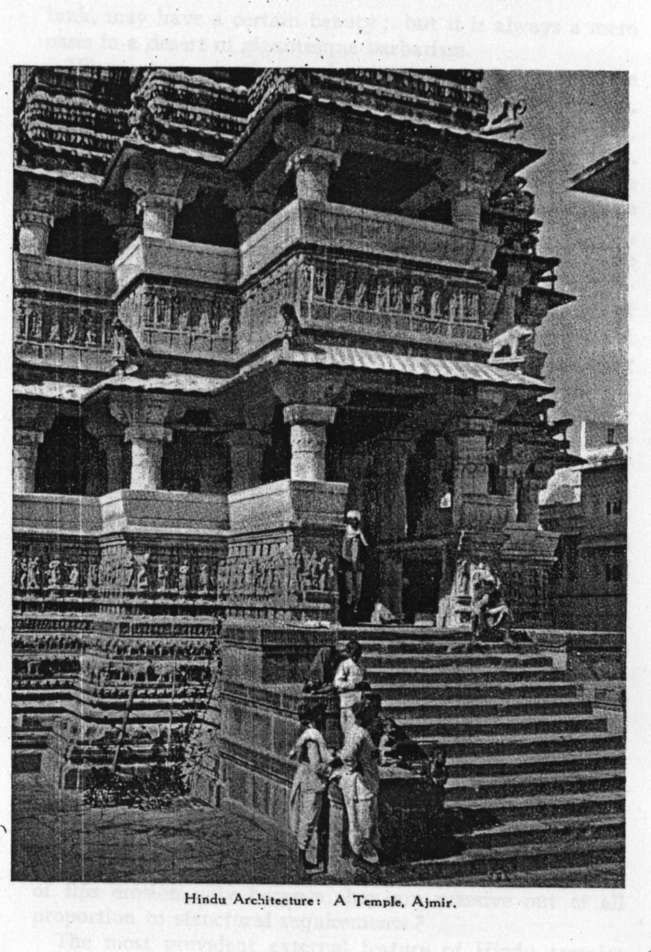
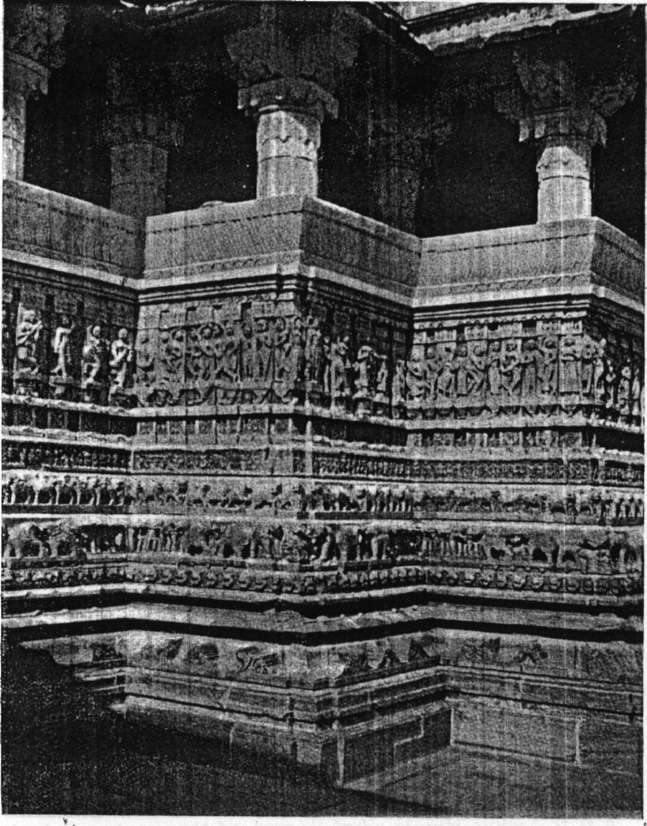
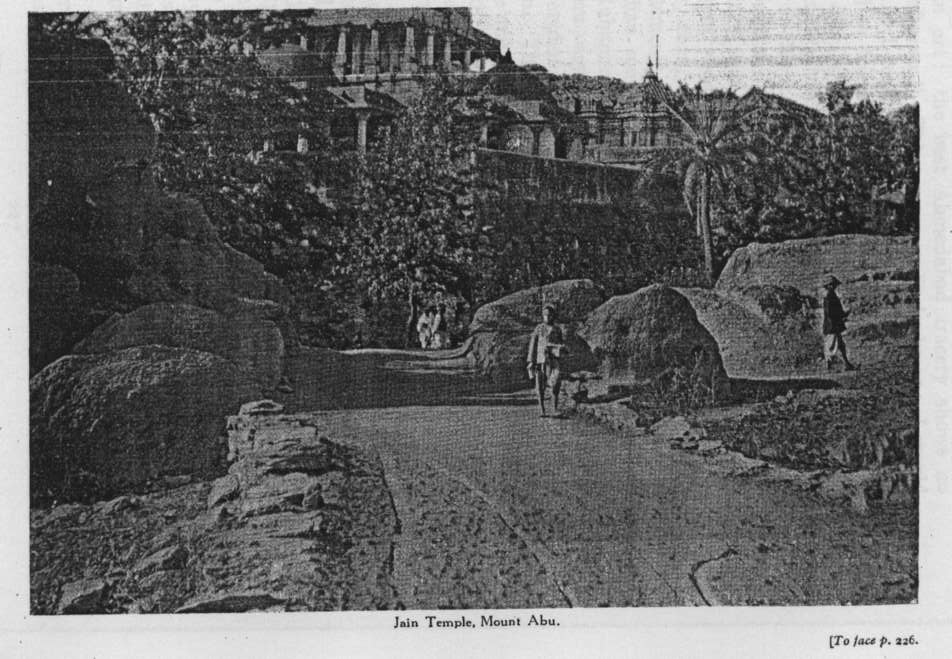
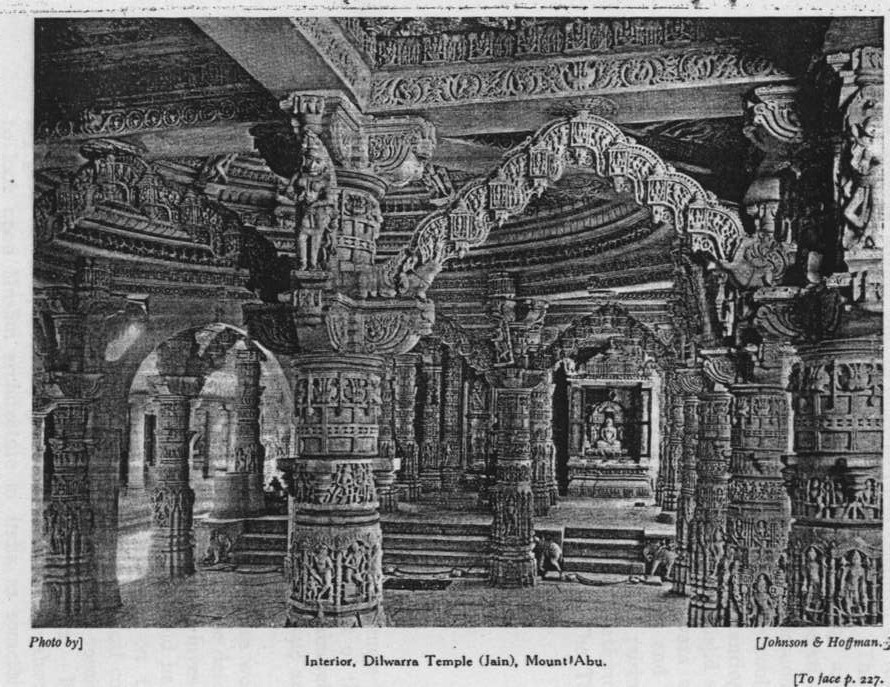
" It was inevitable," Mr. Havell admits, " that Hinduism, comprising as it does so many diverse states of civilization and of intellectual development, should embrace many artistic monstrosities, the wild imaginings of primitive races, and the crude vulgarities of the uncultured. But it will never be difficult to distinguish the barbaric elements of an undeveloped state of culture from the higher ideals of Indian aesthetic philosophy." And again: "It need hardly be stated that the Indian process of artistic thought has often produced many degenerate and revolting types, just as the European process has produced a vast amount of inane and intolerable rubbish." Intentionally or not, Mr. Havell here points to a distinction which I entirely accept. Much of the art of Europe is " inane and intolerable rubbish," but it is not " degenerate and revolting "—at any rate, not in anything like the same degree as an immense amount of Indian art. I am far from denying the technical merit of a great deal of Hindu sculpture. The treatment of animals, whether on a great scale or as motives in decoration, is often superb. There is no temptation to distort and denaturalize the elephant, the bull and the antelope. Such decorative work as that in the Hoysales-vara Temple at Halebid is entirely admirable in quality, if only it were more moderate in quantity. Everywhere, indeed, there is an astounding wealth of beautiful decoration, such as could be produced only by exuberant fancy in a country where time had no existence. The Jain Temples of Mount Abu, for example, are decorated with a profusion absolutely incredible to anyone who has not seen them. Sometimes, too, there is extraordinary power and subtlety in the treatment even of monstrosities. The famous statuette of the dancing " Siva as Natesa,"* for instance, is a really wonderful piece of work, especially remarkable
* This is a frequently repeated motive. The best example known to me is that in the Madras Museum, reproduced by Mr. Havell. for the skill with which the arms are so disposed that one scarcely notices their superabundance. All over the country one may find, here and there, admirable pieces of work, both early and late, in which naturalism wins a momentary victory over extravagant and unwholesome convention. But when Mr. Havell declares that it is " never difficult to distinguish the barbaric elements of an undeveloped state of culture from the higher ideals of Indian aesthetic philosophy," he seems to me to be asserting what his own works disprove. As soon as a piece of sculpture, however monstrous, however barbaric, has a certain technical quality, Mr. Havell declares it to be inspired by the higher ideals of Indian philosophy, and imagines into it all sorts of spiritual significance. Perhaps his greatest achievement in this way is his rhapsody over an alto-rilievo of " Durga slaying Mahisha " now in the Leyden Museum. To the unilluminate eye, it seems like a thick-set, thick-lipped woman with six arms, straddling ungracefully from head to tail of a recumbent and apparently sleeping bull, and resting one of her half-dozen hands on the curly head of an enormously fat boy. To Mr. Havell,* on the contrary, it appears that in this work " Hindu sculpture has produced a masterpiece. . . . Judged by any standard it is a wonderful work of art, grandly composed, splendidly thorough in technique, expressing with extraordinary power and concentrated passion the wrath and might of the Supreme Beneficence roused to warfare with the Spirit of Evil. The student will find in this phase of Indian imaginative art an intensity of feeling—a wonderful suggestion of elemental passion transcending all the feeble emotions of humanity —a revelation of the powers of the Unseen, which nothing in European art has ever approached, unless it be in the creations of Michelangelo or in the music of Wagner."
It says much for the intensity of Mr. Havell's conviction that he should actually accompany this hymn of praise with a photograph of the masterpiece which called it forth,
* Indian Sculpture and Painting, p. 62, Hindu Epic and Drama.
Never, perhaps, have two forms of art more completely reflected and interpreted each other than Hindu sculpture and the Hindu epics. In saying so I am not thinking of the actual scenes from the two great poems, especially from the Ramayana, which not infrequently occur in reliefs and decorations. If these were entirely absent, it would remain none the less true that in reading the epics we seem to see the overstrained, over-elaborated, over-crowded sculptures, and in viewing the sculptures we seem to hear the vast, labyrinthine, multitudinous epics.
The author of Siri Ram, who has evidently studied Indian character at close quarters, says: " There is a popular fallacy that the Indian is imaginative. Nothing is further from the truth. . . . Imagination means much the same to him as multiplication. It is a kind of magnifying-glass through which he sees a swollen universe. The imaginative man is the man who thinks in crores and hecatombs and holocausts, in Kalpas of time and vast compartments of space. The light play of fancy does not touch him." This is, I conceive, a far too sweeping statement, probably founded on observation of a mediocre type of Indian mind. It would be easy to deny imagination to the European, if one judged (say) by the average British schoolboy. But it is probably true—and this is perhaps what the writer really means—that the Indian imagination suffers from habitual and ancestral over-fatigue. The poet and the artist have, from of old, striven to live " au-dela des forces humaines." In a country where everything is exaggerated —the height of the mountains, the width of the plains, the volume of the rivers, rainfall and drought, fertility and aridity, the luxuriance of the jungle, the size and strength of animals, the fecundity and venomousness of reptiles and insects, the splendour of the stars at night, and above all the fierce prepotency of the sun by day—in such a 200 country it was perhaps inevitable that man should overstrain his powers in the attempt to body forth his conceptions of might, majesty and multitude. At all events, that is what has happened. In the Indian epics, the poets are always trying to outdo themselves and each other in their search for the marvellous, whether in virtue, prowess, gorgeousness, wickedness, demoniacal fury, or mere numerical extravagance. They are constantly creating records in exaggeration, which are as constantly broken. What wonder that a people habituated from childhood to these orgies of unbridled fancy should suffer from a certain slackening of imaginative fibre, an insensitiveness to normal and wholesome stimulation ? It is that insensitiveness which seems to me to account for all that is worst in Indian art. It is that insensitiveness which will have to be corrected before India can hope to make the best of her intellectual gifts in a world in which, though all may be illusory, the God-made illusion of Nature must in the end prevail over the man-made illusions of mythology and metaphysics.
The Indian epics and Indian sculpture are, of course, co-ordinate products of the Indian mind, and must not be placed in any direct relation of cause and effect. But as the matter of the epics, at any rate (if not their extant form); is much older than most of the sculpture that has come down to us, we can fairly say that art has been influenced by literature rather than literature by art. And to this day, by all accounts, the epics continue to re-act potently on the Indian mind, and to keep it stagnant in the phase of development to which they themselves belong. It is hard to see how this can be looked upon otherwise than as a grave misfortune. Even if we could assume that the Greek and the Indian epics stood fairly on a level in point of intellectual and ethical value, would it be to the advantage of Europe if the Iliad and the Odyssey were held to be sacred revelations, were the exclusive, or at any rate by far the most desirable, mental and moral sustenance of the great majority of the people, and were regarded with a bibliolatrous rever ence, more extravagant than any that has ever been paid to the Hebrew Bible.* Would the European character be strengthened and ennobled if it were currently believed that salvation was to be attained by the mechanical repetition of the name of (say) Achilles or Ulysses ? And the assumption of equality on which this comparison proceeds is really a preposterous one. The Greek epics would make ten times better Bibles than the huge accumulations of sacer-dotalized folk-lore from which the Indian populace derive their notions of the heroic and the divine. " Although priests are occasionally mentioned in the Iliad and the Odyssey," says Sir M. Monier-Williams, " there is wholly wanting in the Homeric poems any recognition of a regular hierarchy or the necessity for a mediatorial caste of sacri-fieers. This, which may be called the sacerdotal element of the Indian epics, is more or less woven into their very tissue. Priestcraft has been at work in these poems almost as much as the imagination of the poet ; and Brahminism, claiming a monopoly of all knowledge, human and divine, has appropriated this, as it has every other department of literature, and warped it to its own purposes. Its policy being to check the development of intellect, and keep the inferior castes in perpetual childhood, it encouraged an appetite for exaggeration more monstrous and absurd than would be tolerated in the most extravagant European fairytale." In all religions there is too much of the fairy-tale element, but it surely cannot be to the advantage of a country that its popular religion and literature should consist of extravagant fairy-tales and little else. The beauties of diction, of description, of episodic narrative, in the Indian epics are acknowledged by good judges to be very great. I have no means of knowing how far
* " Some idea of the veneration in which it (the Ramayana) is held may be formed from the verses at the end of the introductory chapter, which declare that he who reads and repeats this holy life-giving Ramayana is liberated from all his sins and exalted with all his posterity to the highest heaven.' "* Monier-Williams, Indian Epic Poetry, p. 16. the literary qualities of the original Sanskrit, or even of the Hindi transcript of the Ramayana by Tulsi Das, are reproduced in the versions of the village reciters, to whom the mass of the Indian people owes its knowledge of the epic literature. But, however skilful, however tasteful, may be their renderings, we cannot doubt that it is upon the story— the spectacular, the sensational, the passionate scenes and incidents—that the popular mind most eagerly fastens. Can we, then, regard these scenes and incidents as wholesome mental sustenance for a people which has to live and hold its own in the world of to-day and to-morrow ? Let us look a little into this question.
What are the ideals, or rather, the general ideas, which disengage themselves from these poems ? First, as Sir M. Monier-Williams points out, the peculiar sanotity and the insatiable appetite of the Brahmin caste is dwelt on at every turn. Such passages as these are of ludicrously frequent recurrence :
Kripa guarded wealth and treasure, gold and gems of untold price. And with presents unto Brahmins sanctified the sacrifice.
Hungry men were fed and feasted with an ample feast of rice. Costly gifts to holy Brahmins graced the noble sacrifice. Ida, ajya, hotna offerings pleased the " Shining Ones " on high, Brahmins, pleased with costly presents, with their blessings filled the sky.
" Not so answered him the princess, " Other boon I may not seek. Thou art bounteous, and a woman should be modest, wise and meek. Twice I asked and twice you granted, and a Kshatra asks no more— Unto Brahmins it is given asking favours evermore."*
If ever there was a priesthood naively intent on the loaves and fishes, it is the Brahmins, as represented in these epics. But the glory and grandeur of Brahminhood is nowhere so emphatically announced as in the episode of Visvamitra (Ramayana, Book L, Cantos 52-65). This Kshattrya prince had a contest with the Brahmin Vasishtha for the possession of " the cow of plenty," and was beaten by
* R. C. Dutt's extracts from the Mahabharata.
" the superior power inherent in Brahminism." Therefore, he determined to raise himself to that dignity, and accordingly subjected himself to extreme austerities for thousands of years. " The gods," says Sir M. Monier-Williams, " who had a hard struggle to hold their own against over-zealous ascetics, did what they could to interrupt him, and partially succeeded. Visvamitra yielded for a time to the seductions of the nymph Menaka. . . . However, in the end, the obstinate old ascetic was too much for the whole troop of deities. He obtained complete power over his passions, and when the gods still refused to Brahminize him, he began creating new heavens and new gods, and had already manufactured a few stars when the celestial host thought it prudent to give in and make him a Brahmin." This legend shows Brahminism to be at once the summit of earthly ambition, and a summit unattainable to anyone not born in it, unless he be strong enough to conquer the gods themselves.
In the story of Visvamitra, too, we come upon the second of the general ideas which pervade the epics—to wit, the sanctity, nobility and magical efficacy of asceticism. This idea speaks, not to say shrieks, from every page. " The performance of penitences was like making deposits in the bank of heaven. By degrees an enormous credit was accumulated, which enabled the depositor to draw to the amount of his savings, without fear of his drafts being refused payment. The power gained in this manner by weak mortals was so enormous that gods as well as men were equally at the mercy of these all but omnipotent ascetics." No serious attempt is made to read ethical value into asceticism; it is practically admitted to be a method of pure magic. This is apparent in the fact that even rakshasas, or demons, can accumulate power by self-torture. The theme of the Ramayana, indeed, is nothing but the outwitting of a demon, Ravan, who had by this means rendered himself inconveniently formidable. He had extorted from the god Brahma the assurance that neither gods, genii, demons nor giants should be able to vanquish him. But he had disdained to stipulate for invulnerability at the hands of men ; wherefore Vishnu, ever ready for a new avatar, consented to be born as four men, the reputed sons of King Dasaratha. One half of him became Rama, one fourth Bharata ; and it needs no great skill in vulgar fractions to conjecture that the other two, Lakshman and Satrugna, each represented one-eighth of the godhead. Nevertheless, they were men within the meaning of the Brahma-Ravan compact, and were therefore able, after a gigantic struggle, to vanquish and slay the demon ascetic. This is by no means the most grotesque example of the part played by asceticism in the machinery of the epics. Ascetics are, indeed, (paradoxical as it may seem) the actual fathers of most of the leading figures of the Mahabharata ; and the generation-stories,* of these renowned personages, of Vyasa, Dritarashtra, Pandu, and Vidura, of Yudishthira, Bhima, Arjuna, Nakula, Sahadeva, and Duryodhana, are surely among the most nauseous known to folklore. It is a characteristic of legendary asceticism that it renders its votaries insanely short-tempered and vindictive. Incalculable is the trouble wrought by the maledictions of irascible rishis. In short, it is not easy to think of a more unwholesome doctrine than that of the virtues of self-torture, as presented to the Indian mind in the epics.
Be it noted, however, that asceticism is a jealously-guarded privilege of the twice-born castes. The son of a Brahmin having died at the age of fourteen, it was pointed out to Rama that such a portent showed that there must be some terrible sin in progress in the world. " He found no sin in the west, or in the north, and the east was crystal clear." But in the south, beside a sacred pool, a yogi was standing on his head and " practising the most severe disciplines." Rama asked him to what caste he belonged,
* In the recently-published Myths of the Hindus and Buddhists (London, Harrap, 1913). the birth-stories of the Mahabharata are passed over in discreet silence. This part of the work is by Sister Nivedita. and on learning that he was a Sudra, promptly cut off his head; whereupon " the gods rained down flowers and praised the deed." The cold-blooded arrogance which inspired this legend is outdone in the story of Ekalavya, in the Mahabharata. Ekalavya was " a low-caste prince of non-Aryan birth " who aspired to be taught archery by Drona, the trainer of the Pandu princes. Rejected on account of his low birth, he retired to the forest and made a clay image of Drona, to which he paid such strenuous and ascetic devotion that he became an accomplished marksman. A dog belonging to Drona came upon the devotee, and was so alarmed by his hideous appearance that he began to bark. "Before he could close his mouth, the prince Ekalavya had shot into it no fewer than seven arrows, aiming by sound alone." This achievement attracted attention to Ekalavya, who, being interrogated, proclaimed himself a pupil of Drona. Thereupon that hero sought him out and said, " If thou art really my pupil, give me, then, the teacher's fee. Give me the thumb of thy right hand." The low-born prince, without flinching, cut off his thumb and laid it at Drona's feet. " But when the Brahmin had gone, and he turned again to his archery, he found that his marvellous lightness of hand was for ever vanished. Thus were the royal princes left without rivals in the use of arms."
A more odious anecdote it would be hard to find in any of the Sacred Books of the world. It passes, however, without a word of protest. If David had been a Kshattrya prince, the Brahmin Nathan would have smiled upon his treatment of the Sudra Uriah, and very probably the gods would have rained down flowers.
A third general idea running through the epics, is that heroism consists in having the stronger medicine-man on your side. Especially must you be amply provided with magical weapons, like the arrow of Rama which pierced the stems of seven palm trees, penetrated a hill that stood behind them, then sped through six hells and finally returned to the hero's quiver. Similar ideas, on a less extravagant scale, are no doubt prevalent in the ballad poetry of all primitive peoples. Everywhere we hear of cloaks of darkness, blades graven with magic runes, immersion in waters of invulnerability, and so forth. But only in India do these relics and evidences of savagery pervade from end to end the sacred writings of the race. Only in India is magic the very essence both of law and gospel.
It is sometimes said that the conception of fair play is absent from the epic literature. That is true, but it is not the essential criticism. Fair play is an ideal of the assault-at-arms, not of the battlefield, of sham manoeuvres, not of real war. In a boxing-match, arranged with the object of testing the skill and endurance of two competitors under equal external conditions, it would be manifestly intolerable that one of the combatants should wear spikes on his knuckles. But if a robber attacks me on a lonely road, and I happen to have a knuckle-duster, or a sword-cane, or a revolver, I do not pause to inquire whether my assailant is similarly armed before I make use of any and every advantage I can command. That is real war, and fair play has nothing to do with it. If, having disarmed my assailant, I proceed wantonly to maim him, or perhaps to blow his brains out, the law, on proof of the fact, will punish me. But in this there is no question of fair play, but simply of humanity. Even in war, unnecessary cruelties to defenceless people are, in theory, at any rate, forbidden by the common consent of mankind. If, however, England could, by recourse to magic, make her Dreadnoughts unsinkable and her torpedoes unerringly destructive—if the holy ascetics of Germany could, by uttering mantras over her ammunition-waggons, ensure that every bullet should find its billet in a foeman's heart—would either power hesitate to make use of this advantage, because it would not be fair play ? Assuredly not. Are not all nations, as a matter of fact, striving to secure for themselves the exclusive services of the magicians whom we call inventors ? In bygone times, some feeble effort was made to carry the rules of the tourney into actual hostilities, and it was held unfair to strike the first blow without a formal declaration of war. But even that formality no longer obtains. It is recognized as the business of a belligerent to take every possible advantage ; and if treachery, such as the abuse of. the white flag, is barred, it is only because reason perceives the observance of certain conventions to be equally to the advantage of both parties.
It is not, then, because magic is unfair that its prevalence in the epics is to be regretted—it is because it is unreal. In saying this, I am not dogmatizing as to the existence or non-existence of occult powers : I am merely asserting the obvious fact that the battles of life, whether individual or national, have never been won by magic. When, by a convenient metaphor, we speak of the "magic" of science, we mean the results, not of spells or talismans, but of arduous research into the secrets of Nature, carried on by generations of tireless and devoted students. It is this recognition of the necessity for individual effort that is absent from the epics. We seldom or never feel that anyone is really brave, really strong, really skilful. Of what worth is the valour of the hero who fights with enchanted weapons, and knows that, even if he is killed, it is a hundred to one that he will be brought to life again ? As for strength and skill, they are both constantly represented as so superlative, so astounding, that there is no possibility of their having been acquired by honest human effort and assiduity—they are manifestly (even where it is not stated in so many words) the results of sheer magic. Can there be anything less fortifying to character than the adoration of heroes who, while constantly extolled for their virtue, owe their prodigious powers to influences with which character has nothing to do ?
Even. where character can actually be said to manifest itself, it is dehumanized by gross exaggeration. The saintliness of Rama, for example—his uncomplaining, unresentful acquiescence in the banishment brought upon him by a wicked step-mother—his refusal to return to Ayodhya even when Dasaratha is dead and Bharata implores him to fulfil what both know to have been the real desire of their father—all this is too overstrained to have any true moral value. Again, his repudiation of Sita, not because he has the slightest doubt of her purity, but because " people talk," and Rama's wife must be above suspicion, is as unedifying an act as ever hero perpetrated. This story, no doubt, occurs in the " Uttara Kanda," a late, and, one may almost say, a spurious, addition to the Ramayana proper ; but do the myriad worshippers of the hero, who think to find salvation in repeating, " Ram, Ram, Sita, Ram," distinguish critically between the sacred canon and the apocrypha ? Where the epic heroes perform any action that is not magical, but recognizably human, it is apt to be extremely undesirable. Such an action is Lakshman's cutting off the nose and ears of the rahshasi Surpanakha ; such an action is the Pandus' burning alive of an unoffending low-caste woman and her five sons. Yudhishthira's gambling frenzy, upon which the plot of the Mahabharata turns, is certainly " ail-too human," except in so far as it is represented that he knew he was being cheated, and played on as a point of honour. Who can say how much the Indian passion for gambling has been fortified by this episode in the life of "the Hindu ideal of excellence—a pattern of justice, integrity, calm passionless composure, chivalrous honour and cold heroism ? " The same pattern of virtue, by the way, on the field of Kurukshetra, compasses the death of Drona by a particularly base equivocation. The only characters in the epics that can arouse anything like rational admiration are the long-suffering and devoted women of whom Sita is the type. Their stories are sometimes really touching, though the heroism they display is too often, like that of Alkestis or Griselda, excessive to the verge of immorality. But in any discussion of the Indian character as manifested in, and influenced by, the national epics, the last as well as the first word must be one of regret for the self-defeating, the enervating, the exhausting extravagance of hyperbole which is their most characteristic feature. English readers probably know them best in the able, but enormously condensed, translations of Romesh Chunder Dutt,* in which the wildest monstrosities are very naturally and properly suppressed. Let me give a few instances culled at random from the Ramayana, which, I take it, is really the more popular of the two. Thousands of pilgrims are constantly making the round of the sacred spots where Rama and Sita abode during their exile—the stations of Rama's cross, so to speak.
Here is a passage from the battle between Vasishtha and Visvamitra for the possession of " the cow of plenty." Visvamitra has just slaughtered a mighty host of his adversaries' warriors :
So o'er the field that host lay strewn. By Visvamitra's darts o'erthrown. Then thus Vasishtha charged the cow : " Create with all thy vigour now." Forth sprang Kambojas as she lowed ; Bright as the sun their faces glowed. Forth from her udder Barbara poured,— Soldiers who brandished spear and sword— And Yavans with their shafts and darts, And Sakas from her hinder parts. And every pore upon her fell. And every hair-producing cell, . With Mlechchas and Kiratas teemed, And forth with them Haritas streamed. And Visvamitra's mighty force. Car, elephant, and foot and horse, Fell in a moment's time, subdued, By that tremendous multitude.
* Now accessible in " Everyman's Library " (Dent), Mr. Dutt's version contains something like 8,000 lines. The Ramayana (exclusive of the " Uttara Kanda ") runs to 50,000 lines, and the Mahabharata to 220,000. The Iliad and Odyssey together contain about 30,000 lines. The monarch's hundred sons, whose eyes Beheld the rout in wild surprise. Armed with all weapons, mad with rage, Rushed fiercely on the holy sage: One cry he raised, one glance he shot. And all fell scorched upon the spot: Burnt by the sage to ashes, they With horse, and foot and chariot lay.
Remember that this is only one episode, in a long struggle conceived throughout in similar proportions. Visvamitra next takes to throwing a whole armoury of magical weapons :
These fearful darts in fiery rain, He hurled upon the saint amain, An awful miracle to view. But, as the ceaseless tempest flew. The sage, with wand of god-sent power, Still swallowed up that fiery shower.
Nor could the triple world withdraw Rapt gazes from that sight of awe : For as he swallowed down the dart Of Brahma, sparks from every part. From finest pore and hair-cell, broke, Enveloped in a veil of smoke.
The hermits, whom that sight had awed, Extolled the saint with hymn and laud.
The king, o'erpowered and ashamed, With many a deep-drawn sigh exclaimed, " Ah ! Warriors' strength is poor and slight: A Brahmin's power is truly might."*
The story of the bringing down to earth of Gunga (the Ganges) is very characteristic. She was the daughter of Himavat, lord of mountains. The sixty thousand sons of a certain king, having offended the sage, Kapila, were by him reduced to ashes. A relative, Bhagiratha, wishing to perform their funeral rites, was told that to that end he must employ the sacred waters of Gunga. Thereupon :
Bhagiratha spent a thousand years, earing only once a month, surrounded with five fires and his arms uplifted. Brahma, pleased
* Griffith's translation (Benares, 18703, Book I„ Cantos 55, 56. with his austerities, granted his boon that Gunga should come down to water the ashes of bis forefathers. Bhagiratha next spent a year in adoring Siva, that he might break the fall of Gunga. She fell with great fury upon Siva, thinking to sweep him down to the infernal regions. Siva, however, compelled her to wander many years in the tresses of his hair. By further austerities Bhagiratha forced her to flow on the earth.
Hard upon this follows the story of the Churning of the Ocean, which I shall not recount. It is admired by the thorough-going India-worshipper, and sculptures representing it are warmly praised by Mr. Havell. To me it seems (like the story of Manu, the fish, and the flood) a very interesting piece of folk-lore, but I cannot understand how it can awaken any feeling, other than scientific interest, in any civilized person, or person aspiring to civilization.
Let us now turn to the famous Hindi version of the Ramayana by Tulsi Das*—the version which brings us nearest, no doubt, to the form in which the poem now reaches the Indian masses. Here are two specimens of style :
Not Sarada himself could do justice to the noble steed on which Kama rode. Sankara was enchanted with his beauty, and congratulated himself on having fifteen eyes. When Hari affectionately gazed on Rama, he and Lakshmi were both equally charmed ; while Brahma rejoiced to behold his beauty, and regretted that he had only eight eyes. Kartikeya exulted greatly that in the matter of eyes he was half as well off again as Brahma. . . . All the gods broke out in Indra's praise, saying, "To-day there is no one like him." [Because Indra had one thousand eyes.] All heaven was delighted at the sight of Rama. . . . The welkin resounded with multitudinous kettledrums; the gods rained down flowers and shouted in their joy, " Glory, glory, glory to Ragu's noble son" (p. 152).
From the description of Queen Kaikeyi, in the scene in which she extorts from King Dasaratha the promise to banish Rama:
So saying the wretch rose and stood erect, as it were a swollen flood of wrath that had risen in the mountains of sin, turgid with streams of passion, terrible to behold, with two boons for its banks,
" * Translated by F. S. Growse, Allahabad, 1883. 212 her stern obduracy for its current, and her voluble speech for its eddies, overflowing the king like some tree torn up by its roots, as it rushed on to the ocean of calamity.
Now let us take a characteristic battle-piece—one of a hundred similar passages scattered through the two epics :
Then Ravan* hurled forth ten spears, which struck the four horses and brought them to the ground. Rama was furious : he raised the horses and then drew his bow and let fly his arrows. The edge of Raghubir's [Rama's] shafts swept off Ravan's heads as though they had been lotuses. He smote each of his heads with ten arrows ; the blood rushed forth in torrents. Streaming with gore, he rushed on in his strength ; but the Lord again fitted arrows to his bow and let fly thirty shafts ; his heads and arms all fell to the ground. Again Rama smote away his arms and heads ; for they had grown afresh after being cut off. Time after time the Lord struck off his arms and heads, but they were no sooner smitten off than they were again renewed. . . . The whole heaven was full of heads and arms. . . . "When Ravan saw this multiplication of his heads, he thought no more of death and waxed still more furious. He thundered aloud in his insane pride, and rushed forward with his ten bows all strung at once, raging wildly on the field of battle, and overwhelmed Rama's chariot with such a shower of arrows that, for a moment, it was quite lost to sight, as when the sun is obscured by a mist. The gods cried " Alack, alack ! "-—but the Lord wrathfully grasped his bow, and parrying the arrows,* smote off his enemy's heads, which flew in all directions, covering heaven and earth. Severed as they were, they flew through the sky, uttering hideous cries of " Victory, victory! Where is Lakshman, where Sugriva and Angad ? Where Rama, the prince of Kosala ? Where now is Rama ? " cried the heads as they sped through the air. The monkeys saw and turned to flight ; but the jewel of the race of Raghu, with a smile, made ready his bow, and with his arrows shot the heads through and through ; as though the goddess Kali, with a rosary of skulls in her hand, and accompanied by all her attendants, had bathed in the river Blood and come to worship at the shrine of Battle (pp. 471—472).
* It may be mentioned that the chariots of Ravan's host numbered 150,000,000, his elephants 300,000,000, and his horses and asses 1,200,000,000. Griffith's Ramayana, Book VI., Canto 96.
* There is nothing commoner than for the champion of the stronger magic to ward off a hail-storm of arrows by breaking them in their flight with his own arrows. Such feats are child's play to Rama, Karna, and Arjuna. Let it be noted that this is not a unique or exceptional nightmare : it quite fairly represents all the battle-scenes of the two poems. Indeed, there are many common circumstances of epic strife that do not occur in this passage. For instance :
Ravan mounted his own shining car and led a rakshasa host against the monkeys ; he seemed like the Destroyer himself accompanied by ghosts and flesh-devouring monsters with burning eyes. Big-belly and Goblin and Man-destroyer and Three-heads, fighters with mountain-peaks and flaming maces, came with Ravan. . . . Then first Sugriva hurled a mountain-top at him, but Ravan severed it with bis golden shafts. ... So Kumbhakarna (" Pot-ear") drank two thousand flasks of wine, and marched out like a moving mountain, clad in golden mail, to attack the monkeys. The monkeys fled in terror, but " Pot-ear" caught them and rushed about devouring them by handfuls ; * so that the blood and fat dropped from his mouth. Then Rama with Hanuman and other brave monkeys fell on him with trees and mountain tops. . . . Despite his wounds, Jambavan, the king of the bears, spoke to Hanuman : " Thou shalt bound over the sea, and reach Himalaya, king of mountains, and bring thence the four life-giving herbs that grow on him, and return forthwith with healing for the monkey host." Then Hanuman roared and sprang; and he passed across the sea, and over hills and woodsand rivers and cities till he came to Himalaya and beheld its hermitages. He ranged the mountain, but the herbs were hidden from him ; and angered and impatient Hanuman rooted up the whole mountain and sprang with it into the air and returned to Lanka [Ceylon]. And the slain and wounded monkeys rose up whole, as if from restful sleep, healed by the savour of the four medicinal herbs. . . . Sakra sent down from Heaven his car and his charioteer to aid the son of Dasaratha in his fight; and Rama went about and greeted it, and, mounting upon it, seemed to light the whole world with his splendour. But Ravan loosed at him a rakshasa weapon, and its golden shafts, with fiery faces vomiting flames, poured over Rama from every side, and changed to venomous serpents. . . . Then Rama took up the Brahma weapon given to him by Agastya. Blessing that shaft with Vedic
* Some of them, however, escaped through his nostrils and ears.
* The monkey hero worshipped as a god all over India. There is no commoner road-side idol, unless it be the elephant-headed Ganesh. Fancy Europe bestrewn with flower-decked shrines dedicated to Pussin-Boots ! mantras, Rama, set it on his bow and loosed it, and it sped to its appointed place, and cleft ,the breast of Ravan and, bathed in blood, returned and entered Rama's quiver humbly.*
The Mahabharata is in no way behind the Ramayana in crudity and extravagance. Indeed, though some critics regard it as later in point of composition,* it is in many respects the more barbarous of the two. Not to weary the reader with a piling up of extravagances, I will merely mention one characteristic trait : Arjuna is recognized as the general-in-chief of the Pandu forces because he is " capable of fighting from his chariot with sixty thousand foes at once."
Have we not, in these limitless, insensate conceptions of superhuman heroism, and of divine and demonic power expressing itself in terms of frenzied ferocity, the key to the all-pervading sense of strain and contortion that is so fatiguing in Indian sculpture ? The exercise of imagination is conceived by poet and artist alike as a sort of mental epilepsy, a horrible and exhausting convulsion. As for the plea "that there is a profound metaphysical or spiritual significance under these convulsions, believe it who can ! I am, of course, not denying that symbolical meanings can be read into the folk-lore of the epics and the Puranas, and have been read into them, perhaps from very early ages. But that such meanings were always, or even frequently, present to the minds of the poets who sang, or the sculptors who carved, is to me incredible. Nor do I believe that the unsophisticated populace of to-day have at their command the supersubtle alchemy which can distil spiritual sustenance from the turbid flood of primitive and barbarous legendry.
If the epic heroes have, for the most part, the nine lives of a cat, this is by no means the case with the common, low-caste multitude. The carnage of the battles of Lanka, Kurukshetra and elsewhere is unparalleled in song or story ;
* Condensed from Myths of the Hindus and Buddhists, pp. 84-94. (This portion by Dr. A. K. Coomaraswamy.)
* One of the reasons is that suttee is not mentioned in the Ramayana, but is an established custom in the Mahabharata. and the revival of the monkey host by Hanuman's Himalayan herbs is (I think) a unique incident. Everywhere we are conscious of a background crowded with untold multitudes of unconsidered lives ; and again this characteristic is reflected in sculpture to the utmost limit of material possibility. Overstrain in individual figures, overcrowding in backgrounds and decorations : these are the besetting sins of Hindu art—both clearly traceable to ethnic and climatic influences.
The vice of hyperbole is by no means confined to the epics. It meets us on every hand. In the Harsa-Carita* of Bana, a historical romance, dating from the seventh century of our era, the epic poets are positively outdone ; while with their passion for hyperbole is blended an amazing and amusing Euphuism, anticipating Euphues by a thousand years. Here is a description of the camp of Sri-Harsa :
It seemed like a creation-ground where the Prajapatis practised their skill, or a fourth world made out of the choicest parts, of the other three ; its glory could not be described in hundreds of Maha-bharatas—it must have been put together in a thousand golden ages, and its perfection constructed with millions of swargas [heavens], and it seemed watched over by crores of tutelary royal deities (P- 49).
Four pages of wildly hyperbolical description of the King's favourite elephant culminate in this outburst:
And Bana wondered, thinking to himself, " Surely in his creation mountains were used up as atoms, how else could this astonishing majesty have been produced ? It is indeed a marvel—a Vindhya with tusks " (p. 56).
The Vindhyas are the dividing range between northern and peninsular India. The description of Harsa himself reminds one of Cleopatra's description of Antony (" His face was as the heavens," etc.) multiplied about fifty times both in length and in extravagance. Harsa hears of his father's illness while away on an expedition, and takes prompt measures for the preservation of the old king's life :
* Translation by E. B. Cowell and F. W. Thomas. 2l6 He rinsed his mouth, and conveyed to Brahmins the whole of his regal equipage, jewels and gold and silver to a vast amount.
But his munificence is unavailing, and his father dies. The anguish of his loss, however, is assuaged by the constant attendance of
Old Brahmins versed in Sruti, Smriti, and Itihasa* . . . approved ascetics well-trained in the doctrine of the Self, sages indifferent to pain and pleasure, Vedantists skilled in expounding the nothingness of the fleeting world, mythologists expert in allaying sorrow (p. 162).
The pictures of manners, so far as they can be seen through the mists of exaggeration, are most interesting. The writer shows real art in descriptions of swarming life, in which he brings together a hundred animated groups, such as we see in Indian paintings and illuminations. Everywhere throughout the book we seem to be moving among bewildering throngs of multitudinous humanity. And this is, no doubt, mere realism on the author's part, so long as he keeps in check his passion for mythologico-metaphorical aggrandisement, after this fashion :
The king himself was surprised at his forces, and, casting his eyes in every direction, beheld an army starting out of its encampment, in appearance like the animate world tumbling at an aeon's commencement from Vishnu's belly, the ocean overflooding the world in a stream from Agastya's mouth, the Narmada's flood rolling a thousand rills after being dammed and let loose again by Arjuna's thousand arms (p. 206).
Bana's most stupendous effort, however, is the statement that the Commander-in-Chief, Skandagupta, had " a nose as long as his sovereign's pedigree." This is singled out by Mr. Vincent Smith as " the most grotesque simile in all literature "—and certainly it would be hard to beat.
When we pass from epic to drama, we escape from the atmosphere of systematic inflation and contortion. Here the imagination can move healthfully and at ease, instead of passing through epilepsy to paralysis. The dramatic
* Sruti—revelations. Smriti—authoritative writings, not revealed. Itihasa—histories. form imposed strict limits upon fantasy, since it was impossible to show heroes fighting with sixty thousand foemen at once, or hurling mountain peaks, or cleaving one flying arrow with another, to say nothing of performing the same feat with hundreds of shafts simultaneously. The magic of the epics so infinitely surpassed all possible magic of the stage, that playwrights made no attempt to reproduce it. But even the dialogue, in which, of course, hyperbole would have been possible, is comparatively free from it.* The drama, in fact, is a culture-product, marked, in many cases, by real grace and charm. The testimony of a cloud of witnesses proclaims Kalidasa to be a great poet; and though his Sakuntala may not seem quite to justify Goethe's ecstatic quatrain, it is undoubtedly an exquisite fairy-tale. The Toy-Cart, again, is a spirited novel in dialogue, really interesting as a more or less credible picture of manners : Malati and Madhava is a wild but picturesque romance, playing around the horrors of human sacrifice ; Retnavali is a comedy of intrigue, in which disguise and mistaken identity are employed with a recklessness not without parallel, perhaps, in the Spanish and Elizabethan theatre; and several other plays are like anticipations of Tope or Calderon in their most romantic and rhetorical moods. Of any influence proceeding from the Attic drama I can find no trace. The mere fact that anything like tragedy is undreamed of in India ought surely to negative that hypothesis.
But, with all its human qualities, the Hindu drama remains a curiously undeveloped art-form. In point of
* There seems to have been in the dramatic period a real reaction against monstrosity, not merely due to the conditions of presentation. In the Uttara Rama Cheritra of Bhavabhuti, a large part of the Ramayana is summarized in a series of pictures supposed to be viewed by Rama, Sita and Lakshman. It would have been easy, in the description of these pictures, to pile up the marvels after the epic manner ; but the temptation is, on the whole, resisted. So, too, in the description by " Aerial Spirits " of the fight between Lava and Chandraketu, supposed to be proceeding behind the scenes, the hyperboles, though tremendous, are judiciously vague. quantity it is meagre as compared with the dramatic literature of either the West or the Far East, not more than three plays being attributed to any one writer. As its heroes all speak in Sanskrit, it can never have been under-standed of the people, but must have been mainly, if not exclusively, a court diversion. There are traces, indeed, of a vernacular drama in comparatively early times, but it never took literary form ; and though folk-plays on epic subjects (with wicker-work giants and demons) are common to this day, India has never developed a theatre—I mean a form of building adapted to her form of drama. The Greek, the English, the Spanish, the Chinese, the Japanese dramas, all housed themselves in appropriate edifices, in relation to which they developed a special technic ; but the Indian drama seems never to have had even a stage of its own.* Though critics minutely analysed and classified its devices and effects, it remained fluid to the point of formlessness, accepting every possible convention, scorning all restrictions of time and place, and demanding of the playwright no skill in construction, no labour of condensation.
This might conceivably have been a merit rather than a defect. It is, perhaps, a mere Western prejudice which leads us to value the dramatist's art in proportion to its difficulty, and admire the technical skill with which he concentrates into two or three hours of time, and two or three definite points of space, the culmination of a long life-history or" the disastrous on-rush of a mighty passion. Theorists are not wanting who argue that our endeavours to minimize the element of convention in drama, and limit the necessity for make-believe, are all a mistake ; and even if we cannot go so far as this, we can readily grant it to be possible that a form of drama which abandoned all idea of illusion might profit by its liberty and produce remarkable effects. But I do not think that the Indian drama can be cited in support of this contention.
* The Indian theatre of to-day is frankly copied from the ordinary European theatre. Along with the fluidity of form goes a no less notable fluidity of spirit. The element of will, in which some critics see the very essence of drama, and which is certainly the mainspring of most of the great dramas of the world, is conspicuously absent from Indian plays. Nowhere do we find a great character at odds with destiny, or a great passion sweeping everything before it, like a glistering lava stream. Nowhere do we find energetic determination indomitably compassing its ends,* or, it may be, baffled and broken by superior cunning, or virtue, or might. The personages of Indian drama are always the sport of circumstances or of capricious supernatural powers. Take, for instance, the Sakuntala. More than a third of the play is occupied with the idyllic love-making of hero and heroine. Then, after their " Gandharvan " marriage, an ascetic, irritated by some fancied neglect on Sakuntala's part, decrees that King Dushyanta shall lose all memory of his marriage until it is recalled to his mind by the sight of a signet ring which he has given to Sakuntala. On her way to Dushyanta's palace, Sakuntala chances to drop the ring into a stream, and is consequently disowned by her husband. Does she, then, do anything, make any effort to counteract these unhappy chances, the angering of the rishi and the loss of the ring ? Or does anybody make any effort on her behalf ? Not at all. She is wafted away to some agreeable retreat by a friendly nymph ; the ring is recovered in a fish's maw, and brought to Dushyanta; and then, either by pure chance or by divine intervention—at any rate, without any effort of his own—he comes upon the child Sakuntala has borne him, recognizes him by the help of the voix du sang and other evidences, and is finally reunited to Sakuntala herself. This is, as I have said, a pretty fairy
* One play, Mudra rakshasa, may perhaps be quoted as an exception to this rule. It deals with the stratagems whereby Chanakya, the Brahmin minister of Chandragupta, wins over a rival politician to his side. It is more dramatic in the European sense of the word than any other Indian play known to me.
tale, but it is entirely lacking in that exercise of volition which might have made it a drama. Compare it with Shakespeare's All's well that ends well, of which the theme is not quite dissimilar. The means which Helena takes to impose her will on the recalcitrant Bertram are improbable and repellent, but they are dramatic. She makes a determined struggle to obtain her ends ; she is resolutely active, while Sakuntala (like everybody else in the play) is as passive as a leaf on a stream. The Indian poem is incomparably the more beautiful of the two; but if it be drama at all, it is the drama of passivity, which is, to the European mind, a contradiction in terms. Does not " drama " mean " thing done " ?
In Vikrama and Urvasi, another of Kalidasa's plays, the plot again turns on a sage's curse; again the voix du sang contributes to the solution ; and again the characters are the passive puppets of supernatural wire-pulling. The Uttara Rama Cheritra, which deals with Rama's repudiation of Sita because popular rumour casts suspicion on her conduct during her captivity in Lanka, offers a good instance of the Indian playwright's practice of skipping over the very crisis in which character displays itself. One would think that the interest of such a subject would lie in the struggle in Rama's soul between his love for Sita and his fancied duty to his people. But, as a matter of fact, no such struggle occurs.* The moment the popular slander is reported to him, he decides to cast her off, though a fiery ordeal has long ago removed from his own mind all doubt of her innocence.
* Though there is no struggle there is plenty of lamentation. It may be noted that the Indian dramatic hero, even Rama himself, is very much given to fainting at critical moments. * Translation by H. H. Wilson ; Theatre of the}flindus. Vol. I., p. 309. Page-221 And this is the divine hero of the Indian people, the seventh avatar of Vishnu! It is noteworthy, too, that the playwright entirely omits to present to us Sita's discovery of the heartless stratagem whereby she has been lured away, without leave-taking, from the court of Ayodhya. * It almost seems as though opportunities for the active manifestation of character were systematically avoided.
In assuming character-in-action to be the essence of drama, I may appear to be insisting on an arbitrary point of aesthetic definition ; but that is not really so. India has, no doubt, a perfect right to define mimetic art in her own way. She owes no deference either to the Greek word " drama," or to the European conception which it embodies. My point is psychological, not aesthetic. A people which leaves out of its drama the element of will, probably does so because the element of will plays no efficient part in its life. And is not this just the key to Indian history ? Hinduism, as a popular religion, consists in the cult of a monstrous folk-lore, oppressing and paralysing the imagination, and showing human beings as the passive playthings of stupendous and multitudinous gods, demigods and demons. What avails the human will in a world which is entirely at the mercy of magical influences, in which courage is useless without an appropriate mantra, and resolution impotent against an inauspicious star ? Hinduism, as a philosophy, preaches the unreality of the material world, detachment from terrestrial interests, and the unimportance of the life of the moment as compared with the endless chain of past and future existences—all doctrines which tend directly to the enfeeblement of volitional individuality. Is it not this passivity of mental habit, mirrored in the drama, that has, time out of mind, left India at the mercy of strong-willed races from without, until they have, in their turn, yielded to the creeping paralysis ? The Influence of Islam : Architecture.
From the year 1000 onwards, until the coming of the sea-borne races from Western Europe, all these strong-willed invaders were of the Muslim faith. Now Muhamma-danism was theoretically, and to some extent practically, inimical to art. It carried its hatred of graven images to the point of violent iconoclasm, and thus did all it could, practically as well as theoretically, to discourage sculpture. Its principles do not seem to have prohibited drama, for we hear of Muhammadan miracle-plays ; but neither in India nor elsewhere did it produce anything notable in the Way of dramatic literature. Perhaps its fatalism was unfavourable to the art of the struggling will; perhaps its sanction of polygamy excluded the conflicts of passion on which the European theatre so largely subsists.* A people which declines to idealize the emotions of sex cuts itself off from half the great themes of the world's drama. In narrative or lyric poetry, I cannot discover that Indian literature owes much to Muslim inspiration. But in two great arts—namely, architecture and painting—the influence of Islam was, it seems to me, conspicuous and beneficent.
Here one treads on dangerous ground. Mr. Havell and the sturdy little phalanx of India-worshippers are fiercely contemptuous- of the slightest hint that India is indebted to outside influences for any of her artistic perfections. Every architectural form was independently developed in India. If anything can be proved to have come from Persia or Arabia, it had, in the first instance, been borrowed by Persia or Arabia from India, which was thus simply reclaiming its own. Hindu builders introduced the symbolism of their own creed into the details even of Muslim
* This would also in part account for the comparative scantiness, and nervelessness of Hindu drama. Several comedies such as Retnavali, Malavikagnimitra. and Viddha Salabhankija turn upon a Rani's unavailing opposition to the entrance of a new favourite into the Raja's zenana. mosques and? mausoleums. A preponderance of patently-Muhammadan names on the rolls of the craftsmen em-, ployed upon famous edifices has no terrors for Mr. Havell. He probably assumes that most of them were Muslimized Hindus ; though this explanation seems hardly compatible with his tracing of the decline of architecture under Aurungzeb to that emperor's dismissal of all craftsmen who were not true believers.* If a Muslimized Hindu retained his racial genius under Shah Jahan, it is not clear why he. should have lost it under Aurungzeb. I do not presume, however"; to controvert Mr. Havell's eager arguments on points on which he is learned and I very ignorant. Nor do I doubt that he is right in vindicating for Hindu craftsmanship a very large share in the triumphs of Muhammadan architecture and decoration. All I. say is that he does not succeed in arguing away—or, rather, that he seems to ignore—the cardinal fact that wherever we find in India a building of remarkable beauty or (if I may so phrase it) of rational magnificence, it is almost certain to be distinctively Muhammadan. Among religious edifices, I can think of no exception to this rule. The exceptions that occur to me are certain Hindu palaces, chiefly in Rajputana, from which, however, Muslim and even European influences are by no means excluded.
The giant temples of Southern India are no doubt marvels of massive construction, and have often a sort of titantic impressiveness. They seem as though they might have been built by the rakshasas of the Ramayana. But of unity, clarity, nobility of design they show no trace. Everything is ponderous, everything is overwrought. Their most prominent features, the pyramidal gopuras, or gate-towers, swarming—one might almost say writhing -—with contorted semi-human figures, are surely as senseless as, anything in architecture. Here and there' some individual detail, such as the colonnade around a sacred
* Indian Architecture, -pp. 31 and 37. 224
Detail of a Hindu Temple, Ajmir tank, may have a certain beauty ; but it is always a mere oasis in a desert of gigantesque barbarism.
When we pass further north, to temples of more moderate dimensions, we still find the same ponderousness of material, the same absence of anything like lightness and grace, the same, or even greater, profusion of incised ornament. It has sometimes seemed to me that the tradition of the rock-cut temple must have had an unfortunate influence on temple-building in general. In the rock-cut temple, massiveness means economy, for it is clear that the more material remains, the less has to be hewn away. In constructed buildings, on the contrary, any superfluity of mass is sheer waste, both of material and of labour ; yet it often seems as though Indian architects aimed at piling as many tons of stone as possible on a given plot of ground, in order to make it look as though the building were not pieced together, but carved out of the living rock. I do not state this as a definite theory, but merely to illustrate the impression left on my mind by a certain order of Indian temple. The sense of heaviness is partly due, no doubt, to the total absence of the radiating arch and dome, and the universal prevalence, of the arch (if so it can be called) and dome constructed of horizontal layers of masonry, each layer projecting a little beyond that on which it rests. This system of construction is defended as eliminating the strain from the outward thrust of the true arch. So it does, no doubt; but it also ehminates the beautiful curve of the arch and the soaring majesty of the dome, while it permits of the incrustation on all constructive features of a reckless redundancy of ornament. Is it mere prejudice that prevents one from taking any pleasure in deeply-incised decoration upon columns and other portions of a building which ought to suffer no diminution of their strength, and which permit of this erosion only because they are massive out of all proportion to structural requirements ?
The most prevalent external feature of Hindu temples in middle arid northern India is a cluster of elongated cupolas, suggested, I suppose, by the form of the primitive reed hut of Bengal. Most of these excrescences correspond to no internal feature, and are in no way impressive either individually or in their grouping. They are less barbarous, perhaps, than the gopuras of the south, but scarcely more beautiful.
The self-defeating wastefulness of Hindu architecture is nowhere more conspicuous than in the Dilwarra Temples (Jain) at Mount Abu, dating from the eleventh and twelfth centuries. Externally they are of small account ; internally they might be exquisitely beautiful if (perhaps) a twentieth part of the labour expended on chiselling and undercutting their white marble had been judiciously applied to reasonable ornament. As it is, they are almost incredible marvels of insensate over-elaboration. I should be dis-posed, in the face of a great array of authorities, to apply the same criticism to the famous Towers of Victory at Chitor. The labour lavished on them seems to me quite incommensurate with the effect achieved ; but as I visited them hurriedly, when twilight was falling, I was perhaps unduly unimpressed.
To turn from Hindu to Muhammadan architecture is to enter another world. As chance would have it, I passed with scarcely a pause by the way from the sinister gloom of Madura to the grace and refinement of Ahmedabad. Never shall I forget the impression made upon me by the exquisite marble traceries in Sidi Sayyid's mosque and at the tomb of Shah Alam. It was my first encounter with this wonderful art of piercing "thin sheets of marble in designs of inexhaustible variety ; and I was scarcely more delighted with its beauty than with its appropriateness, in giving air along with jewelled light to the shady spaces of mosque and tomb. Here Mr. Havell agrees with me ; but he, of course,; claims all the merit for Hinduism. ." In this class of window tracery," he says, " India stands alone it is a purely Indian development of the sculptor's craft having
its origin in the Hindu temple tradition. It owed nothing to Persian art: the best Ahmedabad tracery shows no Persian influence." This may very likely be so ; I would not, even if I could, argue the point, for I am in no way concerned to dispute the artistic capacity of the Hindu as a man. All I say is that the Hindu as a Hindu—in his temple architecture—has produced nothing one tithe as beautiful as this marble tracery. It is common in Muhammadan buildings : I never saw it in a Hindu building ; and as Mr. Havell cites no specimen from Hindu buildings, we may pretty safely assume that none exists. What does it matter, then, whose hand held the chisel, or whether certain elements in the design can or can not be traced to extra-Indian sources ? The essential and undeniable fact is that Muhammadanism begot these things of beauty. It begot them very likely out of Hindu craftsmanship, though there is evidence of a considerable importation of foreign craftsmen. The one thing certain is that, however large a part we may assign to the Hindu genius, it was restrained, chastened, rationalized, humanized, by Muhammadan influence, which was thus the determining factor in the case. And in my judgment it was the determining factor, not only in these marble traceries, but in almost all that is truly noble and beautiful in the architecture of India.
This is to say a great deal: for India is a veritable fairyland of exquisite architecture. Wherever the Muslim has firmly planted himself, beautiful domes and minarets have sprung up, stately halls of sepulture, and marvellous loggias and arcades. The palaces of Agra, of Delhi, of Lahore, in the days of their glory, must have thrown utterly into the shade anything that Europe had to show in the way of sheer loveliness of material and design. To the European eye, indeed, their beauty is somewhat discounted by the fact that, when our Western imagination wants to body forth fairyland, on the stage or in book illustration, it generally goes to Muslim India for its motives. Thus the gardens and the fountains, the porticos, the baths and the diwans, of the Mogul palaces have to us an air of theatrical unreality. We find it difficult to dissociate them from our memories of the Arabian Nights, and to imagine them tenanted by real people. Their very perfection of detail is cloying. They suggest, not only unbridled luxury, but effeminacy and decadence. If, however, we put aside fortuitous association and moral suggestion, and are content with visual, sensuous beauty, we cannot but admit that Aladdin's genie could not possibly have conjured up anything more enchanting. For grandeur, again, we may turn to the Jumma Musjid at Delhi, to Humayun's Tomb, to the Buland Darwaza at Fatehpur Sikri, to the great buildings of Bijapur, and a score of other famous sites. The Muslim habit of raising mosques and tombs on magnificent plinths or platforms gives them an extraordinary nobility of effect. The Taj Mahal itself, that
Fabric of enchantment, hewn From lucent quarries of the moon, Or curdled by some thaumaturge From lace-like foam of southern surge. From earliest drift of blossom-spray, And star-lit snows of Himalay—
—the Taj itself owes a great part of its impressiveness to the art with which it is enthroned on the margent of the Jumna, and sequestered by its plinth, its sentinel minarets, its garden and its majestic gateways, from all prosaic and commonplace contiguities.
The share of the purely Indian genius in all these wonderful achievements is an interesting question, to be determined—if it can ever be detennined—by close investigation on the part of technical experts. One would have no hesitation in accepting Mr. Havell's judgment on the point, were he not manifestly biased by theosophical convictions. His all-pervading note of impassioned special-pleading is sufficient in itself to awaken scepticism. For my part, however, I readily grant that it would be absurd to look upon Muslim architecture in India as something
The Tai Mahal.
essentially foreign, in the glory of which India herself had no share. Hindu influences on Muslim building are often patent to the most cursory observer. At Fatehpur Sikri, for instance—that unburied Pompeii of the East—the prevailing style is essentially Hindu. So, too, in that exquisite structure, Dada Harir's well at Ahmedabad, there is nothing characteristically Muslim—except moderation and good taste. It may even be that Mr. Havell is right in maintaining that the Muhammadans brought with them scarcely any form or method that had not been independently evolved in India. That, I say, is possible, if not very probable. But were it proved beyond all question, it would not alter the fact that where Indians built under Muhammadan influence they built nobly, exquisitely and rationally ; where they built under the inspiration of their own mythology, they built, often wonderfully, but almost always heavily, gloomily, barbarously, and irrationally. The Muslim prohibition of the human figure in decoration, and the austere, almost puritan, simplicity of the ritual of Islam, were much-needed correctives of Hindu over-luxuriance in ornament and monstrosity in the conception and adumbration of the divine. I am no ardent admirer of. Islam ; but the glory of its architecture—much of it due to princes of more than doubtful orthodoxy—is a patent, palpable fact, which proves what India can do when it awakes from the hallucinations of yoga and the multitudinous nightmares of its indigenous cults.
Painting.
Indian painting, though discussed with the same fury of partisanship, as Indian sculpture, is in truth a very much simpler matter. It is a comparatively modern art. The famous Buddhist frescoes in the caves of Ajanta, indeed, date from the sixth and seventh centuries of our era; but they are an isolated phenomenon. Judging from the copies at South Kensington, one would be inclined to see in them the beginnings of a bolder, freer, more virile art than has ever, in fact, been developed in India. They show vigour without violence, and a certain sense of composition. If their colour, in the reproductions, is not very pleasing, I presume we must allow for the effects of age, and for the peculiar conditions of light under which they were intended to be viewed. How it happens that they stand alone— that they seem to have sprung from nothing and led to nothing—historians must explain if they can. Was painting neglected because sculpture, as the more laborious, was considered the more meritorious art ? I cannot tell. India is the home of arrested developments and promises unfulfilled. There are only too many analogies to the abortive impulse which has left its traces at Ajanta.
Apart from these frescoes, Indian painting is a late and post-Muhammadan development. It does not seem that anything of importance has come down to us of an earlier date than the sixteenth century. Heaven forbid that I should commit myself to any theory of foreign influence ; but as a matter of historic fact, painting was mainly cultivated at the courts of the Mogul emperors, and of Rajput and other princes, during the Mogul period. It is thus not primarily a religious art, but concerns itself largely with historic scenes, martial and ceremonial, in substance not unlike the illustrations of royal progresses, investitures, marriages, reviews, drawing-rooms, etc., so familiar in the illustrated papers of to-day. There are also many episodes of princely domesticity, hunting-scenes, and the like. Where religion is touched upon, so far as I have observed, it is usually the sensual-sentimental cult of Krishna that provides the inspiration.
What, then, are the general characteristics of this whole body of work ? They are wonderful illuminative richness, extraordinary delicacy of draughtsmanship in miniature,, great beauty of decorative detail, a certain power of lending animation to scenes of swarming life, but withal a total inability to escape from a laborious convention, to attain freedom and breadth of design, to suggest to the imagination anything more than is presented to the eye. The absence or gross imperfection of perspective throws everything upon one plane, and forbids any gradation of tone, any play of light and shade. There are, no doubt, certain night scenes in which firelight or torchlight is employed to produce what are commonly called Rembrandtesque effects ; but there is no depth, no mystery about them—at most a certain hard and limited cleverness. They are an agreeable change from the relentless glitter of military and ceremonial pageantry, and they are interesting as showing a feeling-forth towards something outside the dominant convention. But though they may be great by Indian standards, by world-standards they remain small.
Just as " monstrous " is the epithet that constantly forces itself upon us in dealing with Hindu sculpture, so " miniature " is the term from which there is no escape in the discussion of Indian painting. If Florentine art had stopped short at Pinturicchio and Benozzo Gozzoli, and if these painters had habitually worked on the scale of portfolio illuminations, then Florentine art and Indian art would have stood somewhere on the same level. The Indian painter, at his best, is a consummate miniaturist. Nothing can exceed the delicacy and beauty of the best Mogul portraiture, though even here the sitter is usually presented in flat profile, and we feel that the painter's mastery moves within very narrow limits. I am very far„ however, from denying the charm of this style of art. I would not even make any large deduction from Mr. Havell's praise of certain examples of the school: " With all the sincerity, truthfulness, and perfect finish of the old Dutch and Flemish masters, these drawings have a delicate flavour of then-own, a subtlety and sensitiveness which suggest the music of the Indian vina, or the sonnets of Hafiz or Omar Khayyam." All I say is that Indian design has never thrown off the shackles of a somewhat helpless convention. •With what a sense of enlargement and invigoration does one turn from the graphic arts of India to those of China and Japan !
Though Indian painting is, as a rule, worldly rather than other-worldly, it must not be supposed that the spiritual genius of India fails to manifest itself in this form of art. The Indian landscape-painter, says Mr. Havell, endeavours " to see with the mind, not merely with the eye . . . and, above all, to identify himself with the inner consciousness of the Nature he portrays, and to make manifest the one harmonious law which governs Nature in all her moods." And again : " The difference which the European and Anglicized Indian attribute to defective technical powers or undeveloped intellect, is really due to a different intellectual atmosphere and a different artistic temperament, created by the different answers which East and West give to the question—what is reality ? " On this contention there are two remarks to be made. Firstly, the arrest of development in Indian art seems to be closely paralleled by the arrest of development in Indian civilization, which can scarcely have been determined by metaphysical influences, though they may, no doubt, have contributed to it. Secondly, the Western answer to the question, " What is reality? " would appear to be the right answer from the artist's point of view, if from no other, since it has begotten the superbly vigorous and various painting of Europe, as opposed to the elaborate miniature-work of India. I have seen in a private collection one unfinished painting—I think it represented Aurungzeb with a hunting-party crossing a river by night—which seemed to me a real picture, largely-conceived, imaginative, suggestive. All other Indian paintings that I have come across are more or less elaborate and beautiful illuminations and illustrations.
Art and Character.
There is no more ungracious or unpopular task than the attempt to restore things to reasonable proportions, after they have been exaggerated and distorted by enthusiasm. It is because I think the Hinduizers do a very ill service to India that I have throughout this chapter assumed the part of the devil's-advocate. No nation in the world will ever qualify itself for facing the complexities of the future by idealizing and idolizing its past. No nation will ever make itself valid and self-sufficing by fancying that it is peculiarly favoured by Heaven, an elect people, the depository of inspirations and intuitions not vouchsafed to the rest of mankind. Such illusions may produce a temporary intoxication, and lead to apparent success in some particular crisis. But permanent well-being cannot be founded on illusion.
There is no question whatever that India has splendid artistic capacities. They are manifest even in her worst excesses of architecture, sculpture and epic poetry. Nowhere is it faculty that is lacking : it is restraint, self-criticism, sanity. Where feebleness appears, it is the feebleness of exhaustion, the reaction following upon violent overstrain. I see no reason to think (though the question is really unimportant) that any considerable measure of stimulation reached India from without. It was not stimulation she wanted, it was restraint; and that she received, often very much to her advantage, from Islamic puritanism. From Greece, if she can be said to have learned anything, she did not learn nearly enough. Self-satisfaction was from the first her besetting sin. As it led to the stereotyping and sanctifying of all sorts of social abuses, so it led to the arrest and petrifaction of art, in rudimentary, or at any rate very undeveloped, stages. We find, therefore, -many powerful and promising artistic beginnings, but (except in Muhammadan architecture and architectural decoration) no consummate and perfectly accomplished art. What is entirely lacking in the art history of India is " der nie zufriedene Geist der stets auf Neues sinnt." In other countries artistic movements germinate, ripen, culminate and decay ; in India they do not ripen, but are checked before they have even approached maturity. All this, of course, is shocking heresy in the eyes of the enthusiasts. And why ? Because they have fallen under India's illusion, and have persuaded themselves that art inspired by transcendental Truth must be the greatest art in the world.* But India's truth, if it -were true—and it is neither more nor less true than any other expression of the inexpressible—would be destructive to art. It is only in so far as India ignores her own truth, and accepts, provisionally, the real existence of the visible universe, that she possesses any art at all. Nor is it probable that her artists, as a class, troubled themselves about transcendental Truth. They seem to have been highly contented with the surface aspects of the tropical jungle of folk-lore which they regarded as revelation.
The apotheosis of Indian art has aptly coincided with a tendency to depreciate the accepted values of the West. Europe is a little tired of her own accomplishment, and oppressed, it may be, by the very mass of her achievement. But though this transient weariness is natural enough, and is, indeed, only a symptom of that divine discontent which saves Western art from stagnant self-complacency, it must not be suffered entirely to upset our sense of proportion. The plain truth is that if all the great masterpieces of European sculpture, painting, epic and dramatic literature, were destroyed, Europe would, still, in virtue of its works of the second and third order, be incomparably richer than India in products of artistic genius. In architecture alone can India put forward a really plausible claim to equality, and then not with Europe as a whole, but rather with a single region or a single school. If it be said that the confrontation is not lair, inasmuch as it pits a country against a continent, I reply, firstly, that it is not I, but the India-worshippers who challenge the comparison, secondly, that India is as large and populous as all Western Europe,
* "If India took this from here, that from there, so did Greece, so did Italy ; but out of what she took came higher ideals than Greece ever dreamt of, and things of beauty that Italy never realized." E. B, Havell, Indian Sculpture and Painting, p. 169. and is never tired of asserting the greater antiquity of her civilization.
What is the inmost secret, when all is said and done, of the radical inferiority of Indian art ? Does it not lie in the almost total lack of strong and individual human character ? Why have the Indian epics taken no hold upon the imagination of the world at large ? Simply because Rama and Sita and Lakshman, Arjuna and Yudish-thira, Drona and Kama, Kunti and Draupadi, are not human beings, but clockwork idols, moving in an atmosphere of magic. It is by devotion that they are endowed with a semblance of life for their Indian worshippers. For those who cannot approach them with devotion, they do not live at all. And this lack of human individuality is curiously manifest in the types assigned to them in painting and sculpture. Nothing can be more insipid and characterless than the epic heroes as represented whether in ancient or in modern art.* It is wonderful, as I have already remarked, how hieratic convention has succeeded in blinding Indian artists to the splendid types of humanity they see every day around them.
If we compare classic antiquity with Indian antiquity, is it not manifest that the fundamental difference lies in the wealth of the one, the poverty of the other, in individual human character, mythic and historical ? Greek epic and drama is one glorious pageant of strong individualities ; Greek and Roman history is so obviously a battleground of great men, that historians have often neglected to look behind the protagonists, and study the social and economic forces they represented ; Greek and Roman sculpture, eVen in its ideal aspects, pre-supposes a profound knowledge of reality, and has, moreover, left us such abundant treasures of consummate portraiture that the statesmen and generals
* Note, for instance, the smooth pretti-prettiness of the heroic types in the otherwise charming illustrations provided by the Tagore school of art for the Myths of the Hindus and Buddhists. Abanindro Nath Tagore himself gives his " Buddha as Mendicant " great nobility of character— but the type is European. of antiquity, from Pericles to the Antonines, are almost as familiar to us as the celebrities of our own age. What a contrast is presented by the corresponding period in India ! The heroes of epic and drama are shadowy and conventional when they are not monstrous ; and as for the leading figures of real life, only a few of them are known to us even by name, not one by portraiture. To the splendid procession of Greek and Roman worthies, we can only oppose a shadowy Chandragupta, an Asoka to be laboriously reconstructed from his graven edicts, a vague Kanishka and Vikramaditya. It may be said that there must have been strong men in India, as elsewhere, but that it was not the habit of the people to write histories or carve portraits. They are empty names to us, " carent quia vate sacro." But why was history not written ? Why was portraiture neglected ?
A complete answer to these questions would be a complete psychology of the Indian people. Briefly, I think we must attribute the facts to the general undervaluing in religion and philosophy of will and endeavour. Life was conceived as a shoreless expanse in which generations rose and fell as helplessly and purposelessly as waves in mid-ocean. Passivity, detachment, the inhibition of will, was the summit alike of wisdom and virtue. Men had to be argued into activity, as Krishna, in the Bhagavat-Gita, exhorts Arjuna not to take the doctrine of detachment too literally. Virtue, much talked of, consisted in ceremonial observances and obedience to the rules of caste. Energy, strenuousness, were of no avail; for since life, by hypothesis, was not worth living, to labour for its betterment was futile, if not impious. Kings, indeed, were flattered and adulated ; but even a king was only, as it were, a foam-fleck on the crest of a wave, conspicuous for a moment, but with many obscure existences behind him, and many others, no doubt, awaiting him in the future. Thus the individual life was in every way dwarfed and depreciated, the cultivation of individual character discouraged, and its recognition impeded. Something like this, I conceive, must be our explanation of the amazing lack of character in Indian history and art. It may almost be said that, down to the coming of the Moguls, India had contributed only one great character, Gautama Buddha, to the world's pantheon —and he, perhaps, never existed. If a claim be put in for Asoka, it may possibly be allowed; but, after all, how featureless he is !
And when we pass from antiquity to medieval and modern times, is not the contrast almost as striking ? European history, literature and art swarm, above everything, with great characters. Where are the Indian Charlemagne and Alfred, Columbus and Luther, Cromwell, Richelieu and Napoleon ? Against a score of such master spirits, India may advance one figure who certainly stands in the front rank of historic rulers : the great, the enlightened, the truly heroic Akbar—grandson of a Tartar conqueror. After him come a few individualities of the second rank—the romantic voluptuary Shah Jahan, the tragic zealot Aurungzeb, Sivaji, the typical Maratha chief, Hyder Ali, the daring adventurer, and perhaps a dozen other men of notable political or military talent. But when we have named the Buddha and the Akbar, we have exhausted the list of supreme personalities whom India has given to history.
As for fictitious characters—and they indicate the genius of a race almost as clearly as real personages—where are we to look for the Indian Hamlet or Falstaff, Shylockor Lear, the Indian Quixote, the Indian Alceste or Tartuffe, Don Juan, Mephistopheles or Peer Gynt ? Or if, again, we turn to the portrayal of character in colour, is it possible for a moment to compare the charming miniature portraits of the Mogul period with the superb records of commanding personalities left by Raphael, Titian, Velasquez, Holbein, Rembrandt, Vandyke, Reynolds and a host of other European artists ? At whatever point we institute a comparison, we find India deficient in the record, at any rate, of strong, energetic, dominant personality. However imperfect may be our analysis of the causes of this depression of will and energy, the fact can scarcely be contested ; and India would do well to realize and reflect upon it.
Music.
There remains one art of which nothing has yet been said, and of which, in the absence of technical knowledge, I can at best speak vaguely. There is an undeniable and penetrating charm about Indian music. The fine artists, whom I have been so fortunate as to hear, can produce delightful effects from their very picturesque stringed instruments—cithar, sarangi and vina. I was especially struck with the way in which they could make the strings almost literally speak, coaxing from them plaintive utterances which, with one's eyes shut, one could almost believe to proceed from the human voice. The pieces I heard appeared to me to be composed of fragments of melody akin to the folk-songs of Europe, but developed on wholly different rhythmic principles. I have not the least doubt that Indian music is a most interesting, highly-subtilized and elaborated science, though on some of the claims put forward on its behalf—such as the power of painting landscapes, which can be quite definitely visualized by the initiated—one may beg leave to maintain an attitude of suspended judgment. I very sincerely take on trust a great many refinements and excellences which cannot be fully apprehended without a special education : just as I take on trust the verbal beauties both of Sanskrit and of vernacular poetry. Yet in music, it seems to me, we have the final, irrefragable proof that the Western mind has decisively outgrown the Eastern, has embraced a wider range of experience, and touched greater heights and—I do not hesitate to say—deeper depths of thought. Once more, it is a mere denial of all sense of proportion to institute any serious comparison between the two forms of art—to place the delicate tinklings of Indian melody beside the titanic harmonies of Handel and Haydn, Beethoven and Wagner. The triumphs of imagination which the epic poets sought to attain by force of hyperbolical arithmetic; the miracles of intuition which the sages hoped to achieve by yoga ; these, and far greater triumphs and miracles, are nightly compassed in the European concert-room, by the mightiest rishis the world ever saw, through the medium of that divinest of human inventions, the modern orchestra. It is very possible that Indian music has delicacies and exquisitenesses which escape our grosser ears ; but it is, I suggest, absolutely impossible that the little threads of sound plucked daintily out of the cithar or vina can betoken any approach to the grasp of mind that weaves, from a thousand filaments of passion, and wonder, and ecstasy and despair, the celestial tissues of the European symphony. '
I unfeignedly regret, in conclusion, the controversial and even depreciatory tone of this chapter. Had it been written twenty years ago, its tenor would have been very different. One could then have dwelt with warm appreciation on the numberless beauties of Indian art; one could have noted, without insistence, its obvious defects of exaggeration, excess and monstrosity, and one need not have embarked upon disobliging and quite unnecessary comparisons. The intelligent Indian has undoubtedly a great deal to be proud of in the artistic past of his country. Even its barbarisms are magnificent, while its sane achievements are often of exquisite, sometimes of unique, beauty. Far be it from me to deny that India is from the artistic point of view, one of the most interesting countries in -the world. Her art contributed potently to the spell, she cast upon me, but for which this book would never have been written. But when the intelligent Indian is assured that, in almost every branch of artistic activity, his country, by express favour of the gods, stands supreme over all the world, one can only advise him, in his own interest, not to believe it. That way lies—well, not sanity ; and sanity is essential to India's salvation. |