|
VI
MANNERS
OF the Europeans who visit India, probably three-fourths land at the Apollo Bunder, Bombay. As they stand on that famous wharf, they see adjoining it on their right a rambling, gabled building, with a pleasant lawn and a tall flagstaff in front of it, looking out, from a position of great advantage, over the noble harbour. This is the Yacht Club, one of the chief centres of social life in Bombay ; and (except servants) no one of Indian birth, not even the Rajput prince or the Parsi millionaire, may set foot across its threshold. The same rule obtains at the Byculla Club ; an Indian who was appointed to a post which had always carried with it an almost ex-ofjicio membership of the club, was nevertheless excluded. On the other hand, as you drive round the Back Bay to Malabar Hill, you pass the unpretending but commodious home of the Orient Club, which has recently been founded for the express purpose of bringing Indians and Europeans together. Many European officials frequent it as a point of duty, and meet on equal terms their Indian colleagues, and the leaders of the commercial world of Bombay, Parsi, Hindu and Muhammadan. It is, I understand, a fairly successful institution ; * but it is not as a point of duty that all official
* Some one has called it the true Byculla (bi-colour) Club of Bombay. Mr. Pryce Collier dined at the Orient Club in a mixed company of Indians and Europeans, almost equally divided ; and he records that " problems of government and politics were discussed as freely as they would have been in New York or London."
people, who see their alien rulers, when the business of " running the country " is over, withdraw into impregnable caste-strongholds, with the almost openly-confessed design of; washing their hands of India, and returning in spirit to their island home. The club is a far more irritating mark of subjection than the cantonment.
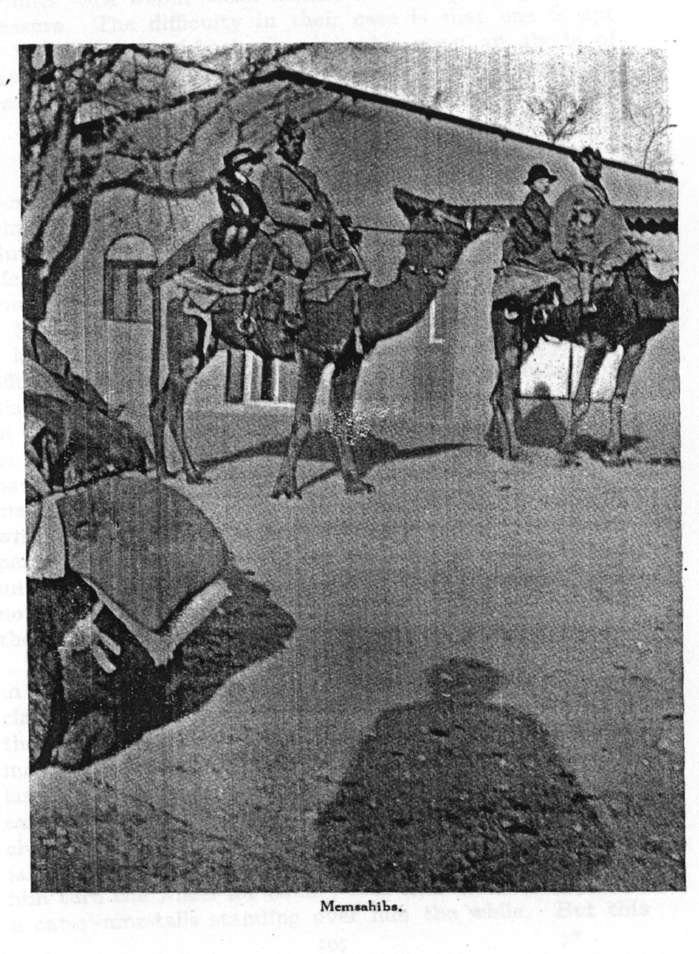
The better sort of British official feels the drawbacks of the situation acutely, and is unwearied in his efforts to diminish them. Aided sometimes (not always) by his womenfolk, he tries to establish some reasonable system of Social intercourse with his Indian colleagues and subordinates. Now and then he succeeds in a certain measure ; but he has two great difficulties to encounter : obstinate prejudice among the stupider members of his own race, and the domestic arrangements and traditions of the other race. Very often the personal relations between British officials and their Indian assistants are excellent— relations of sincere mutual respect and friendship. But the attempt to carry these relations from official into social life is generally a laborious failure.* It is almost impossible for the average memsahib to get upon human terms with the average uneducated purdah woman. Even if the language difficulty be overcome, the three common topics—dress, jewels and babies—are soon exhausted. A few Western women have no doubt a genius for getting " behind the Indian veil; " but they are rare at best, and they seldom happen to be the wives of collectors or commissioners.
Two little experiences of my own may be cited in illustration of these social difficulties. A high-caste Hindu
* Let it be noted, however, that if our attempts at social intercourse are not brilliantly successful, between the different sections of Indian society no such attempts are made at all. "There is less social intercourse," writes H. H. the Aga Khan, " between Muhammadan and Hindu or between Rajput and Parsi than between any of these races and the English in India. . . . Englishmen, and Englishmen alone, receive and have friends among all classes and races." National Review, February, 1907. gentleman, well up in the Government service, invited me to visit his house—thereby showing, of course,., great liberality of spirit. He even introduced me to his wife, a pleasant-featured lady, no longer young,, wearing in her left nostril a sort of little aigrette of rubies and emeralds; It would ill become me to repay his kindness by a detailed criticism of his "interior"; but every moment of the half-hour I spent in it brought home to me the world-wide difference of standards—in ventilation, freshness, decoration, comfort, things material and things spiritual— between this civilization and ours. How impossible it was to imagine any Englishwoman, not violently prepossessed, like " Sister Nivedita," in favour of everything Indian, getting into comfortable social relations with the mistress of this mansion ! It is not a question of superiority or inferiority, but simply (as I have said) of world-wide" difference. Very likely the devotions done by the Brahmin lady at the altar in her back yard, with its little pot of basil, may have more of spiritual quality than whatever exercises of a like nature the collector's or the colonel's wife may indulge in The decorations of her salon—a frieze of garish German colour-prints of Siva, and Parvati, and Rama and Sita, and other divine personages, all elaborately "tinselled" by the ladies of the family—may perhaps express as much artistic feeling as the Tottenham Court Road photogravures that adorn most of the bungalows of the neighbouring civil station. For my part, I have no overpowering admiration for Western culture as it commonly manifests itself in India. But whether it be higher or lower, it is irreconcilably different from the culture of the East. I could not but feel in this high-caste household that any attempt at social intercourse between it and the European households of the station must be. an elaborate and laborious hypocrisy, however admirable might be the spirit prompting it.
There are, in Calcutta, Bombay* and elsewhere, a certain number. of emancipated and highly cultivated Indian
families with whom social intercourse is a privilege and a pleasure. The difficulty in their case is that one is apt to feel like a semi-barbarian intruder upon an abode of ancient, fine-spun, aristocratic culture. One begins to realize the force of Arnold's lines :
—only that " awe " is perhaps not quite the emotion with which these grave Orientals regard our Western crudities. But such households are as drops in the ocean of Indian life. They show what might be and may be ; but they are immeasurably removed from the general level of what is.
My second little experience may be more briefly narrated. I had the pleasure of spending some days with a British official of high rank who makes it a rule to exclude from his kitchen all pork, bacon and other products of the pig, in order that his Muhammadan subordinates may be able at any time to lunch or dine with him, without fear of partaking of any forbidden dish. As a matter of fact, I met at his table two Muhammadan members of his staff, who were evidently quite at their ease among their European colleagues. Here was an admirable instance of real, unforced, social intercourse. But two things have to be noted. First, it was Muslims, not Hindus, who joined in the pleasant repast; second, our host was a bachelor.
There has been a great improvement, beyond a doubt, in the manners of Europeans towards servants and lower-class Indians in general The days are long past when the memsahib could send a khitniutgar to the cantonment magistrate with a chit : " Please give bearer a dozen "— lashes understood—knowing that the order would be executed without inquiry. I have heard an official—a civilian, I am sorry to say—cite admiringly John Nicholson's (alleged) exploit of tying a tehsildar to a well and making him turn the wheel for twenty-four hours, an orderly with a cat-o*-nine-tails standing over him the while. But this was narrated with fond regret, as a trait of the good old days never to return: " You couldn't do such a thing now—you'd be broke." Outrageous domineering and brutality are now very rare.
In the course of six months' pretty constant travelling, I came, across only two mild cases of bad manners. The offender in one instance was a Scotch commercial-traveller or insurance-agent. At tiffin at a Madras hotel, he took it into his head that the waiter had brought him too small a plate for his salad, though, for my part, I could see nothing wrong with the crockery. After angrily ordering the man —who was twice his age and three times as dignified in appearance and bearing—to bring him another plate, he fell to badgering him in this strain : " Now, why couldn't you have done that at first, boy ?* Just because you were too lazy, hey ? * —and so on till he was tired. The waiter listened with imperturbable calm, and was, for the moment at any rate, immeasurably the better man of the two. On the other occasion, a dyspeptic officer lost his temper, very foolishly, because of the failure of a refreshment-room attendant to understand his order—of course a frequent cause of friction, These were the only instances of bad manners that came to my notice.* On the other hand, I heard on unquestionable authority of several cases in which low-class unofficial Europeans, or (unfortunately) young subalterns fresh from England, had treated even
* The habit of addressing waiters as " boy " is greatly to be deprecated. It is not originally Indian, I believe, but has crept in from China, where it is much less offensive. I heard an American woman address a cashier in Cook's office at Calcutta as " boy " ; but this, I think, was a mere slip of the tongue. She was hurried and " rattled."
* There goes my lord the Feringhee, who talks so civil and bland, Till he raves like a soul in Jehannum if I don't quite understand."
Lyall: The Old Pindaree.
* I once heard, in England, a young man in the Indian police speaking of the -natives " in brutal and indefensible terms. He took a very pessimistic view of our position in India ; as well he might, if there were many officers of his stamp in the services.
high-caste Indians with monstrous bumptiousness, scarcely stopping short of violence. There is a general feeling among civilians that the military authorities do not show sufficient sense of the enormity of such conduct on the part of young officers. A gross manifestation of ignorant arrogance will be visited, perhaps, with a little stoppage of leave. It is greatly to be desired that, before they come to India at all, officers should go through a. brief course of instruction as to the country entrusted (in part) to their guardianship, and should have it impressed upon them that in order to be sahibs they need not, and indeed must not, cease to be gentlemen.* I have read an earnest and admirable circular addressed by the Government of India to the Civil Service, urging the cultivation of a scrupulously " courteous and considerate demeanour towards all with whom they are brought in contact."*
* It is agreed on all hands that the relations between British officers and the Indian officers and men of Indian regiments are generally excellent. Many people hold, indeed, that it is a great advantage to members of the *' political " (as distinct from the civil) service that they should have passed through the Indian army, and thus acquired a special understanding and appreciation of the Indian character.
* Since this chapter was written, there has appeared in the Daily News &• Leader (June 5, 1914) an article by Mrs. Besant in which many instances are given of gross rudeness and violence on the part of Europeans towards Indians, some of the cases of rudeness (but not of violence) having come within the writer's own observation. It makes one's blood boil to read of such incidents as the following : " Lately in Madras an Indian nobleman, fearing to miss his train, drove his car swiftly past an Englishman's. The Englishman followed him to the station, insulted him, struck him and kicked him so seriously that the Indian was lifted helpless into the train; he summoned the Englishman and a paltry fine was inflicted. The ex-sheriff of Bombay was assaulted as he approached a ladies carriage to speak to his wife ; he summoned his assailant; and the man apologized and was let off. Such cases are innumerable. Sentences of whipping for trivial thefts are constantly inflicted on coolies, and in one case recently, where a little tobacco was stolen by a railway coolie, he was sentenced to be flogged, and was flogged in the magistrate's office by the magistrate himself, according to the testimony of several respectable Indians. He was ' severely reprimanded,' but remains on the Bench. A coolie, struck by his master, died; a fine was inflicted, But however we may deplore the bad manners of the past, and survivals in the present of a bad tradition, it is only fair to remember that in our worst excesses of arrogance we were only " doing at Rome as the Romans did." When Burke inveighed against " the despotic style, the extreme insolence of language and demeanour used " by Warren Hastings " to a person of great condition among the politest people in the world," he was indulging beyond all measure his gift of idealization. " Polite," in his day, had a wider meaning than in ours ; but, in this context at any rate, it must be taken as including our narrow meaning. It would seem that nothing less than a frenzy of partisanship could make that people the politest in the world which had, in the caste system, elaborated arrogance into a science and elevated it into a religion. On the inhuman insolence of caste what need is there to dwell ? Something has been said of it in the foregoing chapter. I take, almost at random, from the report of the 1901 Census, the following quatrain, expressive, it is said, of the contempt of the up-country Brahmins for men of their own caste who had migrated to Chhattisgarh :
" This is Chhattisgarh, where the Gond is king of the jungle, Under his bed is a fire, for he cannot pay for a blanket. Nor for a hookah indeed—a leaf-pipe holds his tobacco : Kick him soundly first, and then he will do what you tell him."
One would say that the whole spirit of the swashbuckling white ruffian toward the lowest African " nigger " breathed in these lines ; yet Sir Herbert Risley's comment is undoubtedly just, that they " reflect the intolerant and domineering attitude of the Indo-Aryan towards the Dravidian, of the high-caste man towards the low, that
as ' there was only one blow, and it was not meant to kill.' " If Mrs. Besant can substantiate these accusations, and others, she would do a great service by giving them such prominence that the Government of India should be forced to take cognisance of them. The situation is complicated by the fact that young Indians are sometimes guilty of deliberately provocative behaviour ; but that is all the more reason why European brutality should be sternly checked. has been characteristic of Indian society from the earliest times down to the present day." Where such a spirit prevailed between Indian and Indian, is it wonderful that the relations between the European and the Oriental were not always regulated by the most scrupulous courtesy ?
Perhaps it may be said that when impoliteness becomes a religion it ceases to be impolite : in the spirit of that atrocious line of Dante's :
E cortesia fu lui esser villano.
I have not actually come across this plea, but should not be at all surprised to find it in the works of the India-worshippers.* It must not be supposed, however, that caste is responsible for the whole of the mannerlessness of Indian life. It is at the root of a good deal of it, no doubt ; but I think it may be taken as a general rule that the amenities of social behaviour do not greatly flourish anywhere among low-class Orientals. I am doubtful whether an exception should be made for the Japanese. When they exist, Oriental manners are magnificent : but in the intercourse of the masses of the people, they are apt not to* exist. I am not assuming that they are always conspicuous among the masses of Europe. I am making no comparison, but simply stating what I take to be a fact. Beside the two instances I have mentioned of objectionable conduct on the part of Europeans, I could place numberless instances of overbearing rudeness and hustling aggressiveness on the part of Indians towards Indians. These are, indeed, the everyday incidents of travel. Mr. Pryce Collier bears witness to the same effect. He says that in the course of all his wanderings he saw no cases of rudeness, except on
* In The Web of Indian Life (p. 46) " Sister Nivedita " enlarges on Indian courtesy : no doubt justly, as regards the domestic life of certain castes. A man, she admits, will always take precedence of a woman passing through a door ; but this is because they " maintain the tradition of the path-breaker in the jungle." I do not pretend that there is any importance in our conventional rule of " ladies first "—I merely note this as an amusing example of the ingenuity which has been applied to the ennoblement of every slightest trait of Indian manners. the part of minor railway officials towards travellers of then-own race. " Once," he says, " sometime after midnight, I saw an English officer pile out of his carriage in his pyjamas and slippers, and soundly berate a native official who was bullying a third-class native woman passenger."
I shall not, I hope, be suspected of palliating bad manners and brutality. I merely recall to mind a fact which is sometimes forgotten—namely, that the domineering tendencies of the past, which to some extent survive in the present, were indigenous rather than imported. The trouble was that the British official and soldier became too much Orientalized. So far as I can discover, after pretty diligent inquiry, they found in the Indian languages no forms of politeness ready to hand—no " please " or " thank you," or " I beg your pardon." Formulas of servility and adulation existed in plenty, but of ordinary courtesy, none. This may seem a very trifling matter, but it is not. These little phrases are invaluable lubricants of social intercourse, whether between equals or between superior and inferior. Some languages are better supplied with them than English ; and one misses them sadly on returning to England from a country—I have Norway specially in mind—in which they are more abundant. In a country where they are absolutely lacking, there is no such thing as a request—there are only orders. What wonder if " Jo hookum,"—" As ordered,"—is the constant burden of the intercourse between Indians and Europeans ? And what wonder if the awakening national spirit of India resents it ?
Here again I suggest that a vast improvement would be effected if we could rid our minds of the superstition that British rule is and must be a failure if it aims at anything short of an adamantine eternity. Not the least of the evil results ensuing from that habit of thought is the notion that we must constantly pose as conquerors among a conquered people—a notion peculiarly prevalent, it is only fair to say, among bagmen, and shipping-clerks, and other haughty - spirits of the type of my Madras compatriot. I have seen traces of it, too, among very young men of a better class. Once, in an out-of-the-way region, I encountered a young civil-engineer, the only European for many miles around, who invited me to his bungalow and treated me most hospitably, like the nice boy he was. But, perhaps because I did not take my fair share of the bottle of hock he produced in my honour, he became, certainly not drunk, but a little loquacious ; and I shall never forget the comedy of his conversation with the station-master, as I waited for my midnight train. No Viceroy could have been more condescending, or could have imposed his commands on the official with a loftier superiority. I remember, too, that he gravely remonstrated with me for carrying a small handbag, instead of giving it to my servant—thereby lowering the prestige of the ruling race. It was a case of in vino Veritas —without at all impairing his self-control, the hock had simply released the instinct of racial masterdom which he had brought with him from England, only a year before, and which had no doubt been fostered by the tone he found prevalent among other young men of his class. His fresh rapture of autocracy was innocent enough, so far as it went that night; and it would very likely wear off as he advanced in years and discretion. But there are too many irresponsible (and some responsible) Anglo-Indians in whom it does not wear off.
Such an Anglo-Indian is the author of a letter which appeared in the Civil and Military Gazette (the leading paper of the Punjab) on September 5, 1906—a letter signed, I regret to say, " Sagittarius."
I take no alarmist view (says the writer), but regard the whole subject calmly and rationally. Not only myself but many others must surely see daily the increasing impertinence, disrespect, officiousness (!) and disloyalty of the subject race. I wish to lay special emphasis on the words subject race, for the native of India, be his position and salary what it may, should and must understand that British blood has conquered India and rules it, and respect and deference must be shown to it at all times and in all places. This is only one of a number of similar utterances which appeared in the Civil and Military about the same time, and did incalculable harm—as the conductors of the paper have realized and tacitly admitted. Here are one or two more specimens : " Let the Babus clearly understand that we have admitted them into the administration as our servants, not as our partners. A partnership between Europeans and natives there must inevitably be," but it must be " with the ruling classes, not with the servile classes." Again :. " Already discerning people in England must be beginning to see that evert half-a-dozen princely Counsellors of the intellectual type of the Maharaja of Bikanir would be worth a whole parliament of babbling B.A.'s." Yet again—from a letter signed "Fifty Years in India": " When Swadeshism degenerates into ruffianism, unveiled disloyalty and racial antagonism, I say again, ' Sjambok ! ' " Pretty sort of writing this to mitigate " racial antagonism ! "*
* Perhaps the worst, or at any rate the silliest of these effusions, was the following jibe at the extremely popular national song of Bengal, " Hail to the Motherland " :
"BANDE MATARAM" (By Autolycus ).
I love my Aryan brother. And I love to see him gay— It's nice to watch him hard at work, And nicer still at play : As David danced before the Ark (While thinking out a psalm), So doth Bengal Nautch at the call Of " Bande Mataram."
Why should the " Raj " attempt to stay Such pure innocuous folly ? A puny thing of froth and fat (Half " dhoti "—quarter " brolly ") No more accords the ruling race An obsolete " Salaam," But—better still— With organ shrill Gries " Bande Mataram." The senseless swagger of such utterances is directly due to the idea that we have some sort of providential mandate to rule India for ever and a day, and that our right is founded, not on administrative capacity, but on an inborn genius for despotism, in which every white-skinned shop-boy has his share. If we were encouraged by those who set the tone of Anglo-Indian thought to take a saner view of our position and responsibilities, this pitiful and mischievous racial snobbery would soon die out. The fact that it is in some measure due to the contagion of our Oriental environment does not at all excuse it. If we are to justify our existence in India, it must be by our resistance to this contagion, to which all former invaders succumbed,*
Moreover, if we could realize and admit that, our relation to India was temporary, not eternal, we should be less discouraged by the scant success of our heroic efforts to lower existing social barriers. It is the false ideal of our status that makes our isolation seem inhuman. Those of us who give any thought to the matter know that two races cannot be locally intermingled in perpetuity without the smallest social or spiritual intermingling ; so we strive
Our English topsy-turvy rule Possesses humorous charms ; Behold a race that bares its legs, But never, sure, its arms ! How can such children bother MEN ? It really takes the palm To think that we Should care a D For " Bande Mataram."
* The following passage from an article in the Asiatic Quarterly by Shaikh Abdul Qadir (April, 1906), is much to the point : " The European official in India, in the interests of the Empire, and in order to win the confidence of the people, should so act as not to show any assumption of a Divine right to rule, or any air of conscious superiority, which, without strengthening his position, jars upon the susceptibilities of the people. I can quite imagine somebody objecting to the view I have expressed, and saying : This must be some new sensitiveness that the Indians have developed, as their fathers rejoiced in honouring the rulers.' Yes, it is new, but it is there, and it has to be taken into account." to invent some form of social intercourse which shall make the situation a little less manifestly impossible. But in all such efforts there is a tacit " Thus far and no further " which renders them artificial and in great measure abortive. The real amalgamation which springs from inter-marriage is, by common consent, out of the question ; and it is only in the rarest cases that anything like intimate equality of friendship is possible. Nor would it, if possible, be altogether desirable ; for the strength of British administration lies in its superiority, not merely to pecuniary, but to personal influences. Another difficulty arises from the fact that those Indians who show themselves most accessible to social advances from the British side, are not always the best or the most respected members of their own community. This view is stated, with some exaggeration, in a letter from a " Mussulman " which appeared in the Civil and Military Gazette at the time when racial relations were being discussed in such an unfortunate tone by the correspondents of that paper.
" Those Indians," he wrote, " who claim and crave admission to Anglo-Indian society are ' knaves ' and ' fools ; ' but I submit to Anglo-Indians—these knaves and fools are your creation. They are a detestable set; we Indians abhor them and call them degenerate. . . . They are the biggest snobs we have. They decry you when they come strutting to us, and they denounce us when they go cringing before you."
This is clearly a somewhat intemperate, partisan outburst ; but it points to a real difficulty. No Indian, and especially no Hindu, can enter upon social relations with Europeans without in some degree derogating from the ideals of his race ; and though he may be sincerely convinced that the ideals he renounces are false and noxkras, he none the less lays himself open to suspicion of currying favour with the ruling caste.
I am far from suggesting that the efforts to place the two races on a better social footing should cease. I think they are of great educational value, to both parties. But let us not fail to bear this in mind: if these efforts should ever meet with any large measure of success, it would mean that India no longer stood in need of alien tutelage. So soon as there is a large class of educated, emancipated Indians, fitted to take part on equal terms in European society, India will be fitted to take part on equal terms in the fellowship of the nations. I do not mean that fitness for self-government is necessarily to be tested by Europeanization of manners. It is quite possible that, when India awakens to the need for civilization,* she may take a line of her own, very different from that marked out for her by Europe. But if she does elect to make Europe her model, and succeeds in assimilating European manners and ideals, her success will constitute a conspicuous proof of her ability to work out her own salvation.
Meanwhile, if we realize and admit that the two races are not handcuffed together for all eternity, but only associated for a particular purpose, the problem of their social relations loses much of its importance. It is when we take up the " Whom God hath joined, let no man put asunder " attitude that our failure to get into sympathetic personal relations with our Indian fellow-citizens seems like failure in a crucial point of policy, if not of duty. One thinks of old Mrs. Baird's pity for " the chiel that's chained to oor Davie ; " had that union been indissoluble, it would indeed have been of the first importance that the parties should get into some sort of human relation to each other. If, on the other hand, there is no question of eternity in the juxtaposition, we may without any sense of failure " admit impediment " to " the marriage of true minds."
* "When she awakens!" some readers may exclaim. "Is not her civilization the most ancient and the noblest in the world ! " It is precisely because so many even of her educated men are deceived by this juggling with the term " civilization " that I hold her to be very imperfectly awakened to her most urgent needs. Rightly or wrongly (as readers who have followed me so far must realize) this is one of the cardinal points of my whole contention. If we would but see ourselves in a realistic light, as persons called in to perform for certain other persons a set of services which, if honestly and capably rendered, must, in the nature of things, work themselves out and become unnecessary, we should find ourselves relieved, not, indeed, of social duties, but of the oppressive sense of their momentous importance and insurmountable difficulty. Here, in England, doctors, lawyers, architects, bankers, stockbrokers do not feel themselves bound to become the personal cronies of their clients. It is only in a small minority of cases that professional relations lead to social intimacy ; nor does any professional man measure his success by the number of such cases in his own experience. We are, in India, simply professional men exercising certain protective, administrative, educative, constructive functions; and it is only when, forgetting this, we pose as heaven-appointed affable archangels that we have any need to reproach ourselves with the incomplete success of our attempts at affability. |