
IV
HINDU SPIRITUALITY
THE common task which English and Indians have before them—that of bringing India into line in the march of civilization—will not be facilitated by false ideals on either side. And the Indian is at least as liable to them as the Englishman.
The Abbe Dubois, a Catholic missionary who spent the best part of his life in the most intimate contact with the peoples of Southern India—who adopted their dress, spoke their languages, and came to be accepted by them almost as one of themselves—wrote of them nearly a century ago as " a vain and self-sufficient people, filled with the idea of their own moral ascendancy." This is plain speaking, but there is a great deal of justice in it even to-day. Indeed, if the worthy Abbe had said " moral and intellectual ascendancy," he would not have been far wrong. Until Hindu patriotism is dissociated from irrational arrogance, and associated with rational humility, the advance of the mass of the people towards self-respecting intelligence must inevitably be slow.
I do not say that the same remark is not justly applicable to many other people nearer home. That is not the question : two blacks do not make one white. Nor do I say that the reproach applies to all Indians. On the contrary, the leading intelligences of the country prove their claim to that position by seeing things in juster proportions. But the general tendency is to regard India as a sort of divinity
under a cloud : a heaven-born paragon of genius, valour, piety and learning, who has only to cast off an evil spell in order to shine forth in the eyes of all the world, resplendent, incomparable, the saviour of the human species. Now the evil spell is real enough : another name for it is the history of India. The illusion lies in supposing that the races which have undergone that spell were in any way specially favoured at the outset, and that the ban can be lifted in any other way than by a patient and resolute struggle gradually to undo its effects.
It cannot be said that India is self-hypnotized into this illusion. I have already given one or two specimens of the flatteries—or if that word begs the question, let us say eulogies—which have been heaped upon her by Western writers. These eulogies may be roughly divided into two classes : those of scholars whose painfully-acquired knowledge of Sanskrit literature naturally inclines them to make the most of a treasure which has cost them so much; and those of a recent school of enthusiasts who find in the arcana of Hinduism the basis of certain esoteric doctrines which they believe to be the ultimate truths of religion. Of neither group of eulogists would I be understood to speak with disrespect. Certainly not of the latter group : I believe that its leader, Mrs. Annie Besant, has done much good in India, and I know that she has uttered a great deal of sound sense on education and other topics. But when it comes to making India the birthplace and home, not only of all spirituality, but of all science, I can no longer follow either the learned or the illuminated.
Listen to the late Colonel H. S. Olcott, lecturing at Amritsar in 1880 on India, Past, Present and Future. After claiming for the Aryans " a system of telegraphy without either poles, wires or pots of chemicals "—in other words, a probable enough knowledge of telepathy—he proceeded :
" And then the Aryans—if we may believe that good man the late Bramachari Bawa—knew a branch of science (Viman Vidya)
about which the West is now speculating much, but has learnt next to nothing. They could navigate the air, and not only navigate but fight battles in it, like so many war eagles combating for the dominion of the clouds. To be perfect in aeronautics, as he justly says, they must have known all the arts and sciences related to that science, including the strata and currents of the atmosphere, their relative temperature, humidity and density, and the specific gravity of the various gases. At the Mayasabha, described in the Bharata, he tells us, were microscopes, telescopes, clocks, watches, mechanical singing birds, and articulating and speaking animals. The Ashta Vidya—a science of which our modern professors have not even an inkling——enabled its proficients completely to destroy an invading army by enveloping it in an atmosphere of poisonous gases, filled with awe-striking shadowy shapes, and with awful sounds."
The late Bramachari Bawa, one imagines, must have been a spiritual kinsman—possibly a former incarnation— of Mr. H. G. Wells. If the proficients of the Ashta Vidya had indeed at their command this short and easy method of dealing with invading armies, it seems a pity that they were so chary of exercising it—there was ample opportunity in Indian history.
Colonel Olcott, it may be said, was a well-known visionary, credulous of all marvels. But similar credulity is by no means uncommon in India. " I have known an educated Indian," says Professor Oman, " to maintain with much warmth that in the Golden Age the rishis and others were well acquainted with the art of aerial navigation, and probably with other rapid modes of locomotion unknown to us moderns. I have heard him assert boldly that even the telephone, microphone and phonograph were known to the Hindu sages, up to the time when the sciences and arts of the ancient world perished ... on the fatal field of Kuruk-shetra." Some maintain that the art of constructing aeroplanes, and other marvels of applied science, was deliberately withdrawn from human ken by the rishis— a mysterious race of semi-divine sages—because they held them inappropriate to a dark age (Kali Yuga) which they
saw to be impending over the world. Why did they not apply their stupendous powers to averting the dark age, instead of giving us the trouble of conquering Nature all over again ?
On such insanities, however, it is profitless to dwell. The glory which is claimed for India by serious Western thinkers—in words re-echoed a thousandfold by Indians themselves—is that of high spirituality, a unique genius for grasping and expounding the realities behind the phenomenal world, and the innermost meanings of life.
One finds traces of this idea in the most unexpected quarters. I have heard a British civilian, high in place and rich in experience, say that in the daily work of administration and legislation he often had to deal with Indians of greater intellectual capacity than his own ; and on inquiring into his reasons for so esteeming them, I have found it to lie mainly in the fact that they were familiar with regions of thought which were to him untrodden ground, and ground, moreover, on which his robust practical intellect could find no foothold. Now it is probable enough that he did, as a matter of fact, have to meet, in discussion, " foemen worthy of his steel "—perhaps quicker and suppler-minded than he. But I contested, and still contest, his assumption that familiarity with metaphysical conceptions—perhaps even the power of arguing with some subtlety on metaphysical points—is necessarily a proof of great mental capacity. I am sceptical of the value of thought in a region where there is no possible test of values.
Another proof of the widespread acceptance of India's claim to supreme religiO-philosophic genius may be found in a very judicious book by a highly qualified student and observer of Indian affairs—The Economic Transition in India, by Sir Theodore Morison. The very last words of that book are these : " We can only hope that India may be warned in time by the example of Europe, and that her industrial revolution may not be disfigured by the reckless waste of human life and human happiness which has stained
the annals of European industry. Most of all must we wish that, in the fierce struggle for material wealth, she may not lose the lofty idealism by which she has hitherto been so nobly distinguished."
What is this " idealism ? " What is its meaning ? What does it amount to ? These are questions to which I have been unable to find a very satisfactory-answer.
The extraordinary interest of the early religio-philosophic literature of India is beyond all doubt. Beginning with the four Vedas (hymns, invocations and magical formulas) it proceeds through the Brahmanas (ritual prescriptions) and the Aranyakas (literally " jungle books," for the use of anchorites) to the Upanishads or philosophical treatises, explaining, allegorizing or supplementing the primitive nature-worship of the Vedic hymns. The meaning of the word "Upanishad" is much disputed, but Deussen interprets it as " secret word " or '" secret text." The Upanishads, or their doctrines, are sometimes termed the Vedanta—the end or consummation of the Vedas.*
Everyone admits that as documents in the history of the human spirit the Vedas are invaluable. They can be dated only within very wide limits ; their text is thought to have been much " worked over," and is so obscure as to lend itself to ludicrous divergences of interpretation ; but, after all deductions, they remain, I take it, the earliest religious outpourings that have assumed anything like literary form. Some of the hymns are said to be beautiful; a few certainly show a gift of philosophic penetration, rare among primitive peoples. I shall quote in a later chapter an utterance of a sort of agnosticism, very striking in a work of such early date. But to place the Vedas as a whole on the summits of literature is to confuse historic with aesthetic and spiritual values. It has been well said that " two classes of persons entertain the most exalted notions of the Vedas : those who
* I trust there is no gross error in this paragraph ; but very confusing explanations are given of even the nomenclature of this literature.
know nothing of them, and those who know nothing else." Let us hear Max Muller on this point—an authority certainly not apt to depreciate the wisdom of the Orient. He says :
There have been silly persons who have represented the development of the Indian mind as superior to any other, nay, who would make us go back to the Veda, or to the sacred writings of the Buddhists, in order to find there a truer religion, a purer morality and a more sublime philosophy than our own. . . . That the Veda is full of childish, silly, even to our mind monstrous conceptions, who would deny ?
And again, in another place :
The historical importance of the Veda can hardly be exaggerated, but its intrinsic merit, and particularly the beauty or elevation of its sentiments, have by many been rated far too high. Large numbers of the Vedic hymns are childish in the extreme : tedious, low, commonplace. . . . The Veda contains a great deal of what is childish and foolish, though very little of what is bad and objectionable.* Some of its poets ascribe to the gods sentiments and passions unworthy of deity, such as anger, revenge, delight in material sacrifices; they likewise represent human nature on a low level of selfishness and worldliness. Many hymns are utterly unmeaning and insipid, and we must search patiently before we meet, here and there, with sentiments that come from the depth of the soul, and with prayers in which we could join ourselves.
No one, assuredly, who looks into the translations of the Rig-Veda can fail to admire the indomitable industry which has sustained scholars in their struggle not only with the obscurities but with the extreme tediousness of the greater
* Here Max Muller is, of course, thinking of the Rig-Veda, and the same remark may probably apply to the Sama and Yajur Vedas, which closely follow the Rig-Veda. But of the later Atharva Veda we are told that it is " full of magical verses, some to remove disease, cause hair to grow on bald heads, and to abate the nuisance caused by vermin. . . . The incredible filthiness of some of these symbolical and magical rites is almost beyond belief, and the first part of the Aitareya-Aranyaka rivals the most obscene Tantras of the worshippers of Shakti." Burnell, p. xxiii.
part of the hymns. The Rev. K. S. Macdonald, a missionary, no' doubt, but a very liberal-minded one, writes :
The same prayers for the gratification of sensual, carnal and worldly desires occur so continuously that it is a positive pain to read- any large number of hymns at a sitting. One becomes sick of such praises and prayers, and longs to see men and women go about their ordinary occupations. . . . The horizon of the Rishi is confined almost invariably to himself. He prays for the happiness of neither wife nor child, not for the good of his village or his clan, nor yet for his nation, or people. He manifests no common joys, any more than common sorrows.
The evidence of high idealism in such literature as this is certainly scant. Of the " monstrous conceptions " occurring in the Vedas the following specimen may suffice. In one hymn, says Max Muller :
Indra is praised for having made Heaven and Earth ; and then, when the poet remembers that Heaven and Earth had been praised elsewhere as the parents of the gods, and more especially as the parents of Indra, he does not hesitate a moment, but says : " What poets living before us have reached the end of all thy greatness ? for thou hast indeed begotten thy father and thy mother together from thy own body,"
" That is a strong measure," Max Muller continues, " and a god who could once do that was no doubt capable of anything afterwards." Already we see at work the tendency to monstrous generation- and incarnation-stories that runs through all Indian mythology. Yet of the documents wherein such mere ravings occur, otherwise sane people are actually found to declare that they are " faultless from all eternity, evident by themselves, and, as they were revealed, unaffected by the shortcomings of human authorship."
Something will have to be said in a later chapter of the " Back to the Vedas " movement, which finds its chief expression in the Arya Samaj. But though, in the orthodox conception, the seeds of India's spirituality are thought to
be sown in the Vedas, it is only in the Upanishads that they reach their full flower. Now the interest of the Upanishads is incontestable. They are, perhaps, the earliest philosophical writings in the world; and even if this be not so, they are unquestionably original, evolved entirely in the Indian mind, not sprung from wandering foreign thought-germs. They reveal an extraordinary intensity and ingenuity of speculation, a wonderful power of applying to appearances the solvent of thought. No one can read Deussen's great book on the Upanishads without marvelling at the luxuriance of shaer cerebration displayed in the literature he summarizes. That it proceeded from subtle brains there is no doubt whatever. On the other, hand, I do not see how any one can fail to observe that, on its constructive side, Indian thought merely built up a new, and fantastic, and often self-contradictory, mythology, in which speculative concepts took the place of anthropomorphic deities. This was, indeed, inevitable ; it is the process of all metaphysical thought that is not merely destructive ; but India then fell into the error of thinking that it had fathomed the unfathomable, and presenting speculation in the guise of dogma. Wherever its teachings can be tested—as in its cosmology, physiology, psychology— they are found to consist of just what one would naturally expect, namely, baseless classifications and ingenious guesses. Its wildest fancies are often interesting and suggestive ; for the power to think erroneously is better than mere brutish incapacity for thought. It is better to let the mind grope in the darkness than to keep it torpid and incurious. But to mistake groping for seeing, guessing for knowing—that is the very unspiritual habit into which India has fallen.
Whatever may have been the genius of the individual thinkers to whom we owe the Upanishads, their dogmatism must have had a cramping rather than a stimulating effect upon the minds of their disciples. The relation of guru and chela, still admired by many as the basis of India's intel-
lectual greatness, is in fact destructive to all criticism and therefore to all healthy life. " Since the knowledge of the atman," says Deussen, summarizing one of his documents, " is contrasted with the reality of experience as the realm of ignorance, it cannot be gained by mere speculation (tarka) concerning it, but only by a revelation communicated through the teacher."* This is surely the very reverse of a sound doctrine. Teaching may, indeed, put the mind on the track of philosophical realization, may even bring it up to the threshold ; but the threshold can be crossed only by an unteachable act of apprehension, taking place in the individual mind. Nevertheless this conception of truth as something that can be poured mechanically from one mind into another lies at the base of Indian philosophic teaching. Here is another (later) utterance: "As the Purana says,' Do not apply reason to what is unthinkable ! The mark of the unthinkable is that it is above all material causes.' Therefore the cognition of what is supersensuous is based on the holy texts only." " The holy texts ! "— here we touch the heart of the matter. If to look to the past for all wisdom, whether divine or human, be a spiritual tendency, then the spirituality of India cannot be contested. But neither is it doubtful that her spirituality, in this sense, has been one of her greatest misfortunes. She has also displayed an unequalled diligence in thinking about the unthinkable, that being an exercise agreeably compatible with physical immobility and living upon the alms of the faithful. But of what possible value even to the individual himself (to say nothing of his fellow-men or his country) is this mechanical and morbid rumination of " the holy texts," or of the mystic syllable " OM," confessed by Deussen to be
* Deussen, The Philosophy of the Upanishads, p. 78. " Atman " may be roughly rendered as " world-soul."
As when we dwell upon a word we know. Repeating, till the word we know so well Becomes a wonder, and we know not why.
Tennyson.
" entirely meaningless.," but " precisely on that account especially fitted to be the symbol of Brahman " ? May it not fairly be suspected that this much-vaunted habit of meditation is often a cloak for sheer blankness of mind ?
The absolute value of India's contribution to metaphysical thought is of course a matter on which specialists only can give a competent opinion. Several Western philosophers, and particularly Schopenhauer and Cousin, have spoken with warm admiration of the Upanishads ; and the influence of these and later speculations is traceable in a good many quarters—notably among the New England transcendentalists. In fine, there is no difficulty in admitting that individual Indians, some nameless, some known by name, one—Gautama Buddha—world-renowned, have played a more or less distinguished part in the history of philosophy. But between this admission, and the pretension that India as a whole—the Indian people—has manifested a unique religio-philosophic genius, there yawns an immeasurable gulf. The genius which the Indian people, from the Brahmin caste downwards, has displayed to great perfection, is a genius for obfuscating reason and formalizing, materializing, degrading religion.
This may seem a hazardous assertion in the face of a cloud of witnesses. But the witnesses themselves may be cited on both sides ; and where they advance anything like proof, as distinct from the mere repetition of stereotyped formulas, it is all on the negative side of the case. Take Mr. Romesh Chunder Dutt, for example. He assures us, on an early page of his History of Civilization in Ancient India, that " The history of the intellectual and religious life of the ancient Hindus is matchless in its continuity, its fullness and its philosophical truth." But a little further on he tells us that immediately upon the Vedas followed the Brahmanas, " inane and verbose compositions" which " reflect the enervation of the people and the dogmatic pretensions of the priests ; " and that later, in what he calls the Epic Period(B.C. 1400 to 1000 ?) " the gradual enervation
of the Hindus was the cause of the most important results in religious and social rules. Religion changed its spirit. The manly but simple hymns with which the sturdy conquerors of the Punjab had invoked nature-gods scarcely commended themselves to the more effete and more ceremonious Hindus of the Gangetic valley." Later, again, in the Pauranik Period which followed the expulsion of Buddhism :
An unhealthy superstition and social system warped the national mind and paralysed the national vigour. Worshippers were divorced from religious learning, warriors were divided from the people, professions and sects were disunited for ever and enfeebled. Men were subjected to unmeaning restrictions and hurtful rules. Women were encouraged to perish on the pyre. A monopoly of knowledge was established, social and religious freedom was extinguished, and the lamp of national life was quenched with the light of freedom and of knowledge. The Hindu who can deservedly boast of the religion of the Upanishads and the ethics of Gautama Buddha, owes it to Truth and to History to confess to the degeneracy of later times.
On this candid passage one comment seems called for, namely, that the ethics of Gautama Buddha were themselves a protest against the " degeneracy " of earlier times, and that the revival they effected was partial and transitory-In talking of the " extinction " of social and religious " freedom " and so forth, Mr. Dutt falls into the inveterate Hindu habit of assuming a past Golden Age, for which the evidence is of the scantiest. Otherwise the passage is sound enough ; but what becomes of the " matchless continuity and fullness " of the " intellectual and religious life" of the Hindus ?*
When we look into it closely, we can trace the general estimate of Hindu spirituality to two very different sources :
* It may be said that Mr. Dutt's assertion refers only to the ancient Hindus, an expression which might conceivably denote only the Aryans of the Vedas. But the context puts this interpretation out of court: " ancient " must be understood in its widest sense as simply meaning " not modern."
to what may be called the lower and the higher Hinduism. We have on the one hand the spectacle of a people intensely devoted to an infinitude of cults and observances which may be classed as religious inasmuch as they show a constant preoccupation with the supernatural, and belief in its activity in ordinary life. On the other hand, we know that the thinkers of this same race have evolved certain religio-philosophical ideas, of great interest and importance. Putting these two facts together, people vaguely conclude that the religious life of India is at once intimate and exalted—that the average Hindu carries into his daily life religious conceptions of the highest order, even if they be, perhaps, expressed in outward forms that, to an unsympathetic eye, may savour of idolatry.
The fact is, unfortunately, that the lower Hinduism knows and cares very little about the higher, while the higher is so contaminated by the lower that, except in small reforming sects, it can scarcely be said to exist. The " spirituality " manifested in the lower Hinduism is that to which anthropologists have given the name of animism. It is the spirituality of the savage who fears and seeks to propitiate, not only ghosts and demons, but every natural object or phenomenon that can possibly influence his life. New gods and new worships grow like weeds from the teeming soil. They are growing to-day, if not quite with the old luxuriance ; and the higher Hinduism makes no attempt to keep them down. Listen to what " The Saint Ramdas," as quoted by Mr. Justice Chandavarkar, of Bombay, has to say on the subject: " Many gods have risen and run riot; it is a medley of ghosts- and deities ; the One Supreme God has been forgotten ; so all has become a hotch-potch of worship. Hence the thinking power has been destroyed. Who knows the difference between the true and the false in this market cry of the Shastras and the noises of the gods ? " The Saint, as is natural, assumes that this chaos results-"from the corruption and degradation of a once pure faith ; but, historically, this is not the case. The lower
Hinduism is simply an unweeded jungle of indigenous cults and cult-making tendencies which the higher Hinduism has adopted, and to which it has largely assimilated itself. If it be spirituality to think of the whole world as being at the mercy of myriads of capricious powers which may be placated by sacrifices and sometimes dominated by spells, then all one can say is that savagery and spirituality are closely akin.
The higher Hinduism, or Brahminism in the stricter sense of the term, is descended from the religion brought into India by the Aryan invaders, but has, in the course of ages, changed beyond recognition. It has thrown off, so to speak, philosophies the appraisement of which we have agreed to leave to experts. But the" philosophy which inheres in it as a workaday religion, which underlies such definite doctrines as it can be said to possess, is neither technical nor recondite, and may be discussed without presumption. A little scrutiny will show us, I think, that on this side, too, India has achieved a reputation for spirit-uality which the facts are far from justifying. Great thinkers she may have possessed, but she has not extracted from their thoughts a rational, an ennobling, or even a morally helpful religion.* Hinduism is defined in the Census of India (igoi) as " Animism more or less transformed by philosophy," or, more briefly, as " Magic tempered by metaphysics." To my thinking the animism and the magic are much more palpable than the transformation and tempering.
From the holy texts, then, what has actually been extracted ? Three fundamental doctrines, which may be described as the essence of the higher Hinduism. They are :
* Deussen, indeed, says : " The Vedanta, in its unfalsified form, is the strongest support of pure morality, is the greatest consolation in the sufferings of life and death—Indians, keep to it I " Even if we could accept this opinion as authoritative, we should have to inquire.how many Indians now, or at any time, have made the Vedanta " in its unfalsified form " their guide in life and death.
(1) The doctrine of Karma in association with the transmigration of souls.
(2) The doctrine that life is an incurable ill, from which we can be relieved only by attaining re-absorption into the All, or the Self, or That, as the inexpressible is sometimes expressed.*
(3) The doctrine of the supreme and all-conquering efficacy of asceticism.
Can we, then, recognize in these doctrines symptoms of high spirituality or idealism in the people which has evolved and lived upon them ?
Transmigration and Karma.
The first is not a metaphysical doctrine at all, but an assertion of what may be called ethico-physical fact, which might conceivably be proved by such evidence as would satisfy a court of law. For my part, I know of only one objection to it, namely, that satisfactory evidence, or any evidence beyond the assertions of the holy texts, is entirely lacking. No one seems to know precisely how or when the doctrine of transmigration implanted itself in the Indian mind—it is not to be found in the Veda, nor did it come from Greece. It was in all probability borrowed from the aboriginal tribes ; for it is a concept that has occurred to the untutored savage fancy in almost every region of the world. It is, of course, impossible of disproof. No one can say that his vital principle, whatever it may be, has not at some time inhabited other bodies, animal or human, and may not pass through a further series of incarnations. But as it is scarcely asserted, and certainly not proved, that memory ever links-up these existences,
* There appears, indeed, to be some distinction between " the Self " and " That." Brahma as " That " would seem to include Brahma as " the Self." The one is unmanifested, the other is manifested. The reader will, perhaps, pardon me for not going more at large into the matter.
Theosophists, I understand, sometimes profess to recall, or otherwise identify, their previous incarnations ; but I am not aware that they adduce anything that can be called evidence
so as to establish their identity with one another, it is hard to see what is the value, or indeed the meaning, of an identity which never represents itself in consciousness. My memory is me : what is outside my memory is not me, in any sense that matters to me ; and if an angel from heaven assured me that once upon a time I was Julius Caesar or Judas Iscariot, I should be politely interested—no more. It would be otherwise if we were promised, and believed, that, at the end of our series of avatars, we should suddenly recall them all, and see and realize the thread of personality running through them. That would be a consummation of unique interest: a cinematograph-show of the ages, which we could turn on at will in the theatre of our sublimated brain. But what we are actually promised when we have " dreed our weird " to the end, is, not memory, but forgetfulness, or something practically indistinguishable from it: so that we should toil up a Himalaya of experiences only to close our eyes to the view. Lafcadio Hearn somewhere relates a Buddhist legend of a disciple and Master— a chela and guru—painfully ascending a mountain which seems to crumble away under their feet, until at last the disciple realizes that it is not on loose stones he is treading, button skulls—the mountain is entirely composed of them. " Whose skulls are these ? " he asks ; and the Master replies : " They have all been your own." One could not desire a better parable of the transmigration theory : each of us is to climb up a mountain of his own skulls in order to merit the privilege of nirvana at the top.
As for karma, it is simply the transmigrationist form of the old moral: as a man sows, so shall he reap. It is certainly more consonant with abstract justice than the theory which allots us only one brief seed-time on earth, to be followed by a singularly disproportionate harvest of eternal bliss or pain. Assuming that our actions are not the mathematical result of their antecedents,. but are in some measure, at any rate, originated by a free moral agent within us, there is doubtless a sort of fair-play in giving
us an indefinite series of lives in which to struggle upwards, through temporary error and defeat, to some ultimate goal of spiritual perfection. If there were the smallest evidence that such was the lot imposed upon us, we could accept it, if not with rapture, at any rate with tolerable fortitude—on condition that in undergoing this series of adventures, the soul should be conscious of its identity. The admitted non-fulfilment of this condition robs the scheme of all its virtues. Why should I care what I sow when it is (to all intents and purposes) a stranger who will reap, I myself, as a conscious individual, having ceased to exist ? No doubt, as the world goes on, the idea of the welfare of coming generations takes more and more hold of us, and we are more and more willing to make strenuous exertions, and even to sacrifice what may seem our immediate personal good, for the sake of that idea. But who is so fantastically self-centred as to feel his benevolence towards posterity reinforced by the notion that one of the partakers in the good time coming will, in some inconceivable and wholly unrealized fashion, be he himself ? Such identity is surely immaterial in every sense of the word. A man who has children, may, indeed, tell himself that the " posterity " he works for will probably be, in some measure, his very own ; but does that idea perceptibly stimulate his endeavours ? To think so would be to take an extravagantly cynical view of human nature. Egoists we may be, but not such morbid egoists as to think more of our own great great great great grandsons than of the descendants of other people. Do we find, as a matter of fact, that the man who has children is apt to be more concerned about the future of humanity than the childless man ? No, we do not: it might rather be argued that, from Jesus Christ onwards, the most passionate workers for the kingdom of heaven on earth have been celibate or childless. And if the real, though attenuated, continuance of our personality in our distant offspring be not a sensible spur to benevolence, why should an unrealizable, unthinkable
identity between me and some man, woman, or animal a thousand years hence—an identity for which there is no evidence save " the holy texts "—furnish me with an ethical motive of any measurable efficiency ?* I suggest, then, that the theory is not deep, but shallow—that it founds an illusory spiritual law upon an imaginary natural law, conceived at a venture by some primitive people.
It is said by some who know the Indian character well that the foregoing argument is rebutted by the facts— that, whether it ought to or ought not, the theory of karma does in practice supply " an ethical motive of measurable efficiency." For instance, Mr. Burn, of the United Provinces, one of the workers in the Census of 1901, writes as follows :
" It has been stated that the ordinary Hindu peasant has practically no belief in the doctrine of transmigration; but this is contradicted by my own experience and by all the reports that have been supplied to me. I believe that the doctrine of karma is one of the firmest beliefs of all classes of Hindus, and that the fear that a man shall reap as he has sown is an appreciable element in the average morality." This may very well be true : though, like the fear of hell, the doctrine of karma (which, by the way, does not exclude the fear of hell) has probably much more effect on the naturally good than on the naturally evil. At all events, I am not concerned to deny the efficiency of karma as a factor in Hindu morality, such as it is. My point is that the doctrine is not one which testifies to any spiritual genius on the part of those who conceived and elaborated it; and that point is rather strengthened than otherwise if all their brooding on " the holy texts " has not shown the Hindu people its insubstantiality. If the theory
* Professor Hyslop, of Columbia University, puts the matter briefly and forcibly : " An identity of subject or substance without a retention of our memories would have neither interest nor moral importance for us." The Borderland of Psychical Research, p. 368.
is an empty one, there is little proof of spiritual genius in having evolved it, and still less in having clung to it for three thousand years.
Pessimism.
We come now to the second characteristic of Hindu thought—its deep-seated pessimism. Here, again, the credit of mere priority cannot be denied to the thinkers of Aryavarta. As they Were the first to seek the reality behind the appearances of things, so, too, were they the first to frame a systematic indictment of life, and to aver, like Leopardi that " men are miserable by necessity, though resolute in declaring themselves miserable by accident." The mere formulation of this theory shows considerable acuteness of thought—a substantial advance upon the primitive attitude of mind which accepts life, as a dog accepts it, with unreflecting acquiescence. Until man has acquired the faculty of conscious discontent, he is a mere thrall to his destiny. And, discontent once born, it was inevitable that it should be carried to its logical issue in systematic pessimism ; even though, for the mass of mankind, psychology gives logic the lie, and re-asserts1 the value of life, spite of " age, ache, penury and imprisonment."
But it is not in the mere formulation of a pessimistic philosophy that Indian spiritual genius is supposed to have manifested itself ; it isjrather in the discovery of a method of releasing the soul from the treadmill of innumerable re-incarnations. Wherein lies the evil of life ? What is it that binds us to the wheel ? Why, desire, the thirst for this, that or the other gratification, which, being attained, cloys; not being attained, tortures. " There are only two tragedies in life ; not getting what you want—and getting it" : that is the kernel of Indian wisdom. Consequently,
as the soul is indestructible and cannot be simply extinguished, the evil of life must be circumvented by the extinction of desire, the cultivation of detachment, indifference, until nirvana, or re-absorption into Brahma, the Self, from which all being emanates, be ultimately achieved. The exact conditions of nirvana, and whether the soul, after re-absorption, retains any sort of individuality, I have never been able to make out. The oracles are either dumb or contradictory. But if individuality be not retained, nirvana would seem to be little more than a euphemism for death.
Many people imagine that this pessimistic philosophy, culminating in the dogma of nirvana, is peculiar to Buddhism ; but that is not so.* It was characteristic of Hinduism long before Gautama was born ; and it remains an integral part of Hinduism, though Buddhism is practically extinct in the land of its birth. The Bhagavad-Gita, though of comparatively late origin, and outside the pale of the so-called " inspired " books, is nevertheless recognized by the modern Hindu as a work of the highest authority : so that the following quotations from it may be accepted as presenting an orthodox view of the theory of detachment. The speaker is the god Krishna, an incarnation of Vishnu ; and he is supposed to be addressing Arjuna, the leading hero of the Mahabharata, on the eve of the battle of Kurukshetra. Thus, then, saith Krishna :
" Humility, unpretentiousness, harmlessness, rectitude, service of the teacher, purity and steadfastness, self-control,
" Indifference to the objects of the senses, and also absence of egoism, insight into the pain and evil of birth, death, old-age and sickness,
" Unattachment, absence of self-identification with son, wife or home, and constant balance of mind in wished-for and unwished-for events,
* Buddhism, rejecting the doctrine of the Self, and denying the individual soul, has to adopt a still more elusive conception of nirvana.
" Unflinchipg devotion to Me by yoga* without other object, resort to sequestered places, absence of enjoyment in the company of men,
" Constancy in the Wisdom of the Self, understanding of the object of essential wisdom : that is declared to be the Wisdom ; all against it is ignorance."
" One should neither rejoice in obtaining what is pleasant nor sorrow in obtaining what is unpleasant; with Reason firm, un-perplext, the Brahma-knower is established in Brahma.
" He whose self is unattached to external contacts, and findeth joy in the Self, having the self harmonized with Brahma by yoga, enjoyeth happiness exempt from decay."
" He who is happy within, who rejoices within, and who is illuminated within, that yogi, becoming Brahma, goeth to the Nirvana of Brahma. . ."
It may be noticed that in these passages there is no reference to transmigration. The theory, indeed, is so hard to work out in detail, that Indian sages often forget to use the language appropriate to it. But none of them, so far as I am aware, explicitly renounces it ; and the most modern exponents of Hinduism cling to it with desperate tenacity. Witness this passage from Sanatana Dharma, a work from which I have already quoted, under its sub-title of An Elementary Text Book of Hindu Religion and Ethics :
A Jiva [that is, practically, a soul] may slip backwards for a time, and stay awhile in a stage that he has long left behind him. There is something he has not quite learned, some power he has not quite evolved, and he falls by this into a lower stage again, as a boy at school, if he were idle, might be put back into a lower class. A Jiva which has reached the human stage may be attached to an animal or to a plant, or . . . even to a stone, till he has learnt to use the human form better. . . . But the Jiva is not to be tied for ever to the wheel of births and deaths. The ropes
* Yoga, in this aspect, is defined as " ecstatic union of soul with the supreme spirit."
that tie him to this wheel are his desires. So long as he desires objects that belong to this earth, he must come back to this earth in order to possess and enjoy these objects. But when he ceases to desire these objects, then the ropes are broken and he is free. He need not be born any more : he has reached liberation.
This is the stage of development indicated by the Buddha himself, in the following passage : " The man who is free from anger, endowed with holy works, virtuous, without desires, subdued and wearing his last body, him I call a Brahmin."
"Can we, then, accept as a great discovery, a lofty ideal, a proof of rare spiritual genius, this concept of salvation through the annihilation of desire? Is it not, on the contrary, the glorification of a simple device for "hedging " against destiny, which most of us discover for ourselves, and the strong man discovers only to abandon as being cowardly and ineffective ? There is something, no doubt, in the rule of practical philosophy which bids us not to found the livability of life upon external satisfactions, subject to the caprice of fortune, but rather on internal resources of which nothing can deprive us. Up to a certain point, this is true wisdom ; carried beyond that point, it lands us in sheer insanities of egoism which strike at the very root of all human association. This is so evident that Indian thinkers have expended a great deal of ingenuity on the attempt to reconcile a philosophy which denies all value to life with an ethical system based, as all ethical systems must be, on the assumption that life is supremely valuable, and the test of all other values. A good act is, ultimately, one which tends to make life livable; a bad act, on the contrary, one which tends to make life unlivable. That is so in Indian as in all other ethics : but if life be inherently evil, why should that which makes for life be good ? To this question there is no rational answer. A consistently pessimistic ethical system is a contradiction in terms.
If we wish to see how Indian thought escaped, or tried
to escape, from this dilemma, we may turn again to the Bhagavad-Gita. The argument, so far as I can follow it, amounts to this: since nothing matters to the wise man, and since he must do something (for even he who passes his life in contemplating the end of his own nose, is performing action of some sort), he may just as well act virtuously as the other way :
" * The man who rejoiceth in the SELF, with the SELF is satisfied, and is content in the SELF, for him verily there is nothing to do.
" For him there is no interest in things done in this world, nor any in things not done, nor doth any object of his depend on any being.
" Therefore, without attachment, constantly perform action which is duty, for by performing action without attachment man verily reacheth the Supreme."
It does not, at this point, occur to Arjuna to inquire what duty is, or why it is duty. If he did, he would probably be referred to the holy texts, or to the will of Brahma. A few lines further back, Krishna has told him that " all things which have life are generated from the bread they eat: bread is generated from rain, rain from divine worship and divine worship from good works"—so that the sanction of good works lies ultimately, even for Krishna, in their making for life. It is only fair to add that the particular good work which Krishna is enjoining upon Arjuna is that of slaughtering as many as possible of his kinsmen and former friends in a gigantic battle, arising out of a family feud: a work which certainly cannot be said to make for life. But this does not appreciably help us to find any stable foothold in a region of logical quicksands and whirlpools.*
The upshot, as it seems to me, is something like this :
* It might, perhaps, be possible to construct a scheme of moral values in which actions should rank as more or less laudable according as they did or did not tend to promote in others that subjugation of will and detachment from desire in which the highest good is assumed to consist. But I am not aware that this has been seriously attempted.
The doctrine of detachment, passionlessness, indifference, as a cure for the inherent evil of existence, is not a profound one at all, but is merely the exaggeration of a. common and somewhat pusillanimous rule of prudence. In its exaggerated form, it is violently anti-social, and consequently incompatible with any rational system of ethics. If, nevertheless, we find in the Hindu writings many admirable ethical doctrines, it is only because Hindu philosophy is, after all, too human to be logical. This is not the place to discuss that problem so strangely overlooked by the theologians—the Origin of Good. Suffice it to say that good is a plant which springs from every soil, along with the beginnings of social cohesion and co-operation; and according as it flourishes or sickens we say that a people rises or falls in the scale of humanity. That it has at times flourished greatly on the soil of India is beyond question. One day, perhaps, when a world-standard of " good " has been evolved, it may be possible to measure with some accuracy the comparative values of the ethical achievements of India, Judea, Greece, Rome and the modern world. In the meantime all we can say with confidence is that India has lived an interesting and chequered moral life, with a fair share of victories and perhaps more than a fair share of disasters. But to base any claim to special genius upon her attempt to reconcile a high conception of moral activity with a flat negation of the value of life is surely an extravagant paradox.
Asceticism.
The third fundamental doctrine of Hinduism is the supreme and all-conquering virtue of asceticism. Can this be accepted as a token of spiritual genius ?
Asceticism has entered more or less largely into the practices of every religion, and in some cases, no doubt,
we must recognize it as a measure of spiritual hygiene. " Plain living," carried even to the point of abstinence, may conduce to " high thinking ; " and in times of rampant luxury and sensuality, the ascetic's protest is at any rate well meant. Of more questionable value, but still respectable, is the asceticism which finds in physical privation a means of spiritual illumination, insight, intuition. This is sometimes, no doubt, the motive of the yogi ; but Indian asceticism was, in its origin, neither a protest against luxury, nor an aid to clairvoyance, but very patently a branch of magic. Not that it was peculiar in this respect ; a magical element is everywhere traceable in ascetic practices ; but in India that element is particularly prominent and persistent. The rishis whom modern Hinduizers would have us mention with bated breath, figure in popular legend, not as beneficent sages, but as peculiarly irritable ascetics who, by dint of hideous " austerities," have acquired a power of cursing which they use with the utmost freedom, often on very slight provocation. Nor can it be said of their comminations that " nobody seems a penny the worse." On the contrary, the gods themselves cannot stand up against " the potent curse of a holy ascetic." Here is a characteristic story—one of hundreds—from the Maha-bharata. An ascetic, under a vow of silence, was accused of receiving the stolen goods of a gang of robbers. Debarred by his vow from pleading not guilty, he was impaled along with the bandits. With the stake in his body, he " serenely devoted himself to contemplation," and lived on as though nothing had happened. This miracle being brought to the notice of the king, he humbly apologized to the skewered sage, and ordered his immediate release. It was found impossible to extract the stake from his body, so it was sawn off, " and the ascetic, apparently none the worse for this addition to his internal economy, went about as usual." He was not grateful, however, for so notable an addition to his stock of " merit," and called the God of Justice to account for his misadventure. That
deity explained that the ascetic had once, in his childhood, impaled an insect on a blade of grass, so that the punishment exactly fitted the crime. The holy man was not of that opinion, " particularly as the Shastras exempted children from responsibility for their actions." Feeling that such maladministration of an important department must not be overlooked, he uttered the following curse, " Thou shalt, oh God of Justice, be born among men, and in the Sudra (or servant) caste." Hence followed an incarnation of the erring deity, through the human agency of another renowned ascetic, whose amour with a maidservant need not be here related. It is not the least repulsive of the nauseous birth-stories in which Hindu mythology abounds.
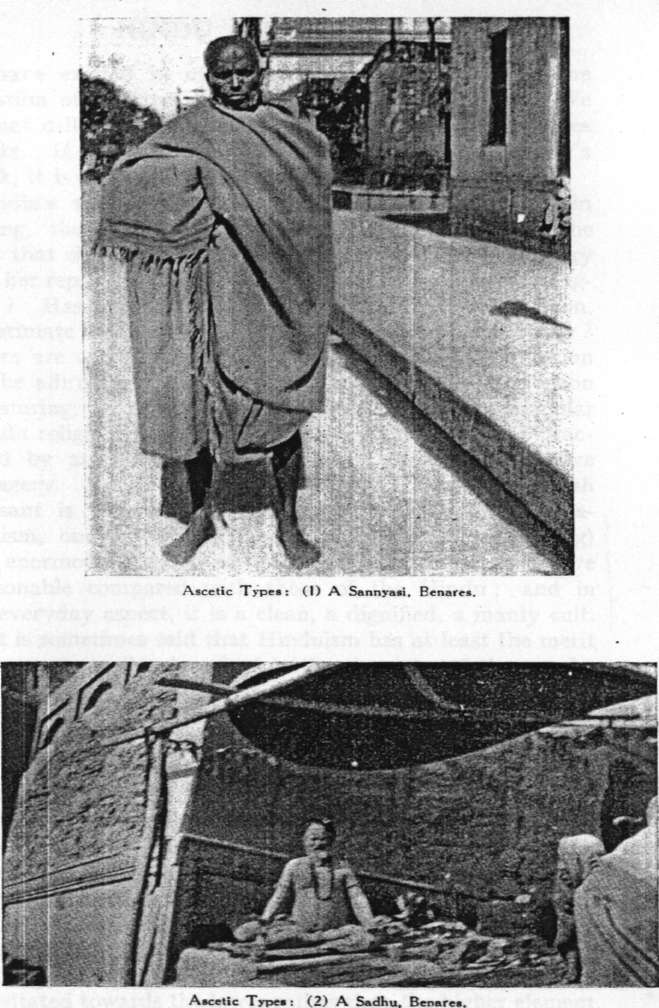
These, it may be said, are late and debased legends, and the irascible and malignant rishis of the epics are not to be confounded with the rishis of the Vedic hymns. Perhaps not; but the mass of the Indian people has for ages drawn its spiritual nourishment, not from the Vedas, but precisely from these monstrous epics which attribute to sages and holy anchorites unlimited powers of maleficent magic* " Devotion and asceticism impress," says Sir Alfred Lyall, " because they are found to connote influence with heaven, rather than as ethical examples." And assuredly it is from the worser, not the better, side of asceticism that the ascetics of to-day draw their inspiration. They are of two classes : the comparatively clean sturdy-beggars, with shaven heads and saffron robes, who perambulate the country ; and the filthy and disgusting creatures, daubed with ashes, and wearing their uncut hair in matted chignons, who haunt sacred places and are, I imagine, more or less stationary. Some of them, no doubt, are sincere fanatics ; but many, by the admission of everyone, are simply noxious ruffians. Mrs. Annie Besant's
* The plot of the celebrated Sakuntala at Kalidasa turns upon a curse uttered by a holy ascetic, merely because Sakuntala was a little tardy in opening the door of her cottage to him.
enthusiasm'for Hinduism makes her tolerant of many strange things ; but even she cannot away with the common fakir. Addressing the Hindu people, she says : " You are not too poor to build colleges and schools for your children while you are able to maintain, as you are doing, large crowds of men as mendicants, in the full strength of vigorous life, who are innocent of all sacred learning, innocent of the light, who have nothing of the sannyasi but the cloth that covers them, and who are yet fed and sheltered by the crore."
The Census of 1901 showed that 5,200,000 sadhus and persons of like character lived by begging. " Taking the cost of their upkeep at the low average of R.3 a month [a little more than three-halfpence a day], this means an annual tax of £12,500,000 which the workers of India pay to the drones." The alleged " drain " upon India, due to her association with Britain, amounts, at any reasonable reckoning, to little more than half this sum. Whether it is really a " drain" at all is a question to be afterwards considered. In any case, the politicians who are so loud in their complaints that India pays too dear for the services rendered her by Britain, would do well to inquire what services are rendered by the sadhus and sannyasis for whom she pays nearly twice as much. The answer that the upkeep of the mendicants does not go out of the country is nothing to the point. Unless they render some equivalent service, it is just as though rats every year devoured grain to the value of twelve and a half millions.
On examination, then, it would seem that India's claim to spiritual genius rests, not on any exceptional value in her contributions to the intellectual heritage of the world, but simply on priority of date in some of her philosophical speculations. There seems to have been a considerable body of rehgio-philosophical thought in India some centuries before any similar body of doctrine can be shown
to have existed in other parts of the world. But the question of priority is more curious than important. We do not call a man a good worker merely because he rises at six. If the man who rises at eight does a better day's work, it is he who merits the palm.
India's real distinction lies, not in evolving, but in killing, the germs of sane and virile spirituality. The fact that she, so to speak, got up at six, is not her glory but her reproach. What has she made of her long working-day ? Has she evolved a noble, pure, progressive religion, in intimate relation with high social and individual morality ? There are a few fanatics who would answer this question in the affirmative, but I can imagine no wilder perversion of staring, glaring, incontrovertible fact. The popular Hindu religion of to-day is the lowest professed and practised by any people that purports to have risen. above savagery. Beside it the devotion of the Russian or Spanish peasant is - rational and enlightened. As for Muhamma-danism, one leaves India with (comparatively speaking) an enormous respect for it. Even its fanaticisms are reasonable compared with those of the Hindu ; and in its everyday aspect, it is a clean, a dignified, a manly cult.
It is sometimes said that Hinduism has at least the merit of being marvellously suited to the character of the people. As well might we marvel at the nicety with which a man's skin fits his flesh. Hinduism is the character of the people, and it indicates a melancholy proclivity towards whatever is monstrous and unwholesome. This may seem an absurdly sweeping " indictment of a nation;" and so it would be if it were not for the well-known fact that people are always, in many respects, better than their religion. That there are fine and admirable qualities in the Hindu character I do not for a moment deny : else were the future of India hopeless indeed. It is precisely on the religious side that the character of the Indian people, as I read it, is conspicuously defective. They have always gravitated towards the lower rather than the higher element
in religion, towards the form rather than the substance, towards the letter rather than the spirit. That is why I hold it the very acme of paradox to claim for them an exalted spirituality.
Does not the matter lie in a nutshell, when we find the most enlightened religious thought of to-day concentrated on a movement " back to the Vedas " ? What a confession of the only too patent fact that the religious history of the people has been one long downward drift, scarcely interrupted by heroic but futile attempts to stem the tide ! It is hardly fair, however, to speak as though the Hinduism of to-day were a lineal, though degenerate, descendant of the Vedic religion. It is much rather to be regarded as a product of the welter of fetishism and witchcraft into which the Aryan settlers plunged on their arrival in India. In phrases, names and forms, a good deal of degenerate Aryan-ism no doubt survives ; but the substance of Indian popular religion is little more than the rank crop of superstitions which have always grown, and which continue to grow, out of the sun-baked soil. These superstitions, says Sir Alfred Lyall, " are not so much the offspring of Brahmin-ism as its children by adoption; "* but assuredly they have overrun and taken possession of the house.
In the Vedas we have a wholesome, primitive, nature-religion, free from sacerdotalism, free from asceticism,
* See Sir Alfred Lyall's " classification of beliefs " in his Asiatic Studies, Vol. I., p. 7. The same highly qualified authority says in another essay : " The masses have preserved their immemorial polytheism ; they worship innumerable gods directly by prayer and sacrifice ; the middle class adores the great gods of the Hindu pantheon as the signs and figures of ubiquitous divinity." And again, " In India you may behold at this moment an immense and intelligent society much given to dreamy meditation over insoluble problems, and practically unanimous in rejecting any solution that stops short of Pantheism." He is here writing in the assumed character of a Brahmin ; but though the whole essay (Asiatic Studies, Vol. II., Chap, i.) is ironical, these passages are doubtless intended as sober Statements of fact. Presumptuous as it may appear, I cannot but wonder whether if he could be cross-questioned. Sir Alfred might not be moved to qualify one or other of the two epithets " immense " and " intelligent."
knowing nothing of metempsychosis, and based on a simple, natural form of social organization. A few centuries elapse, and we find religion the property of a hereditary priesthood; ceremonial so tinctured with magic that the misplacing of a syllable or an emphasis in a sacred mantra is supposed to annul its efficacy; asceticism rampant and arrogant; the theory of metempsychosis morbidly overstraining the imagination, and leading men to look upon life as an illimitable, fantastic, more or less cruel fairytale ; and, to crown all, a social organization the most elaborately anti-social that the mind of man ever conceived. Caste and its concomitant abuses we must consider in another chapter ; for the present it is sufficient, to note that they are of the very essence 6f Hinduism, growing with its growth and strengthening with its strength. A few more centuries pass, and great efforts are made to remedy the worst of these abuses. Two almost contemporary movements, Buddhism and Jainism, have a certain measure of success. But Brahminism, tenaciously invincible, soon rears its undiminished head. Buddhism is cast out,* and the Jains survive as a comparatively small sect, worshipping a different set of idols, and more fanatical on the point of not taking animal life, but otherwise much" on a level with orthodox Hindus. And so it goes with a hundred attempts at reform, the Sikh propaganda in the seventeenth century being perhaps the most notable. They find many adherents at first, generally among the castes whom Brahminism treads under foot ; but they soon sink back almost indistinguishably into crass superstition and inveterate social prejudice. The result is that the spiritual genius of the Indian people is to-day found expressing itself, not here and there, but everywhere, in forms which not only the Western world but China and Japan have for ages outgrown. The whole country is
* Not without persecution it would appear, though as a rule Brahminism is too vague, too unformulated and unorganized, to be a persecuting religion.
populated with myriads of monster-gods, many-headed, many-armed, often colossal, always hideous ; to say nothing of the animal gods, Ganesh and Hanuman, the elephant and the monkey, who are even more popular than their quasi-human rivals. If a census of idols—even confined to objects of public, as distinct from domestic, worship-could be taken in India, the result would be amazing, certainly running into millions. Nor do the rites whereby these idols are worshipped bear testimony to any superabundant spirituality. Of obscene and licentious practices I say nothing. I did not witness any ; and though they certainly prevail to some extent, it is hard to say how far they leaven the mass of Hinduism. Even if they did not exist at all, the ordinary daily practices of the cult are sufficient to place it beyond the pale of civilization. Not in out-of-the-way barbarous corners, but wherever you turn, you meet with repulsive performances of piety. A twopenny tram will take you from the centre of Calcutta to the " Kalighat," from which some suppose that the city takes its name, where you may see, in the slimy, swarming precincts of the temple, the ground crimson with the blood of sacrifices, while in a filthy but very sacred backwater of the Hooghly men, women and children not only bathe in their hundreds, but drink the yellow ooze in which their bodies and their garments have been steeped.* Hinduism has, indeed, a marvellous gift for extracting bad effects from good intentions, actual ugliness from potential beauty. It is always washing and never clean ; some of its practices have probably been hygienic in their origin, yet it is innocent, and often bitterly resentful, of sanitation ; it professes a superstitious respect for animal life, but
* This is not, however, the most disgusting beverage prescribed by Hindu piety. The urine of cows, with other scarcely less nauseous ingredients, enters largely into their " purificatory " doses.
The Jains cover their mouths with a respirator lest they should inadvertently inhale, and so kill, an insect. " Pinjrapole " hospitals for animals are, it is said, " so administered as to cause more suffering than they prevent." They have been known to contain wards for bugs, lice and scorpions.
it raises no finger to check the most callous cruelty to animals.* It is, in short, the great anachronism of the modern world. There is a synagogue in Prague which claims special sanctity on the ground that it has never been cleaned for seven centuries. For " seven" read " thirty " and you have the history of Hinduism.
What is the distinguishing characteristic of all the great religions of the world—at any rate of the three now prevalent over three-fourths of the globe ? Is it not that each has been filtered, at a definite historic period, through one or more great minds. The historic individuality of the Buddha and the Christ may be doubtful : perhaps they are legendary personifications of the purifying forces, rather than real personages. But even if we take this view (and it seems to me by no means established) we cannot deny the reality of the movements associated with their names. At all events, St. Paul and Muhammad are incontestably historic personages, and in them we see the process of filtration very clearly at work. It is true that, in all these cases, corruptions have subsequently crept in, and that attempts at re-filtration have been only partially successful. Here and there, indeed, all three religions have relapsed into something very like primitive fetishism. Still, the character of the (real or ideal) founder of the cult has always set a standard to which reformers might appeal, and placed a certain check upon the worst degenerations. Hinduism, on the other hand, is a wholly unfiltered religion—a paganism which has resolutely declined filtration. If it includes in its pantheon any personage holding a position in the least analogous to that of Gautama or Jesus, it can only be Krishna—and what a difference is there ! It is this tendency
* See an article by the Hon. Mrs. Charlton in the Nineteenth Century for September, 1912. Sir Bampfylde Fuller says, " No one teases animals in India ; " but this is certainly far too sweeping. On the very first day I spent in India, I saw some boys tormenting a poor sick squirrel, mangy, ragged and evidently dying. I reproached myself for not putting it out of its misery ; but perhaps, if I had done so, there would have been a riot.
towards pollution rather than purification that assigns it its place—incomparably the lowest—in the scale of world-religions. Until Hinduism has somehow got itself filtered, India cannot reasonably claim fellowship on terms of equality with the civilized nations of the earth.