|
TWO SIDES TO THE RACIAL MEDAL
THE first thing to be done if we would understand the Indian problem aright is to determine the true status of the Indian peoples among the races of the world. The instinct of the European is to assume without further inquiry the inferiority of everyone who wears, like Othello, " the shadowed livery of the burnished sun." Even the olive complexion of an Italian or Spaniard is a little suspicious to the peoples of the North. In America to-day, Dante and Cervantes would be contemptuously bracketed as " dagos." But when the olive tint deepens into chocolate, there is no longer any question, in some minds, as to the racial inferiority it implies. When Mr. Dadabhai. Naoroji, a Bombay Parsi, stood for the borough of Central Finsbury, Lord Salisbury sneered at the notion that a British constituency should ever return " a black man ; " and it is likely enough that Mr. Naoroji would not have been elected had his complexion in any way justified Lord Salisbury's epithet. The time is not so long gone by when Englishmen used to lump together the peoples of India as " niggers ; " and though that stupidity has been stamped out,* the inveterate habit of associating a dark skin with congenital inferiority still lies at the root of a great deal of our thinking and feeling with regard to India.
* Mrs. Besant says that it still survives ; and, as she would not speak without warrant, I presume there must be isolated Rip Van Winkles who have not yet awakened to its enormity. They have not even read their Kipling. On the other hand, as I have already said, many Indians return the compliment by looking down on Europeans as an inferior and upstart brood, mere parvenus in the domain of civilization. Hindustan—" Aryavarta "—is the nursery and home of all true religion, philosophy and culture ; and, when her present period of eclipse is past, India is to arise in her glory for the salvation of the world. Such is the sentiment expressed by that very cultivated woman and true poetess, Sarojini Naidu, of Hyderabad, in her ode :
TO INDIA
Oh, young through all thy immemorial years, Rise, Mother, rise regenerate from thy gloom. And, like a bride high-mated with the spheres, Beget new glories from thy ageless womb.
The nations that in fettered darkness weep Crave thee to lead them where great mornings break. . . . Mother, oh Mother, wherefore dost thou sleep ? Arise and answer, for thy children's sake.
The Future calls thee with a manifold sound To crescent honors, splendors, victories vast; Waken, oh slumbering Mother, and be crowned, Who once wert empress of the sovereign Past.
It is only fair to assume that " the nations " who are represented as waiting to be liberated by India are nations within her bounds, she being conceived for the nonce as an ideal entity, distinct from the geographical or racial divisions of which she is composed. But even if we thus limit the meaning of the second stanza, we can scarcely interpret in so limited a sense the line " Who once wert empress of the sovereign Past." The poetess does not mean that India was empress of her own past, but of the past of the world ; and, as it is manifest that this was never true in a political sense, we must interpret it spiritually, as an assertion of bygone but recoverable supremacy in the realm of intellect and soul. And to thousands of Indians this is an article of faith. Far from being conscious of any drawback of race, they hold themselves a chosen people, the depositories from of old of all the highest wisdom of the world. In this belief, moreover, they are encouraged and established by plenty of Western testimony. For instance, the Central Hindu College at Benares, founded by an Englishwoman and (until recently) controlled by an Englishman, publishes An Elementary Text-Book of Hindu Religion and Ethics, on the second page of which the novice is assured that
No other Religion has produced so many great men—great teachers, great writers, great sages, great saints, great kings, great warriors, great statesmen, great benefactors, great patriots.
It would be easy to quote scores of testimonials to a like effect, from Western as well as Eastern sources, often combined with vague allusions to a political Golden Age, at some undetermined point in the misty regions of Indian antiquity. One need scarcely add that these crude stimulants to national self-esteem are greedily swallowed, with such effects as crude stimulants are usually apt to produce.
If we clear our minds of unreasoning prejudice on the one hand and visionary sentimentality on the other, we shall arrive without too much difficulty at the plain truth of the matter. The Indian races, take them all round, are not low, but very high races. They are not "black men " as the negro is black, but sunburnt white men.* Colour is an accident in India ; in Africa, and Afro America, it marks a radical difference. In some districts of India there is, no doubt, a slight negroid infusion, but it is scarcely more influential than the negroid infusion in Europe. A large part of the Indian people is admittedly of the same stock as ourselves ; but I am not claiming any necessary superiority
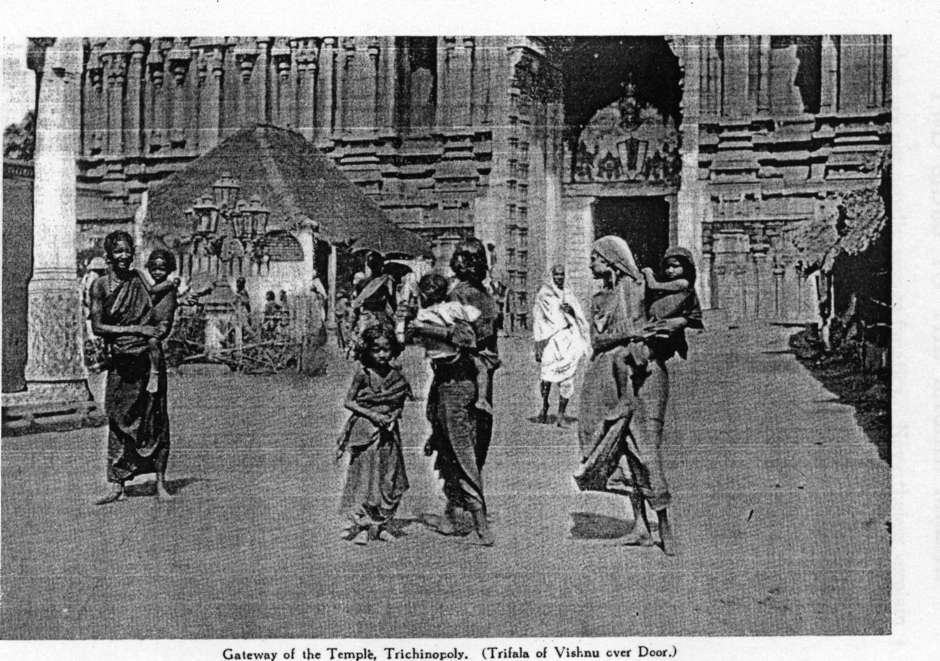
* Recent research is said to discountenance the idea that the heat of the sun has anything to do with dark pigmentation. Nature, in that case, seems to have taken some trouble to put us on a wrong scent. for the " Aryan brother." It is pretty clear that many of the races whom the Aryans found in possession of India, and with whom they intermingled, must have been nearly, if not quite, their equals in racial development. At any rate, it does not seem possible, at the present day, to declare the presumable Aryan a better man than the presumable Dravidian. There is no part of India which does not produce a considerable percentage of notably fine men— fine in stature, in features, in facial angle, in physical development—and is there any country in Europe for which a larger claim can be advanced? The military pageants of recent years have made Londoners familiar with the magnificent specimens of humanity who abound in our Sikh, Punjabi, Rajput, Maratha, Pathan regiments; but these might be assumed to be picked men. They were, no doubt, exceptional in the sense that they were well fed and athletically trained; but the raw material of such men abounds in every Indian village. As for the women of India, is not their grace proverbial ? In the North (under Muhammadan influence, I presume) they often contrive to conceal it by wearing hideous trousers ; but in the South every girl who drapes herself in her sari, and goes forth to the well with her shining brass pitcher on her head, is a model for either sculptor or painter—perfect in contour, brilliant and yet harmonious in colouring. It is true that their grace is short-lived, and that they age before their time ; but it is also true that the children whom they carry astride on their hips are often divinely beautiful. Physically, then—whenever their circumstances are such as to give them a fair chance of development—the peoples of India stand high among the races of the world. They stand high in stature, proportion, power, dignity, delicacy ; and —judged by the highest standards known to us—they often excel in beauty. Some of the noblest types of manhood, I have ever seen were—or rather are—Indians.
" Even if all you say be true," the reader may object, " you refer only to physique ; and the place of a people in the racial scale cannot be determined by physique alone." Certainly not ; and we shall come presently to other considerations. But when we talk of " a fine race," we mean, in the first instance, physically " fine ; " and it seems important to make it clear that in this respect the Indian is at no disadvantage as compared with the ruling races of the world. His physique denotes (shall we say ?) the highest potentialities of development. One is forced, however reluctantly, to recur to a comparison with the African races. In moving among negroes, one has constantly to avow—perhaps to struggle against—a sense of their fundamental, inherent, ineradicable inferiority. Whatever may be their amiable and even admirable qualities, one cannot resist the conviction that they are some degrees nearer the brute ; nor can one wonder at their proved incapacity to evolve for themselves any approach to civilization. In moving among Indians, on the other hand, what is constantly borne in upon one is a sense of their fundamental equality, and a vague wonder as to how they happen to have sunk to a position of apparent, and to some extent real, inferiority. The difference between the negro and the Indian is so enormous that the comparison seems cruel to the one and insulting to the other ; but I know not how else to make clear the absurdity, as well as the brutality, of in any way associating the dark races of Asia with those of Africa. Even in point of complexion, many of the Indian stocks are much nearer to ourselves than to the negro.
But now we come to a distinction which it is easier to feel than to explain. The sense of high potentiality is constantly overborne in India by a sense of actual, practical, palpable low development—more painful than that of the negro, inasmuch as it is the low development, not of one who has failed to rise, but of one who has fallen. I am not speaking, of course, of selected individuals—of a few thousands or hundreds of thousands at the top of the social, educational, economic tree. I am speaking of the hundreds of millions who are the real people of India—who must form the Indian nation, if,such a nation is ever to exist in any true sense of the word. Look at the life of the villages, the fields, the bazaars ; study the crowds at railway-stations, at bathing-ghats, at places of pilgrimage ; and you cannot but feel nearer to barbarism than in any other country that makes the slightest pretence to civilization. It is not wholly or mainly a question of caste. The " depressed castes," indeed, are very depressed ; but the stranger does not with any certainty recognize caste distinctions. Many of the personages who strike one as most barbarous are, in fact, Brahmins ; and from some of the scenes in which barbarism is rampant, pariahs and " untouchables" are fiercely excluded. It may be an open question whether this sense of melancholy backwardness is justified, and whether it is, as some maintain, in great part an illusion due to Western prejudice. But even those who take up this position must surely have moments of oppression and dismay in viewing the sheer multitudinousness of the Indian populace. These swarming myriads, vegetating, and content to vegetate, under the dominion of noxious traditions and grotesque superstitions—by what magical influence are they or their children's children to be rendered capable of self-conscious, self-respecting national life ? By education ? Yes, that is the sole resource. But in how many years or centuries can education undo the work of enervating, soul-sapping millenniums ?
This, then, is my reading of the racial status of the Indian people. Fundamentally they are inferior to none ; but a long chain of prehistoric and historic circumstances, ultimately traceable to geographical conditions, has reduced the masses to a condition of stagnant barbarism, and " the classes " to an even less desirable state of inveterately self-satisfied pseudo-civilization, which must be radically amended before India can reasonably aspire to take her place on a footing of equality among the nations of the world. Far" from being the most favoured region of the earth, as sentimental patriotism is fond of asserting, India has been, from the very dawn of history, among the most unfortunate. That is the key to her past and her present: it is by realizing that, and striving to repair her misfortunes, not by talk about reviving a mythical Golden Age,* that her sons and her sympathizers can hasten the coming of a united and (so to speak) an adult India. If it be asked whether the British rule is to be placed to the account of good or of evil fortune, the answer must be paradoxical and yet (I think) obvious. It is—or at any rate we trust it will prove to be— an extraordinary piece of good fortune ; but at the same time it is the outcome and final evidence of no less extraordinary ill-fortune. That country must be hapless indeed of which it can be said that the best thing that could possibly befall it was a protracted period of foreign domination ; yet all reasonable Indians admit that, whatever may be the shortcomings of the British rule, this is the truth of the matter. If India will but realize the immense leeway she has to make up, and take patient, strenuous advantage of the opportunity for doing so afforded her by the British rule, she may one day come to date the dawn of her regeneration from the Battle of Plassey.
But I have strayed away from my immediate theme : the high racial potentialities of India, contrasted with its actual state of degradation. By way of bringing the contrast
* There have been two periods, of a little over a century each, when the greater part of India was at any rate nominally united under Indian rulers, and when some approach to good government seems to have been attained. The Maurya Empire covered the third century B.C. and the Gupta Empire, roughly speaking, the fourth century A.D. The earlier period, described by Megasthenes, produced a really great monarch in the person of Asoka, and is certainly the nearest approach to an Indian Golden Age of which we have any record. Much less is known of the later period. Indeed, its greatest figure, Samudragupta, has left no trace in written records, his history having to be pieced together from inscriptions and coins. But even if we take the most romantic view of the civilization of these misty " empires," it is obvious that they lacked one important element of political well-being—namely, stability. They were transitory gleams in a dark and stormy internal history, constantly diversified by foreign invasion. home to the reader, let me jot down two impressions that came to me immediately before and immediately after I first set foot on Indian soil.
Ceylon is not India, but may be called its vestibule or outer court ; and Colombo swarms with Indians of many tribes and castes, from Pathans of the north to Tamil-speaking people of the south. Coming from Japan and China, I spent a few days in Colombo, and noted on the one hand the white people around me at my hotel, on the other hand the brown types I encountered in the streets. And quite sincerely—without the slightest tinge of preconceived theory or paradox—I found myself almost blushing for my race. These Orientals, with their noble carriage, their dignity and distinction, seemed incomparably the finer breed of men. I do not mean the Sinhalese, but more particularly the Indian immigrants. One saw sinister faces, one saw fanatical faces, one saw heavy and rather stupid faces, but not one of the unfinished, shapeless, potato-faces so common in a European crowd—so common in the crowd at my hotel. I must confess that, for some reason or other, that crowd was an exceptionally insignificant set of people. As I looked round the dining-room of an evening, and saw the dapper little men in their dinner-jacket uniform, and the overdressed or underdressed women, chattering about the day's racing or the morrow's hockey, and complacently listening to the imbecile jingles ground out by the band—I could not but ask myself by what possible right we posed as a superior race. Outside, in the streets, I had seen Shylock, I had seen Othello, I had seen Sohrab and Rustum, I had seen a hundred stately and impressive figures. I had even seen two or three men who might have sat to a realistic painter as models for Christ—not, of course, the bland and lymphatic Saviour of pictorial convention, but the olive-browed, coal-eyed Enthusiast of historic probability. Surely it was a strange topsy-turvydom that reckoned the races which had produced these figures essentially inferior to the trivial mob around me—devoid of dignity, devoid of originality, devoid of earnestness, all cut to one dull pattern, all living up to the ideals of the vulgarest sporting papers, the only literature to which they appeared addicted.
I do not attribute any evidential value to this somewhat splenetic mood. I own that it never recurred with equal strength in India itself, where, take them all round, the sahibs look like sahibs in whatever environment they may be placed. They are often by no means such " fine men " as the Indians around them ; but they and their forefathers for many generations have lived an intenser, a larger, a saner life, and it has left its imprint on their features. I speak particularly of the men in the upper grades of the services, who are, in a very real sense, picked men ; while my fellow-sojourners at the Colombo hotel were (I know not why) distinctly below the fair British average. Perhaps, too, my keen admiration for the Indian types to be seen in Ceylon was partly to be traced to my recent recollections of the Japanese and Chinese, whose warmest admirers will scarcely claim for them great dignity of carriage or nobility of feature. I admit, in short, that this early impression of positive physical superiority in the races of India is subject to a good deal of discount ; but I note it for what it is worth. Oddly enough, the one place where it definitely recurred to me was Calcutta. The physical type of the average Bengali as you meet him in the streets—tall, bare-headed, with his toga-like garment lightly draped around him—seemed to me remarkably distinguished.
Now take another impression of only two days later. From Colombo to Tuticorin you cross in a night ; and the early afternoon finds you in the city of Madura, famous for its giant temple. The railway platform and all the purlieus of the station are densely thronged with pilgrims, a motley, scantily-attired, clamorous throng. Each family group has its rope-tied bundle, its brass water-jar and simple cooking. utensils. Some are rushing aimlessly about; others squatting patiently to await a train which may not be due, perhaps, till next day ; others, and these are many, have stretched themselves on the ground, here, there and everywhere, and are blissfully asleep, without even a pilloW for their heads. The first thing you learn in India, especially in Southern India, is that you must walk warily for fear of treading upon a slumbering fellow-citizen. But what is it that gives the crowd such a strange and savage aspect ? Unless you are prepared for it (as I was not) you almost gasp as you realize that everyone has his or her forehead daubed with some garish device, for all the world like the war-paint of the Indians of the West. But this is not warpaint, it is religion-paint. One commonly sees these devices alluded to as " caste-marks," but that they are not, at least as a general rule. They are sect-marks-—riaarks of devotion to one or other deity of the swarming Hindu pantheon. Many men — perhaps most—have a huge trident plastered on their foreheads : one red prong between two white. This is the trifala, the mark of a Vaishnavite —a devotee of Vishnu. The devotees of Siva, at Madura at any rate, wear a comparatively chaste and unobtrusive devices—a large round spot of bright carmine. But the daubs and blotches are endless in their variety—I never mastered the significance of more than two or three of them. Some people go about with three horizontal stripes of red or yellow across the whole breadth of their foreheads. Others wear two narrow vertical lines of vermilion with a white spot between them. Some wear a lozenge, others a triangle, others a circle with a spot in its centre. The sect-marks of the women are generally less obtrusive than those of the men, and the wearing of sect-marks at all seems to be on the decline in Northern India. But in the South it is practically universal, and it gives to the people a strange air of savagery combined with fanaticism. No doubt this does them some injustice; for, fanatics though they be,
they are not usually savage fanatics. Nevertheless, explain and explain-away the custom as much as we please, it marks a low stage of spiritual development. True, it has its analogies in civilized life. There are people in Europe, not even of religious profession, who obtrude their " views " by wearing some sort of ecclesiastical ornament or badge. I have in my mind's eye at this moment a large cross aggressively pendent from the watch-chain of a prominent and rising British politician. But to show that isolated survivals of savagery lurk here and there in civilized countries is not to prove that a whole population which plasters itself with religious war-paint* can be placed in the forefront of human development—or anywhere but sadly in the rear.
So, too, the fact that many European women wear earrings does not render the jewellery of their Southern Indian sisters any the less hideous. I say nothing of the anklets and bangles, finger-rings and toe-rings, worn in extravagant profusion. It is unreasonable, no doubt, to carry these pounds and pounds of metal on the person ; but one cannot call the effect positively ugly ; it has even a certain barbaric charm. But what of the ear-decorations and nose-jewels ? Outside of Darkest Africa, there is probably only one more repellent manifestation 6f a perverted sense of beauty, and that is the tortured feet of the women of China. The women of Southern India carry in their ears not only enormous hoops and clusters of hoops—that would be a trifle—but often great carven bars of gold, three or four inches long and an inch thick, for the insertion of which not only the lobe of the ear but the upper cartilage is pierced and horribly distorted. There is a fantastic Variety in these ornaments. You often see an- ear in which half a jeweller's stock seems to be ingeniously inserted and suspended,
* These marks, I believe, are not really of paint, but of sandal-wood paste dusted over with, the required colours. In some cases they are drawn on the devotee's forehead (no donbt for a consideration) by the Brahmin who is his spiritual guide.
the other half being in the other ear. And sometimes the same woman will wear in her nose either a gold ring three or four inches in diameter or a sort of aigrette of pearls and rubies drooping over the left side of her upper lip and coming well over the mouth. Not all women, of course, wear so much gold as this ; not all bedeck both nose and ears ; but it seemed to me in Madura that all women, down to the very humblest, had either silver or gold pendants or attachments, either in nose or ears, and generally of monstrous size. I have seen little girls of ten or twelve with clusters of silver hoops in their ears that must have weighed nearly as much as their heads.
But stay ! not all women are so decorated. You see in Southern India not a few whose ear-lobes are monstrously expanded, so as to consist of a mere strip of cartilage round a hole three or four inches long, but who have nothing at all to fill the holes, their hoops and bars and ingots having all vanished away. I presume they are for the most part widows, whose finery has been confiscated by their deceased husband's relatives ; but they may also be married women who have gone bankrupt and been forced to part with their treasures—to " live upon their capital." In any case, they are pathetic spectacles.
The south of India is more extravagant than the north in the variety and weight of its adornments ; but huge ear-hoops and more or less elaborate nose-jewels are common everywhere. Now I do not forget the parable of the mote and the beam, and I grant that a traveller from India might find many relics of barbarism in European fashions of feminine adornment, for some of which I have not a word to say. But I submit that it is no mere local prejudice which holds a nose-jewel fit only for savages, and which sees all the difference in the world between a featherweight pendant at the ear and a golden dumb-bell which drags the lobe almost down to the shoulder. Even the pendant seems to me an undesirable survival, and I imagine that the civilized woman of the future will reject all such ornament. But no array of arguments of the " tu quoque" type can alter the fact that the boasted " civilization"' of India has left its women, in their use of jewellery, at a very primitive stage of development. Their innate grace and nobility of carriage bear testimony to splendid racial potentialities ; but in this matter of personal adornment they have stood still for a thousand years. And the nose-ring, it need scarcely be added, is not only an obtrusive fact, but a symbol of profound significance.
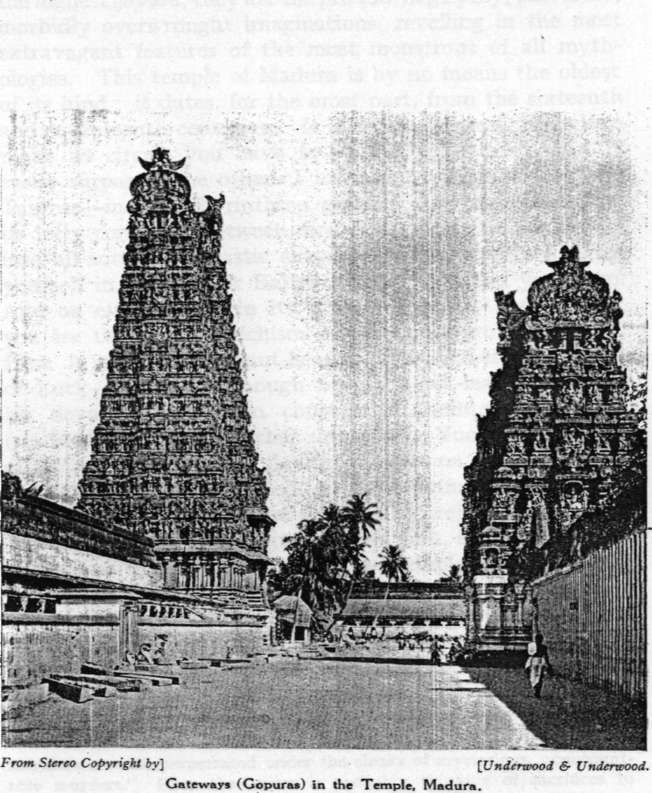
Discussing caste-marks and nose-rings, we have not yet got beyond the platform of the Madura station. If we follow the stream of pilgrims, five minutes' walk will bring us to a street at the further end of which towers one of the huge gopuras of the temple. The gopura is a gateway surmounted by a wedge-shaped tower, 150 feet high; and, as you approach it, you see that the whole surface of the tower is one mass of human or quasi-human figures, ranged in horizontal rows. They are mitred, hawk-faced figures, wasp-waisted, and posed in a sort of affected prancing attitude, so that they are not only grotesque, but vaguely suggest some sort of sophistication or corruption. The main figures are, I fancy, something over life-size; and there are numberless subsidiary figures around them. Whether they are in high relief or absolutely in the round, I cannot say ; but the relief, if relief there be, is certainly very high. The material, I take it, is some sort of terracotta ; the general colouring a reddish yellow. I tried to count the figures on a small section of the tower, but found it quite impossible ; at a rough guess, I should say that on one gopura alone there must be well over a thousand. In the distance, its mere mass is impressive ; close at hand it is no longer impressive, but oppressive in the highest degree. This senseless reduplication to infinity of one mincing, prancing figure produces an indescribably nightmare-like effect ; and what can be said for it, from the point of view either of art or of religion, I, for my part, cannot conceive. Who the figures represent I am not sure; they may be guardians of the temple, they may be Gand-harvas, they may be Siva himself. I forgot to mention that, to the best of my belief, they have either four or six arms apiece ; at least, if these particular figures have not, they strangely depart from the usual type. It may seem odd that my memory should be uncertain on such a point ; but where all is monstrous, a few extra arms or heads are mere details that easily escape attention. And here, assuredly, all was monstrous, from the general conception of the gateway to the smallest subsidiary figure. I had seen fragments of such monstrosity before, in museums such as that of Mexico City, where are preserved the relics of extinct barbarisms. But to come face to face with it on so enormous a scale;—not fragmentary, not under a glass case, but towering under the open sky,, an adjunct to a living cult, a " going concern "—this was an experience which positively took my breath away.* Does it show gross ignorance on my part that I should have come upon it unprepared ? Was the reader, by chance, better informed ? There are thousands of Europeans in India itself who know nothing of the wonder and the horror of these great temples of the South.
Yes, the horror—that is the only word for it. I do not mean that nowadays any particular horrors are perpetrated in the grim recesses of these giant fanes. I do not know that at any time they were the scenes of great cruelty or other abominations, though certainly they present the completest mise-en-scene for such excesses. What I
* Pierre Loti calls these gopuras " pyramids of gods," and says : "L'in-concevable abus du detail inquiete autant que l'exces de la masse. Tout ce qu'ori croyait savoir, tout ce que des feeries, des spectacles, avaient cru reproduire, est etonnamment surpasse."
Sir Alfred Lyall writes in his Asiatic Studies, Vol. I. (1882) : " The more cruel and indecent rites of Brahmanism have hitherto owed their reformation principally to ordinances of the English police, who have suppressed suicide, self-mutilation, and other unsightly or immodest spectacles. . . . Our police drag people from under Jagannath's" car, and fine the whole township if a man kills or mutilates himself. Human
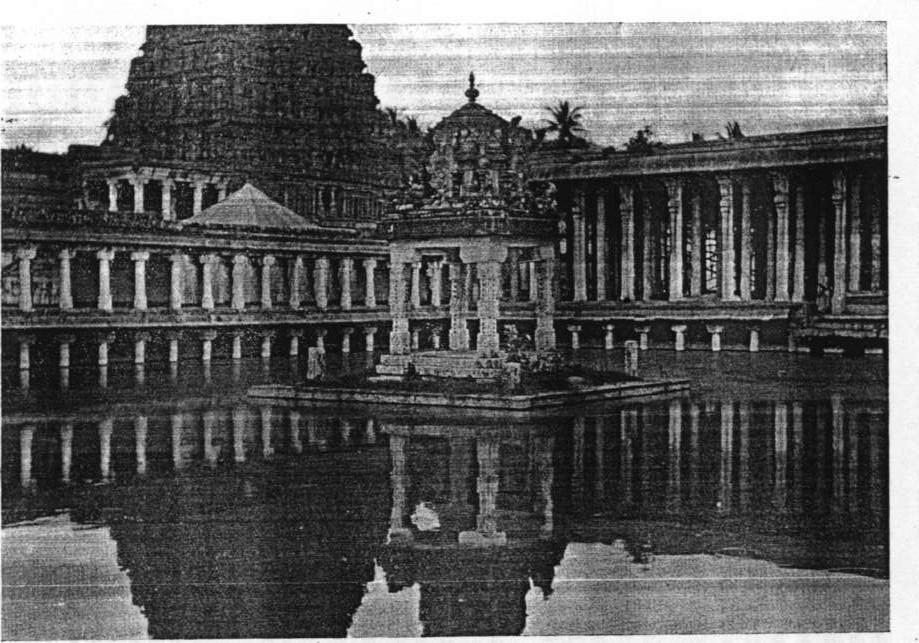
do know is that, from the corner-stone to the coping of the highest gopura, they are the product of gloomy, perverted, morbidly overwrought imaginations, revelling in the most extravagant features of the most monstrous of all mythologies. This temple of Madura is by no means the oldest of its kind : it dates, for the most part, from the sixteenth and seventeenth centuries. It is not the largest, though to make its circuit you have to walk a good mile. But it easily surpasses the others I have seen—Trichinopoly and Tanjore—in its labyrinthine gloom. As you pass along its lofty corridors, between monolith granite pillars carved into all sorts of fantastic shapes, you can readily imagine yourself in Nineveh or Babylon three thousand years ago. And on every hand, in its swarming courts and alcoves, you see the lowest fetichism intent on its grovelling rites. Here is a huge elephant-headed idol—-Ganesh, the God of Luck-—shining as though freshly black-leaded, because his devotees keep him constantly anointed with ghee (clarified butter) and other unguents. Yonder is a band of women decking with flowers the lingam, an emblem of procreation, known, indeed, to most primitive cults, but surviving unabashed (so far as I am aware) in India alone. In the sacred water of a great green tank, surrounded with colonnades (the one feature of the temple which can by any stretch of language be called beautiful) men and women are washing away their sins : but where is the fire-hose that ought to be turned on them to wash away the filth of the sacred tank ? In the neighbourhood of the Holy of Holies, a half-naked group of shaven-headed Brahmins are squatting on the ground, twining the thread
sacrifices are still perpetrated under the cloaks of mysterious, unaccountable murders." Here the writer is probably thinking of sacrifices to obscure deities of the village or the jungle. I have heard nothing to connect the great temples of Southern India with any such practices. But one cannot but wonder how much the police knows of what goes on in the dark penetralia of these labyrinths of stone, jealously guarded against intrusion on the part of low-caste or casteless persons, whether Indian or European. that marks their " twicer-born" caste, and discussing (let us hope) some of those metaphysical mysteries that are believed to underlie the " allegories" of Hinduism. Not far off, a long wall is covered with miniature frescoes, old and new, childish in drawing, crude in colour, illustrating various grotesque and horrible, but doubtless edifying, legends. The only one I remember depicted the impaling of certain Jain heretics. I did not know before what " impaling " meant, and the reader will do wisely not to inquire. That there were any actual obscenities in the frescoes I cannot aver; but the carving of several of the pillars represented unspeakable aberrations of sensual imagery, which the guide pointed out with modest satisfaction.* The atmosphere of the whole vast building was heavy with the emanations of cows, the scent of camphor, and the sickly smell of decaying marigolds and other flowers. For it is the dominant characteristic of Hinduism, not in the South alone, that whatever it touches it soils. Flowers enter largely into its ritual, but I have never seen them used with the smallest sense of beauty. Generally, as here at Madura, they are left rotting around, bedraggled and faded, like torn bouquets on an ash-heap,
* These carvings were, no doubt, some three centuries old ; but in another temple of the South I saw a quite new Jagannath Car, still under the hands of the artist, one panel at least of which represented a revolting obscenity.
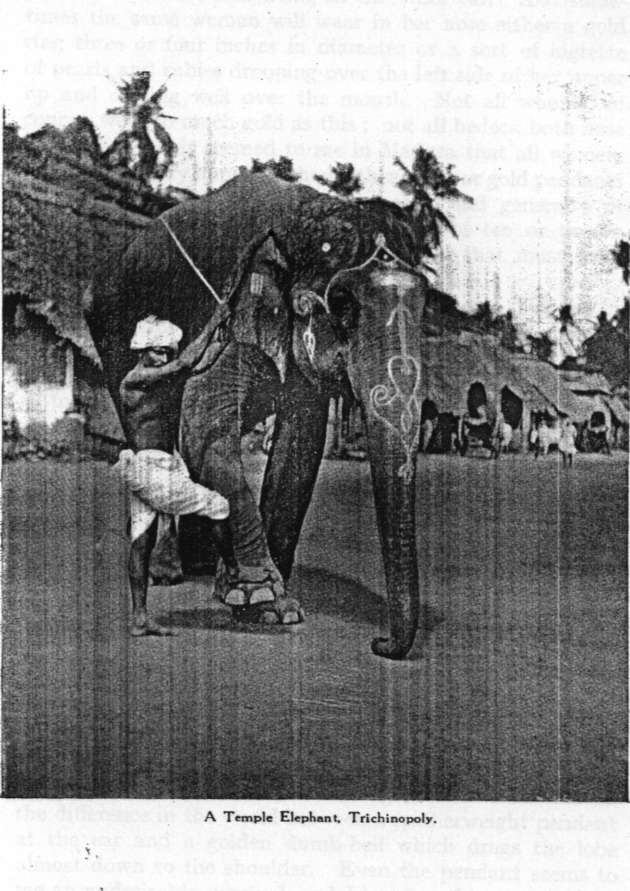
Lest it be thought that I have achieved the impossible and exaggerated the hugeness and the squalor of the temple at Madura, I append a page from Pierre Loti's masterly description of it : " Il faut renoncer a comprendre par quels chemins les pretres me menent dans le dedale des voutes. A mesure que nous avancons, tout me semble plus ecrasant et plus surhumain ; tout est bati a coup de blocs de plus en plus enormes. Les dieux a vingt bras, les dieux au geste colossal et multiple, pullulent dans 1 ombre ; . . . je marche comme en reve dans le pays des geants et des epouVantes. . . . Toujours de plus prodlgieuses sculptures, toujours plus de magnificence, et en meme temps plus d'incurie barbare, plus d'immondices. . . . Voici une galerie consacree a Ganesa, le dieu a tete d'elephant, dont la monstrueuse personne s'eclaire par en dessous a la lueur de quelques lumignons fumeux brulant a ses pieds, sous sa trompe. Voici dans un recoin farouche, en pleine nuit . . . une famille paresseuse As I walked along one of the outer corridors, I heard a curious rapid shuffling behind me. Thinking that a beggar with loose sandals was following at my heels, I turned round to send him away, when, behold ! I stood face to face with a giant elephant, swaying his gorgeously painted trunk almost over my head. I looked with respect upon the mighty brute. He seemed to me the most dignified, the most sane, the most wholesome among all the denizens of the temple—and certainly not the worst theologian.
Then I took a gharry and drove, past a wonderful banyan-tree that might have sheltered an army, to a really beautiful square tank with an island fane in its middle. Under some trees on the farther shore, stood a little yellow temple. It consisted of a shadowy cella, wherein a figure of the goddess Kali was dimly visible, and a long narrow portico, the roof of which was crowded with rude plaster figures— votive offerings, I conceive. But these are not the offerings in which Kali or Durga chiefly delights. In front of the portico stood an altar, and the earth around it was sodden with blood. Four newly severed heads of kids lay at the altar foot; and as I stood there a burly Brahmin caught one of several live kids that were skipping around, douched it with water from a brass pot, threw it down, placed his foot on its head, and gashed its throat with a knife. Then he turned back the head so as to make the muscles of the throat tense and, with another slash, completed the decapitation. It was quickly and skilfully done. Far worse cruelties are perpetrated, I daresay, in slaughter-houses ; infinitely worse on battlefields. But it was the first time I had seen innocent blood shed in the name of religion ; and I drove back to Madura radically revising the illusion, to which I had well-nigh yielded in Colombo, only fortyeight
de vaches zebus. . . . On glisse dans leur fiente.dont les dalles sont couvertes ; mais personne n'oserait la jeter dehors ainsi qu'une chose vile, car ce qui vient de leurs entrailles est sacre autant qu'elles-rhemes. Et constamment des chauves-souris, de tres large envergure. s'effarent au-dessus de nos tetes." eight hours before, of the racial superiority of the Oriental. My present feeling was very like that of the hero of Locksley Hall:
" For I hold the grey barbarian lower than the Christian child."
Barbarian, barbarism, barbarous—I am sorry to harp so much on these words. But they express the essence of the situation. The potentially noble peoples of India have, by an age-old concatenation of inauspicious circumstances, been baulked of adequate opportunity of development, and arrested in a condition of barbarism. There are, of course, many thousands of individuals who have risen and are rising above it; but the plain truth concerning the mass of the population—and not the poorer classes alone—is that they are not civilized people. The tokens of barbarism in manners and religion on which I have been dwelling are, indeed, superficial. They might conceivably cover, if not a highly developed, at least a healthy and progressive social state. But it need scarcely be said that this is not the case : even the strange Europeans who are attracted by Hinduism as a religion are but half-hearted in their defence of the social institutions associated with it. The more we look into it, the more clearly do we realize that these institutions have spelt disaster for the peoples of India.
No intelligent Hindu would contest this statement, though many, if not all, would contend for a soul of goodness in Hinduism. Perhaps they are right. At all events they are probably wise in attempting to base their efforts at reform on the conservation of whatever elements of good they can find in the national traditions. These reforming movements are in many ways admirable and deserving of all sympathy ; but the task before them is dishearteningly huge. It seems to me manifest beyond all argument that India must at least be well advanced towards social salvation before she can dream of attaining a stable political' organization, unbuttressed from without. If circumstances enabled her to throw off British rule before the leaven of social reform had thoroughly permeated her system, she would simply add a crowning calamity to the long series of which her history consists. Another recent observer, not to be suspected of British bias,* has noted in the following terms the contrast between racial potentialities and actual development, which I have been trying to illustrate in the present chapter:
" Some of these dark people," he writes, "have the faces and the port and carriage of power ; but it is hollow, the shadow of an inheritance, not the real substance. It is as though the masks of warriors and sages were walking about untenanted. The character and power have become exhausted, leaving the husk of a great civilization gone to seed."
This is a picturesque image, but, in my view, scarcely a just one. There never was a " great civilization " in India ; but there must have been, in the epic ages, a splendid barbarism. In the course of hapless centuries, it sank into the Hinduism we see to-day ; but the survival in so large a measure of the noble physical characteristics of the race warrants the hope that the development, arrested so many ages ago, may be successfully resumed, and, once fairly under way, may proceed with great rapidity. That is an optimistic view ; but there are moments when one can hold to it without too much effort.
* Pryce Collier : The West in the East, from an American point of view, P- 332. |